Hello, I'm Dr. Dongkyu Lee, an orthopedic specialist. When a rotator cuff tear is present, the treatment approach varies depending on the severity of the tear. First, one thing is clear: when a full-thickness (complete) tear has occurred, surgical treatment is the right course of action. The rotator cuff is a tendon — tissue that connects muscle to bone — so once a tear begins, it progressively worsens over time. That's why no non-surgical treatment can adequately address a complete tear. But what about a partial tear — one that hasn't torn all the way through? Typically, the first line of treatment is injection therapy. By injection therapy, I mean treatments designed to promote tissue healing. (I'm not referring to pain-relief or anti-inflammatory injections.) These include prolotherapy and proliferation therapy, among others — treatments that many patients are familiar with. (There are several types depending on the specific agents used.) These treatments can be effective when tendinosis is severe or when the tear is very small. However, when the tear doesn't heal despite these injections, or when a partial tear has already progressed significantly, injection therapy alone is often not enough. Yet the tear may not be large enough to warrant surgery, and this is the most challenging situation for both patients and doctors. Continuing injections indefinitely doesn't guarantee results, and if the tear progresses to a full-thickness tear, surgery becomes the only option. It's a frustrating situation for everyone involved. Patients don't want surgery, but there's no guarantee that more injections will work. Meanwhile, the pain persists and quality of life deteriorates. Doctors hesitate to recommend surgery for fear of overtreatment, yet they know from experience that more injections won't help. So they end up prescribing pain-relief injections just to manage symptoms, until the tear eventually progresses and surgery becomes unavoidable. For cases like these, there is an effective non-surgical treatment option. It's called bone marrow stimulation stem cell regeneration combined with reduction suture. For more details, please check the links below. Bone marrow stimulation stem cell regeneration: https://blog.naver.com/9690067/222934136001
🔗 https://blog.naver.com/9690067/222934136001Reduction suture: https://blog.naver.com/9690067/222961123101
🔗 https://blog.naver.com/9690067/222961123101Rather than more explanation, let me show you an actual case. This case involves a relatively young man in his 30s. He was an avid exerciser who had been receiving injection treatments at various hospitals for two years due to right shoulder pain. He said he'd tried so many treatments that there was nothing left he hadn't tried. Each treatment would bring brief improvement, only for the pain to return shortly after. Unable to exercise anymore, he lost significant muscle mass, and being unable to do the sports he loved left him feeling deeply depressed. Let's take a look at his condition.
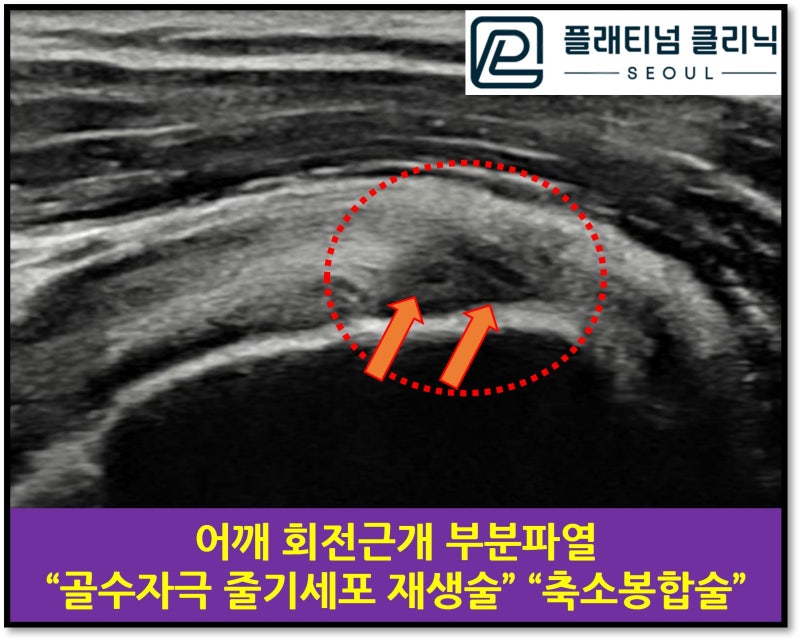
On ultrasound, normal rotator cuff tissue appears white with a subtle fibrous texture. Within the red circle, indicated by arrows, you can see that the rotator cuff has turned dark with intermittent empty spaces — almost as if holes have been punched through it. This partial tear had failed to respond to multiple injection treatments. I performed bone marrow stimulation stem cell regeneration combined with reduction suture.
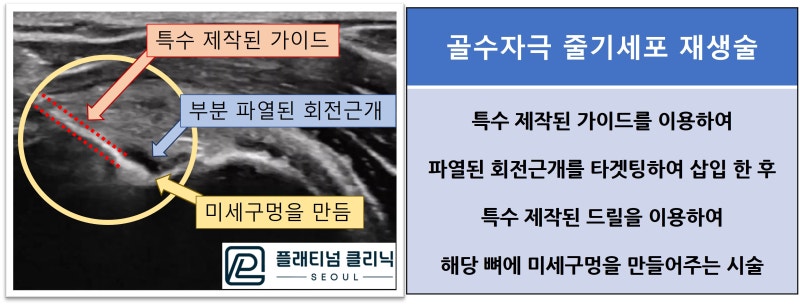
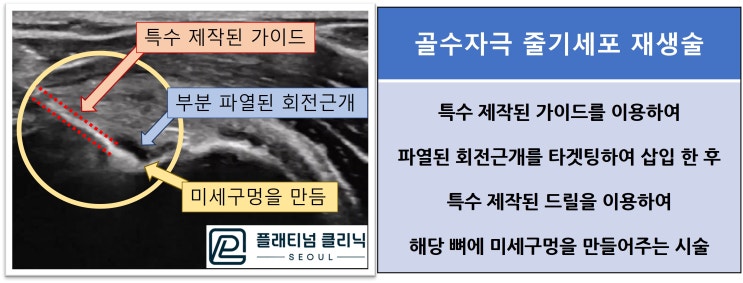
As illustrated in the diagram above, a specially designed guide is inserted targeting the partially torn area, and through it, a specially designed drill is used to create micro-holes in the bone around the torn rotator cuff.
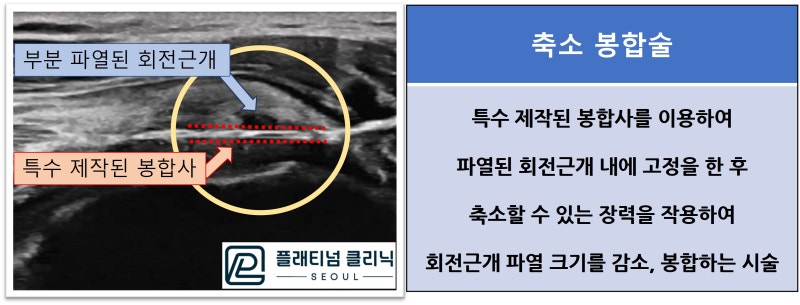
After performing bone marrow stimulation stem cell regeneration, a specially designed suture is inserted into the torn rotator cuff, secured in place, and tension is applied to reduce the tear size — this is the reduction suture procedure. The entire procedure is performed under regional anesthesia, with sedation added so patients feel no anxiety during the process. Procedure time varies depending on the condition, but averages about 20 to 25 minutes. Following the procedure, medication to promote tissue regeneration is also administered via injection. Tissue healing takes approximately 12 weeks, during which patients should rest as much as possible. (This doesn't mean restricting daily activities — just avoiding strenuous exercise or heavy lifting.) Rehabilitation exercises for scapular stabilization and functional recovery continue throughout this period. An ultrasound was performed again approximately three months later.
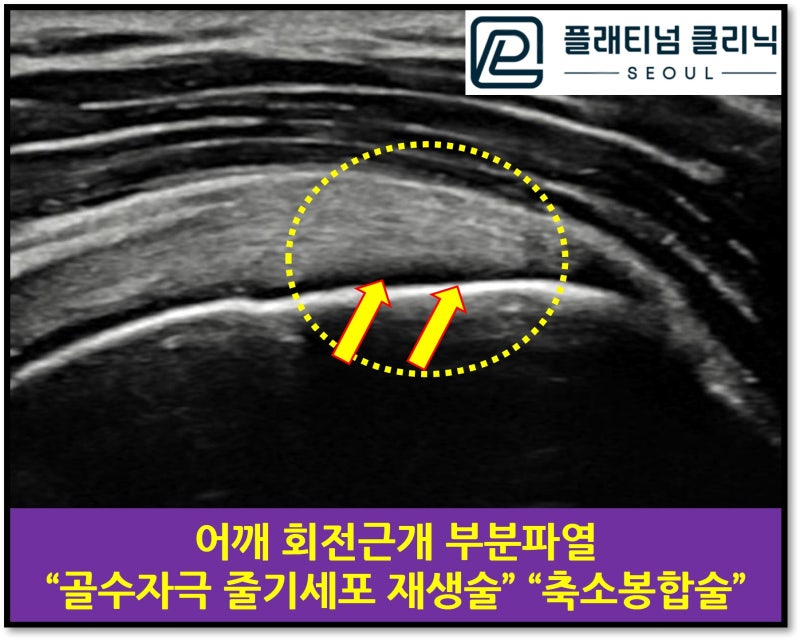
The torn area of the rotator cuff visible before the procedure has now regenerated — appearing white and healed.
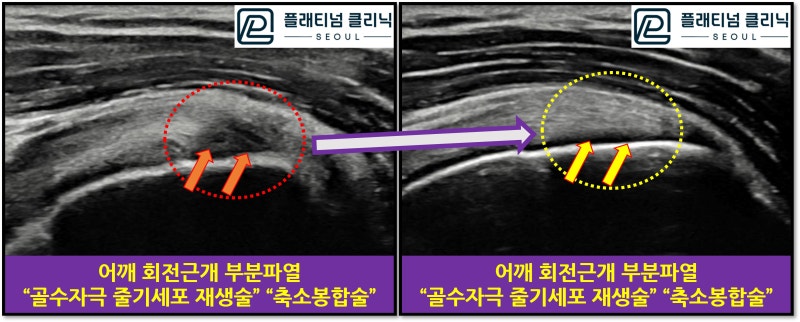
The comparison makes it even more evident that the rotator cuff has healed. The patient was incredibly satisfied and said he would now begin progressively advancing his strength and rehabilitation exercises. Even when tissue has structurally healed, without functional recovery, it remains in a weakened state. If a patient returns to sports in this condition, secondary injuries can occur. That's why I always emphasize the importance of rehabilitation to every patient. For anyone reading this — whether you've had surgery or not — if your hospital says everything looks fine but you still feel discomfort, pain, or a sense that something isn't quite right, please consider the rehabilitation aspect of your recovery.
If your rotator cuff tear hasn't healed despite treatment; If you've been told it's not quite severe enough for surgery and to just endure it; If you've been diagnosed with a partial rotator cuff tear and want it to truly heal; Bone marrow stimulation stem cell regeneration and reduction suture may be worth considering.