Hello. I'm Dr. Dongkyu Lee. Today I'll show you the results of "bone marrow stimulation stem cell regeneration" and "reduction suture technique" for treating partial rotator cuff tears. For partial rotator cuff tears, prolotherapy is often the first treatment approach. Prolotherapy is a treatment method that heals tissue through injection therapy performed in the outpatient setting. The original treatment used a basic solution of dextrose and local anesthetic. As therapeutic agents have been developed and advanced, options now include DNA-based agents, collagen-based agents, and agents containing growth factors, providing a wider range of injection treatment options for tissue healing. Additionally, using ultrasound guidance to precisely target the damaged area during prolotherapy can further improve treatment outcomes. Nevertheless, there are cases where healing doesn't occur well or the partial tear is too large for prolotherapy alone to resolve. Today's patient had been undergoing injection therapy for approximately 4 years for a partial rotator cuff tear, but the tear remained unhealed and pain persisted when they came to see me. The patient was exhausted from years of treatment, and their previous hospital said there was nothing more they could do, essentially telling the patient to give up and that surgery would be the only option if the pain worsened or the tear progressed to complete. First, ultrasound examination was performed to assess the current condition.
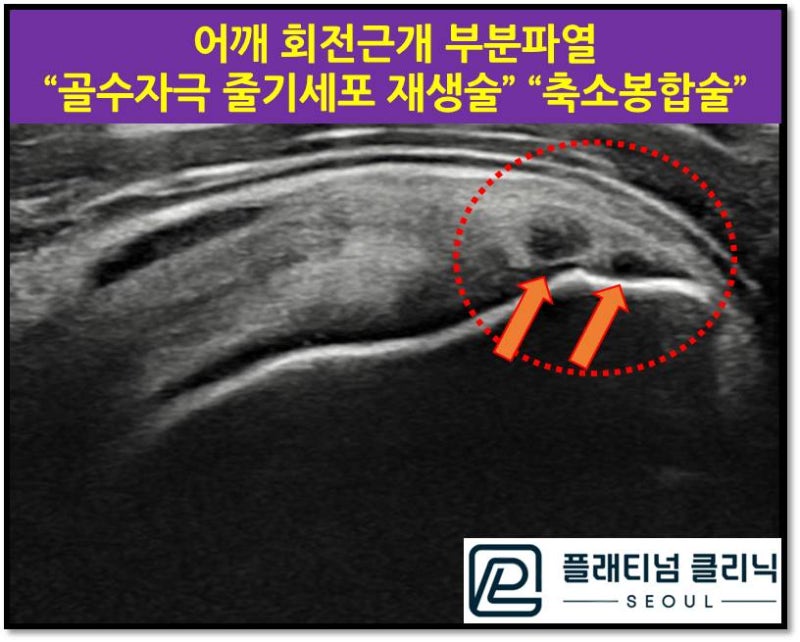
In the ultrasound image above, the dark area indicated by the arrow within the red circle shows the partially torn rotator cuff. The ultrasound shows the tear appearing as if there's a hole in the rotator cuff.
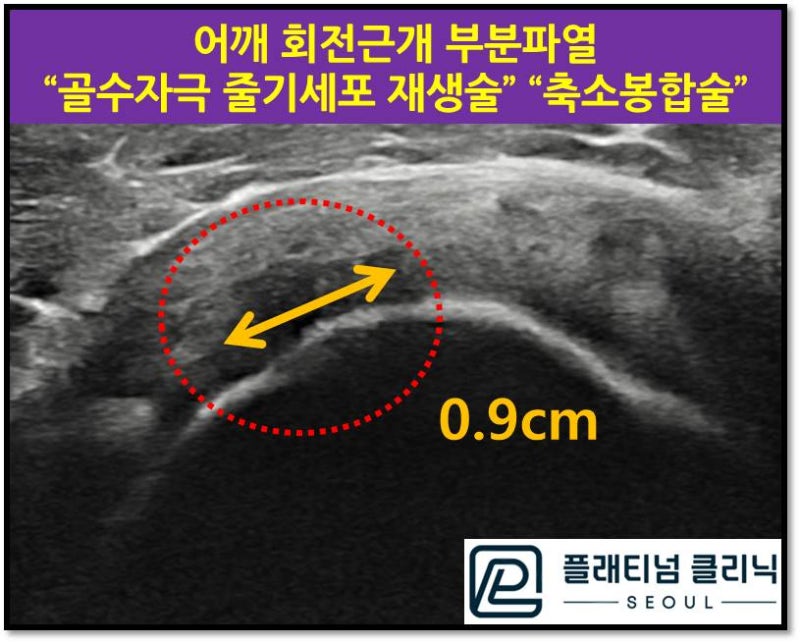
The ultrasound image above shows a cross-section of the rotator cuff, revealing an approximately 0.9 cm partial tear. Given that 4 years of consistent injection therapy hadn't healed the rotator cuff and the partial tear was relatively large, "Bone marrow stimulation stem cell regeneration" and "reduction suture technique" were performed. For information about bone marrow stimulation stem cell regeneration, please refer to the link below. https://blog.naver.com/9690067/222771089454
🔗 https://blog.naver.com/9690067/222771089454For information about the reduction suture technique, please refer to the link below. https://blog.naver.com/9690067/222961123101
🔗 https://blog.naver.com/9690067/222961123101The ultrasound footage above shows the bone marrow stimulation stem cell regeneration procedure. A guide is precisely placed at the rotator cuff tear site, and a specialized drill is used to create holes in the bone. Through these holes, bone marrow exits, and the stem cells, platelets, growth factors, and other components within the marrow are abundantly secreted, promoting tissue healing.
The ultrasound footage above shows the reduction suture technique. A specialized guide is passed through the tear site, and a specially designed absorbable suture with barbs is inserted and anchored. The absorbable suture is then pulled to reduce the tear size and secure it to prevent further progression. This process is repeated 2-6 times, anchoring the sutures in a grid pattern to reduce tear size and prevent the tear from progressing further. After the procedure, consistent rehabilitation and management were maintained, and ultrasound examination was performed again at 4 months post-procedure.
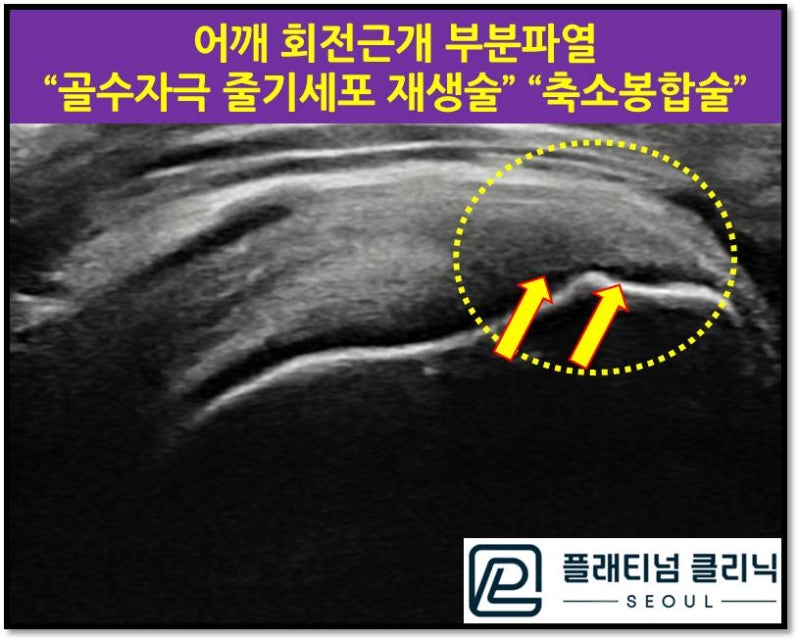
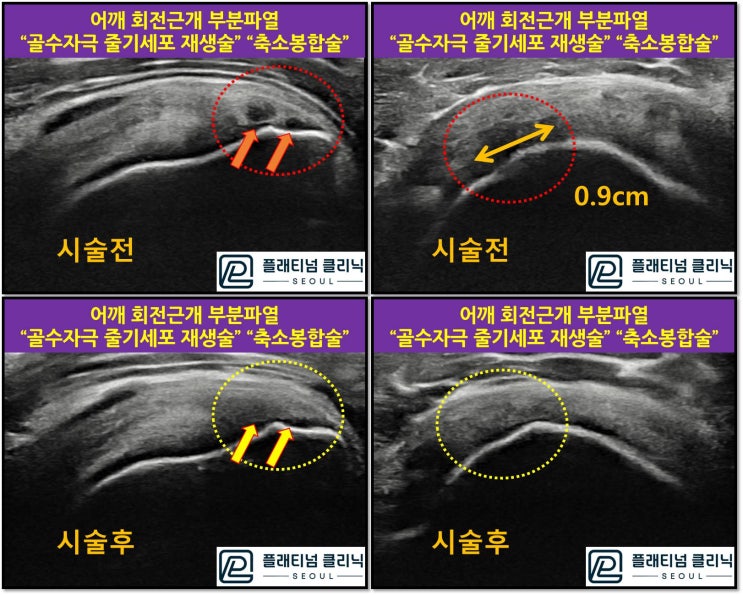
In the ultrasound image above, the area indicated by the arrow within the yellow circle is where the previous hole-like tear was, and it has now recovered to look like normal tissue.
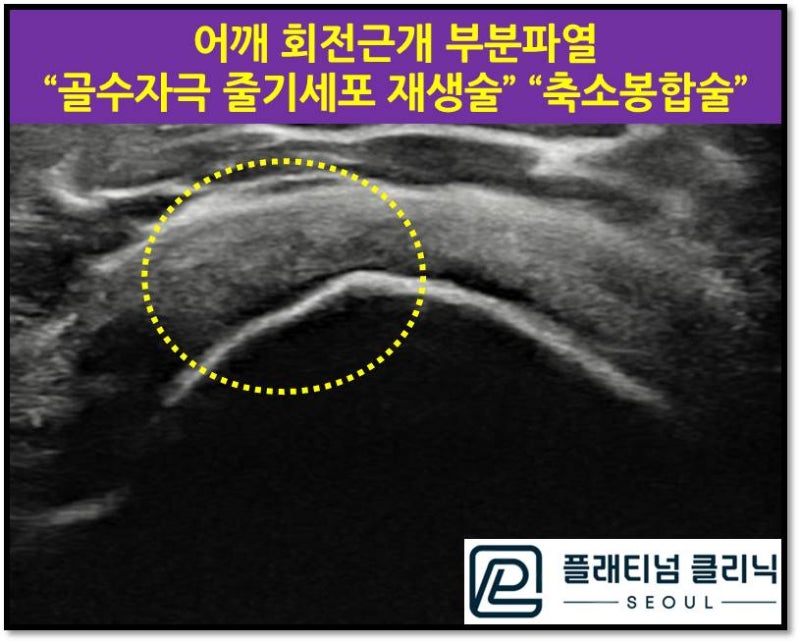
The image above shows a cross-section of the tear site, where the previously dark torn area has recovered to normal tissue. Let's compare the before and after images side by side.
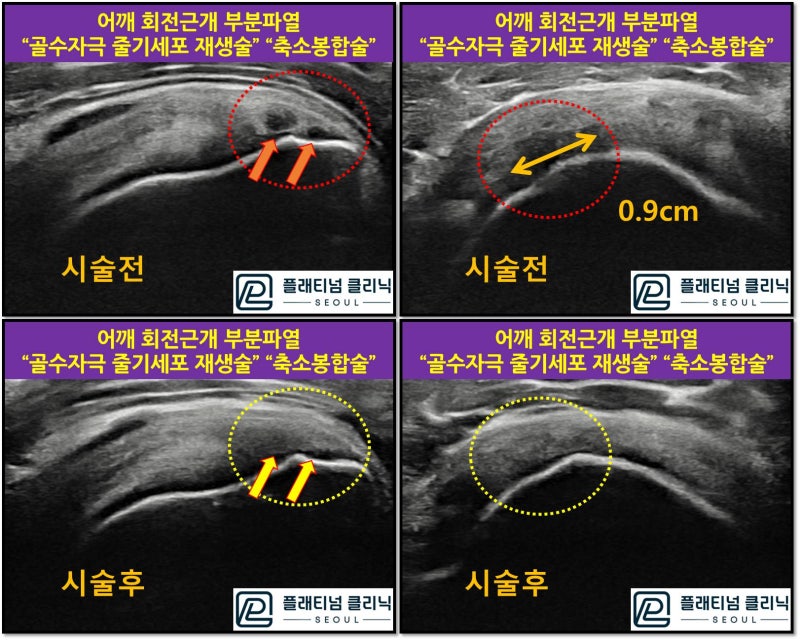
Comparing the before and after images, the dark area that appeared torn on ultrasound has healed to white, normal tissue. For partial rotator cuff tears that don't respond to conservative treatment (injections, prolotherapy) or tears that are relatively large, satisfactory results were achieved through non-surgical treatment without surgery.
Bone marrow stimulation stem cell regeneration and reduction suture technique can treat partial rotator cuff tears.