The shoulder is the most freely moving joint in our body. Unlike other joints such as the knee, ankle, and back, the shoulder is the only joint in the body capable of 360-degree rotation. However, the greater and freer the joint movement, the higher the risk of injury compared to other joints. While shoulder injuries from exercise are common, even more cases involve sudden shoulder pain occurring during everyday activities.
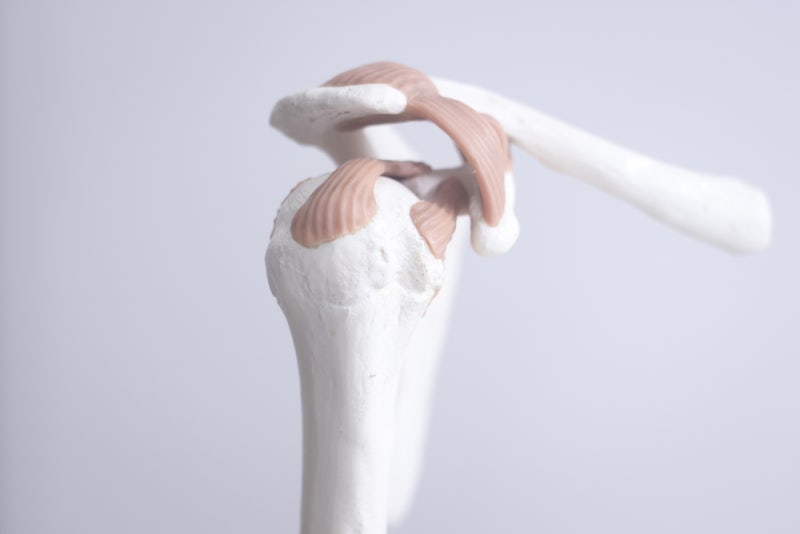
Beyond exercise, repetitive overuse from household chores or occupational demands increases the likelihood of shoulder conditions. Among the many shoulder diseases, calcific tendinitis, where stones form in the shoulder tendons, causes extremely severe shoulder pain. Shoulder calcific tendinitis is a condition where calcification forms in the tendons and soft tissues that surround the shoulder. This calcification lodged between tendons irritates the surrounding area, causes inflammation, and produces severe shoulder pain. When degenerative changes or blood flow disruption in the rotator cuff tendons cause calcium deposits to accumulate, they transform into calcified material, known as "calcification."
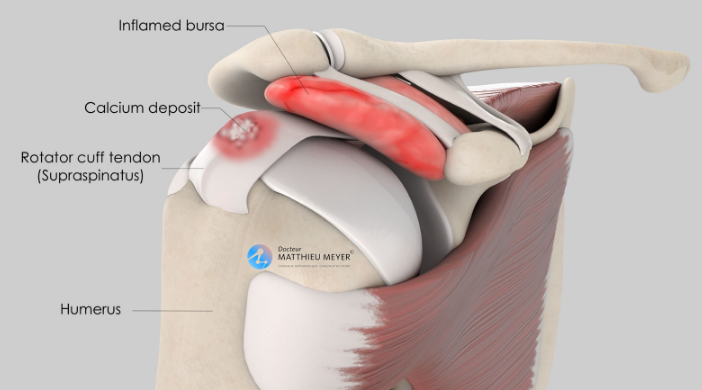
Shoulder calcific tendinitis characteristically causes sudden severe pain even when the shoulder has been pain-free. Common symptoms include a burning sensation in the shoulder, severe pain when rolling onto the affected shoulder during sleep, excruciating pain even from touching the shoulder, shoulder pain even without arm movement, pain radiating from the shoulder to the arm and neck, and worsening pain at night. If you have three or more of these symptoms, you should suspect shoulder calcific tendinitis.

In medicine, pain intensity is measured using the 'VAS score.' It's measured on a scale of 0-10, where 0 means no pain and 10 represents the most severe pain. While the pain of childbirth is rated at 6-7 points, shoulder calcific tendinitis pain scores 8-9 points, indicating it's actually more painful than labor. Shoulder calcific tendinitis causes severe shoulder pain especially at night. Nighttime pain can be so extreme that sleep is impossible, while daytime pain is relatively milder. Sharp, stabbing shoulder pain is common. Sometimes pain appears and disappears intermittently. Naturally, lifting the affected arm forward or sideways is restricted.
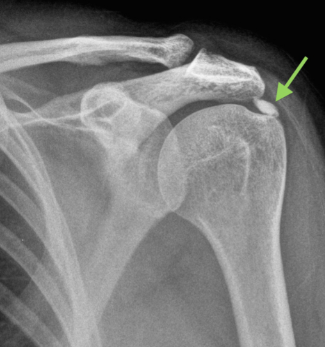
Once diagnosed, shoulder calcific tendinitis is relatively straightforward to treat. Symptomatic improvement comes from removing the calcific deposit or reducing its size to promote absorption. Shoulder calcific tendinitis progresses through three stages: formation, maintenance, and absorption. The absorption phase is when pain is most severe. During the absorption phase, when the calcification suddenly begins dissolving, chemicals that cause intense shoulder pain are released, resulting in extreme pain and limited shoulder mobility. As the calcification enters the absorption phase, it expands in volume, increasing pressure within the rotator cuff and causing extreme pain. If the calcification doesn't fully dissolve during the absorption phase, the shoulder pain temporarily subsides. Many people assume this means natural healing has occurred and neglect the condition. However, if the undissolved calcification enters another absorption phase later, extreme shoulder pain can return. Proper diagnosis and timely treatment are essential. Calcific deposit treatment begins with reducing inflammation caused by the deposit, then proceeds to remove or promote absorption of the causative calcification. If frozen shoulder has developed due to the calcification, rehabilitation exercises may be needed as range of motion may have become restricted. In the formation stage, since calcific pain is extreme, removing the deposit provides the fastest treatment results.
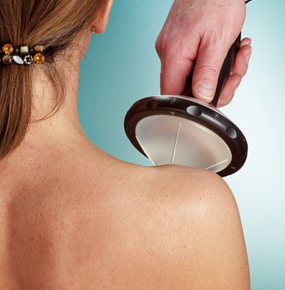
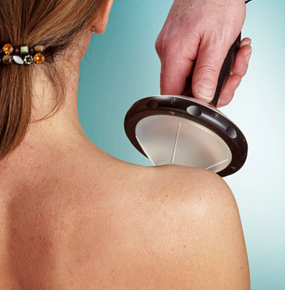
Calcification can be removed using extracorporeal shockwave therapy to improve tendon blood supply. For larger deposits, calcific deposit aspiration can be performed under ultrasound guidance using a specialized needle to crush hard, large calcification and aspirate it with a syringe. The advantage of PIMS therapy calcific deposit aspiration is that calcification embedded in the shoulder tendons can be removed with a syringe without arthroscopic surgery. Another advantage is that ultrasound guidance allows precise targeting of only the calcified tissue without disturbing healthy rotator cuff tendons. PIMS therapy for calcific deposits is most effective when performed during the acute painful phase when calcification is dissolving.
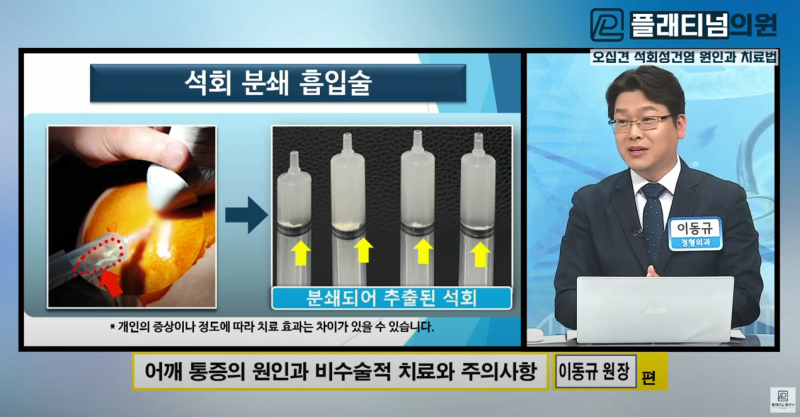
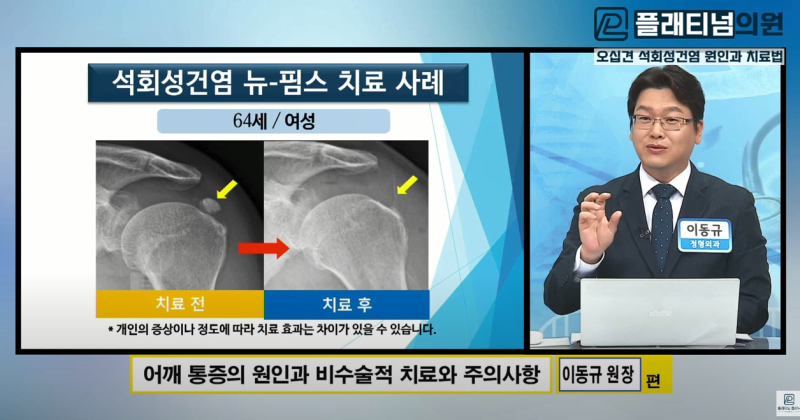
Usually, a single PIMS therapy session is performed, but if the calcification has hardened significantly, additional sessions may be required. However, an important note: even after calcific deposit aspiration treatment eliminates shoulder pain, additional shoulder stretching and rehabilitation exercises must be performed to prevent inflammatory adhesion reactions and shoulder joint stiffness. Additionally, since it's not possible to extract all calcification from the shoulder joint with a syringe, residual calcification remaining after the aspiration procedure should be addressed with extracorporeal shockwave therapy. Shockwave therapy not only breaks down residual calcification but also increases blood flow around the shoulder and promotes cell regeneration. In its early stages, shoulder calcific tendinitis may be mistaken for simple shoulder muscle pain, leading to neglect and self-treatment. It can also be confused with common conditions like frozen shoulder or rotator cuff tears. Self-diagnosis can worsen symptoms and lead to inappropriate treatment with various side effects. If severe shoulder pain develops, please visit a hospital promptly for proper diagnosis and treatment.