
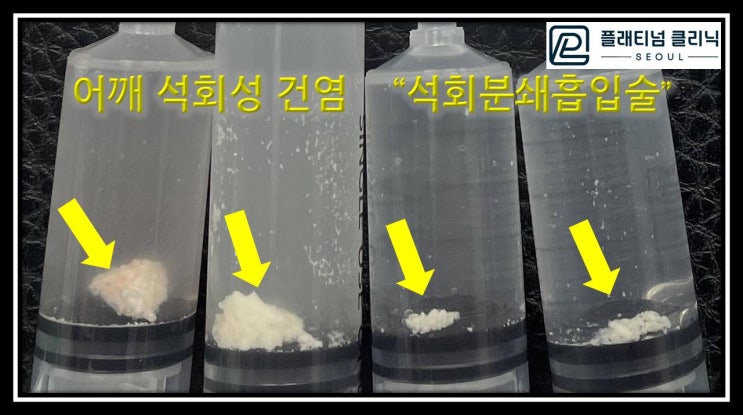
Hello. I am Dr. Dongkyu Lee, an orthopedic specialist. I have previously discussed how barbotage is an excellent procedure for calcific tendinitis. https://blog.naver.com/9690067/222788428381
🔗 https://blog.naver.com/9690067/222788428381Patients often tell me they were told at other hospitals that soft, cheese-like calcium can be aspirated but hard calcium cannot, and that surgery or multiple procedures (at least 3) would be needed. In my experience, I can fragment and remove calcium regardless of its consistency... Hearing about 3 procedures gave me pause. What exactly would be done 3 times? After investigating, I learned they meant puncturing the hard calcium with a needle to create holes for absorption, repeated 3 times. Since they could not fragment the hard calcium, they would puncture it to promote absorption. While this approach may have some effect, if the severe pain from calcium cannot be immediately resolved, the patient must endure ongoing suffering. When performing barbotage, I use 18-gauge or 16-gauge needles. The needle tip is precisely inserted into the calcium, and through it, another needle is used to fragment the calcium from the inside. By gradually adjusting the needle direction while staying within the range that avoids tendon damage, the calcium is fragmented. The fragmented calcium is then washed out and aspirated using saline, making it fully possible to remove even hard calcium. Of course, in my early days, I had cases where removal was incomplete and results were unsatisfactory. But after more than 10 years of experience, my technique has improved and experience has grown, allowing me to successfully remove even hard calcium in a single session. Currently, I use custom-made instruments designed to fragment calcium while minimizing tendon damage. Here is a case. A female patient in her 40s had calcium in the subscapularis tendon. She was told at another hospital that the calcium was too hard and surgery was needed, so she came to see me. First, let's look at the X-ray.
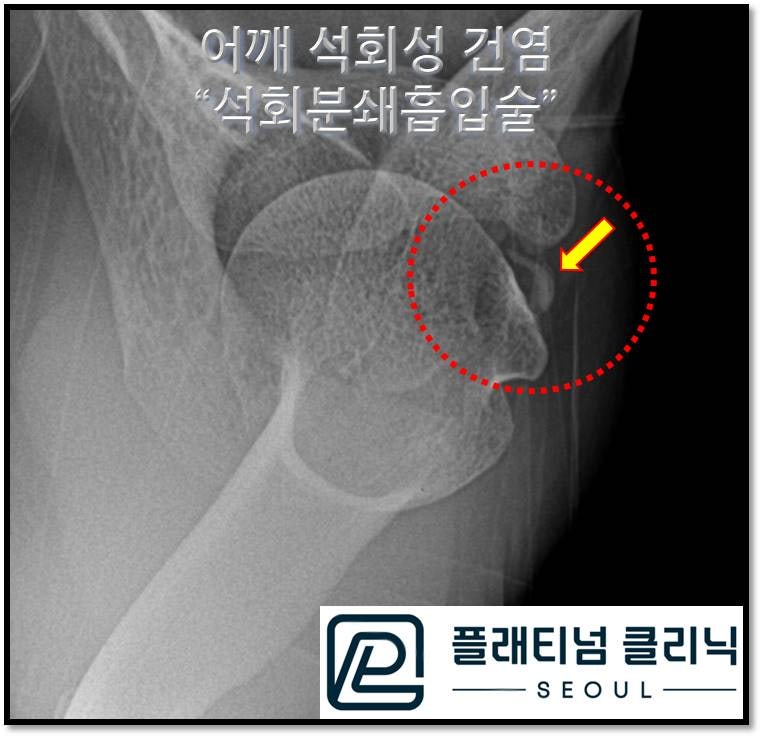
The X-ray shows calcium indicated by the arrow within the red circle. Ultrasound can determine whether the calcium is hard or soft.
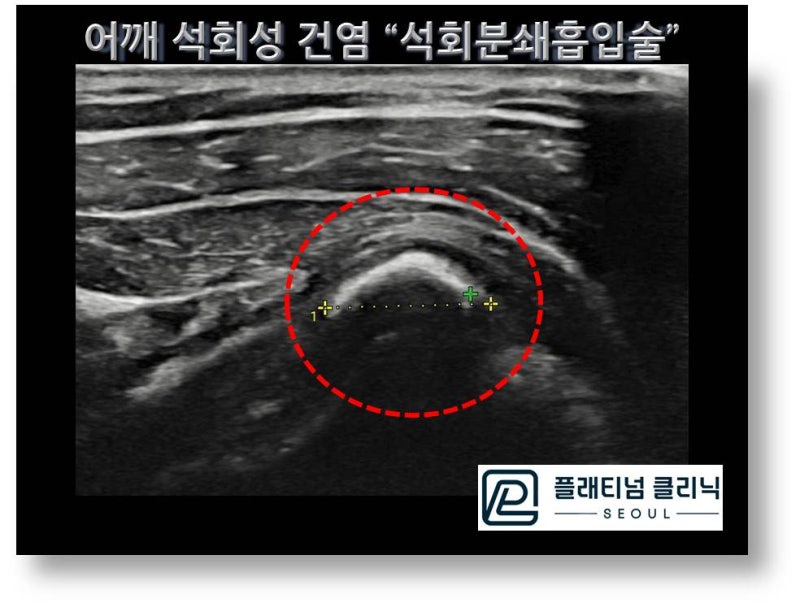
The ultrasound shows the white area within the red circle as the calcium. Since ultrasound cannot penetrate solid structures, the area below bone appears dark. This calcium also appears dark below, confirming it is hard. Despite being hard, I determined it could be sufficiently removed and performed barbotage.
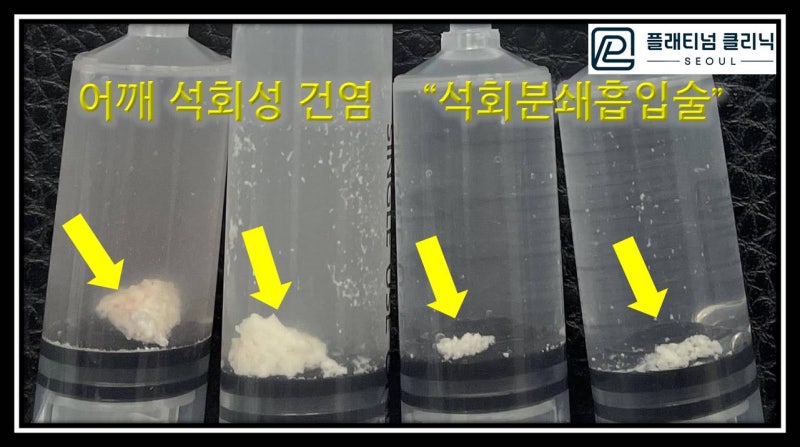
The extracted calcium is visible inside the syringe (yellow arrows). It may look a bit unpleasant, but removing it cleanly feels very satisfying.
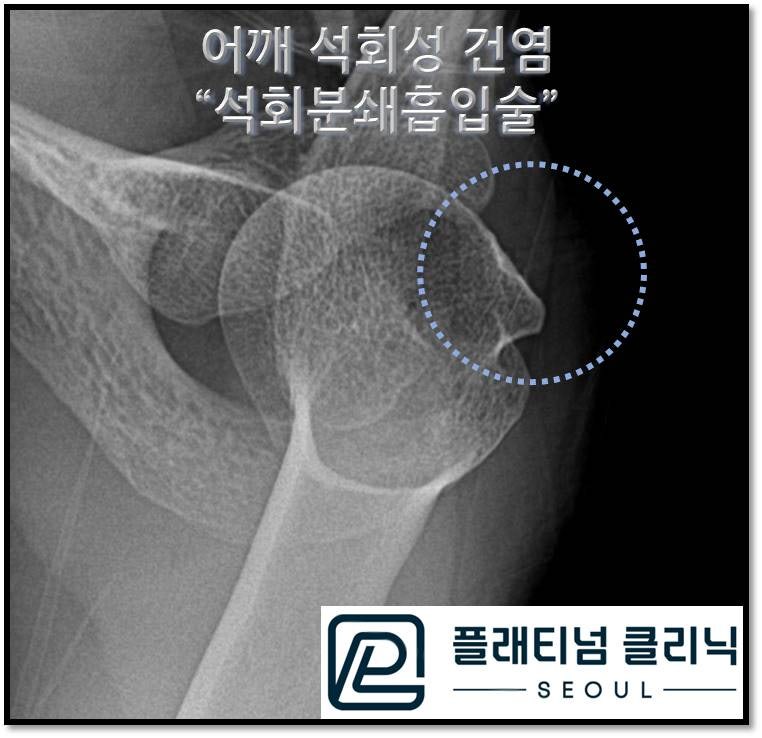
The post-procedure X-ray confirms the previously present calcium has disappeared.
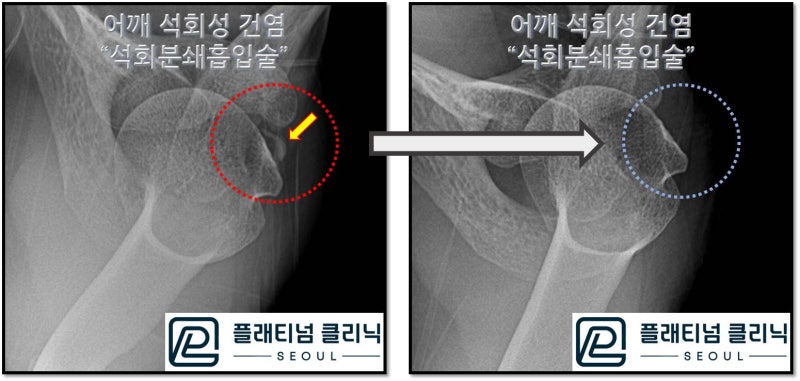
Comparing the before and after images makes the calcium removal even more obvious. In this case, the calcium was almost completely removed in a single session, and the patient was treated without any additional procedures. The patient was extremely satisfied that surgery was avoided, and appreciated being able to come in for a same-day procedure and go home the same day.
Even hard calcium deposits can be removed in a single barbotage session.