
A 71-year-old male patient traveled all the way from Jeju Island to our clinic after visiting multiple hospitals for long-standing left knee pain without being able to decide on treatment. He had been diagnosed with osteoarthritis and had received numerous cartilage injections (most recently 15 days before his visit) as well as multiple steroid injections. While these had been somewhat effective years ago, recent pain was no longer controlled, so he wanted more definitive treatment. However, each hospital recommended a different approach, leaving him unable to decide, which is why he came to our clinic. First, we took X-rays.
Grade IV arthritis is observed in the medial compartment of the left knee.
On the scanogram, the mechanical axis has shifted completely medial to the knee, showing severe varus deformity.
What is the most appropriate treatment for this patient? He had heard about various options from other hospitals -- total knee replacement, CartiStem, osteotomy, and Invossa injection -- and came to us wanting the most appropriate treatment. First, I explained that Invossa injection does not meet the criteria for his case. It is applicable for stage 3 arthritis, but this patient has stage 4. While it could be tried, the results are unpredictable, and given its high cost, disappointing results would frustrate both patient and doctor. CartiStem alone would be insufficient because the mechanical axis is significantly shifted medially, so combining it with a corrective osteotomy would be a reasonable option that preserves native cartilage. However, CartiStem with osteotomy requires approximately 8 weeks of non-weight-bearing crutch ambulation, which is very challenging for elderly patients and can cause muscle loss that may not fully recover in older individuals. For elderly patients, the ability to mobilize as quickly as possible after surgery is key to good outcomes. Considering all these factors, I recommended total knee replacement. The patient can walk the day after surgery, costs are likely lower than other treatments, and most importantly, total knee replacement is the most appropriate treatment for this patient. The patient said he would think about it and returned to Jeju Island. One month later, he was admitted for total knee replacement. The prosthesis used was the Smith & Nephew GENESIS II total knee system. It features the latest Oxinium technology, offering a lifespan of up to 30 years, far longer than conventional products.
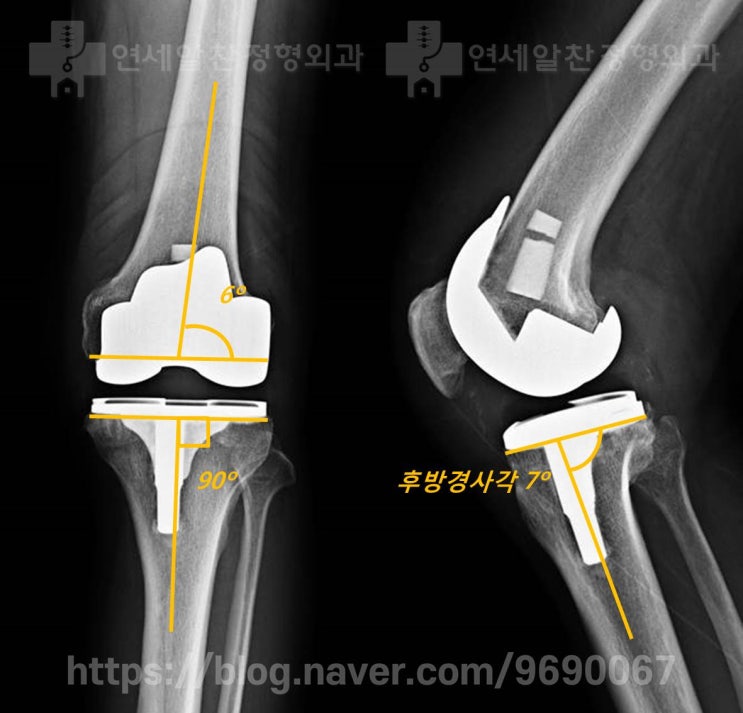
On the anteroposterior view, the femur has approximately 6 degrees between the mechanical and anatomical axes, which must be maintained during femoral component insertion. The tibial component must also be inserted at 90 degrees, parallel to the mechanical axis from the knee center. In this patient, accurate bone cuts and component placement achieved an ideal mechanical axis. On the lateral view, the tibial component should have a posterior slope of 7-10 degrees to achieve normal flexion range. Insufficient posterior slope limits knee bending, causing patient discomfort. In this patient, a 7-degree posterior slope was achieved, with no limitation in range of motion.
Comparing the scanograms, the pre-operative severe varus deformity with the mechanical axis shifted far medially has been corrected, with the post-operative mechanical axis now passing through the center of the knee -- an ideal alignment after total knee replacement.
Treatment options for knee osteoarthritis have advanced considerably, with many effective approaches available. CartiStem, osteotomy, and total knee replacement are all excellent options. However, newer does not always mean better. Treatment must be matched to each patient's specific situation to achieve satisfaction for both patient and doctor. Patients with osteoarthritis should not blindly pursue the newest or most expensive option. Instead, understand your condition accurately, consider which treatment is most appropriate for you, and make an informed decision. Guiding patients through this process with honest, accurate information is the role of the physician.