Hello, I'm Dr. Dongkyu Lee, a board-certified orthopedic surgeon. Many patients ask me about partial rotator cuff tears. One hospital says you need surgery. Another says it's too early for surgery and to hold off a bit longer. Others suggest trying more injections. Patients end up visiting multiple hospitals and receive different treatment recommendations at each one, leaving them unsure about what to do or which treatment to choose. When the rotator cuff is completely torn, surgery is indeed the right option. However, there are so many patients who have been diagnosed with a partial rotator cuff tear and have tried various treatments without improvement. Even after visiting multiple hospitals, very few offer a definitive treatment plan. In cases where conservative treatments fail to show improvement for a partial tear, a more invasive and proactive approach is necessary to prevent progression to a complete tear and avoid surgery. There is a treatment worth considering in these situations. It is bone marrow stimulation stem cell therapy combined with reduction suture repair. Please refer to the link below for more information. https://blog.naver.com/9690067/223251719566
🔗 https://blog.naver.com/9690067/223251719566The patient I'm showing you today had been diagnosed with a partial rotator cuff tear for two years and says there isn't a treatment they haven't tried. They said they've received every type of injection available — DNA injections, PRP injections, collagen injections, and more. They also consistently underwent shockwave therapy and manual therapy, but their symptoms never improved, and the pain kept getting worse. That's when they came to see me. This patient runs a business and, given the nature of their work, plays golf frequently, attends many meetings, and travels abroad often. They told me the pain had been severe and truly unbearable. They even considered surgery and visited a university hospital, but were told it wasn't yet at the stage for surgery and only received a steroid injection. However, the pain returned shortly after, and being told that surgery wasn't an option either left them feeling frustrated. Daily life and running their business had become extremely difficult, and they pleaded with me to find a solution. Let's take a look at the condition with ultrasound.
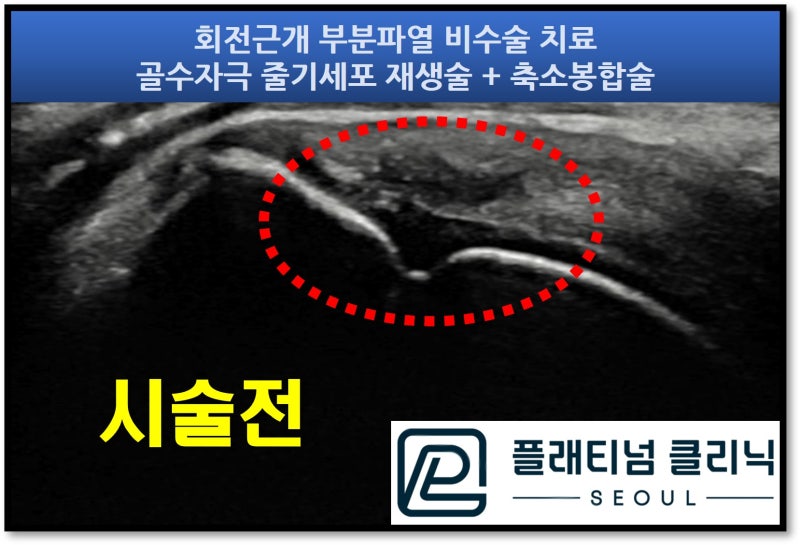
On the ultrasound, a partially torn rotator cuff can be seen within the red circle. Normally, the rotator cuff appears white and filled with a slight fibrous texture on ultrasound. However, in the image above, nearly half of the rotator cuff appears dark and somewhat ragged, indicating that the partial tear has progressed quite significantly. In this case, numerous injection treatments had been ineffective, and the pattern of the tear was beyond what injections alone could resolve. So we decided to pursue a more invasive and proactive treatment approach. We performed bone marrow stimulation stem cell therapy and reduction suture repair simultaneously.
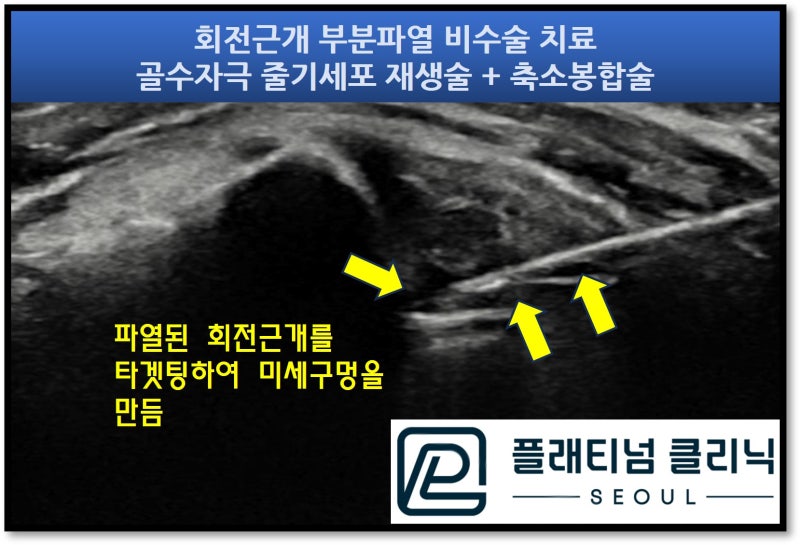
Bone marrow stimulation stem cell therapy involves precisely targeting the torn rotator cuff under ultrasound guidance, inserting a specially designed guide, and using a specially designed drill to create micro-holes. Because the holes are less than 1mm in size, there is no damage to the bone. Bone marrow flows out through these micro-holes, and the body's own stem cells within the marrow are used to heal the tissue.
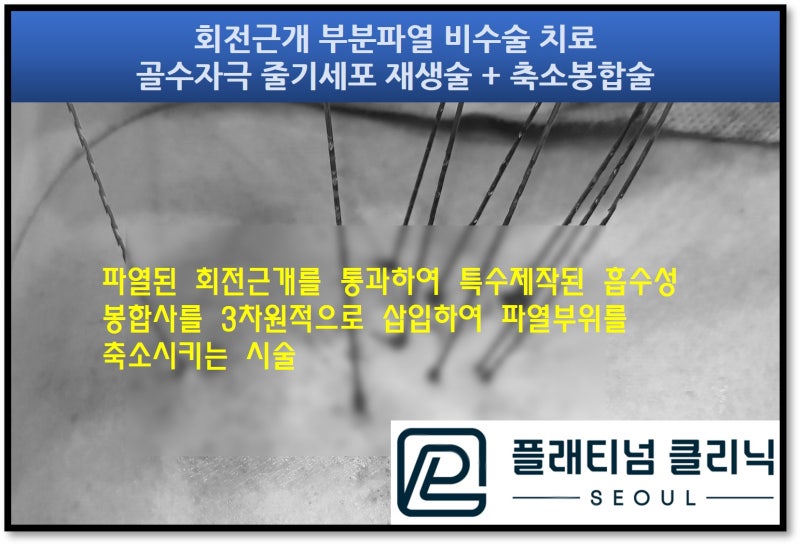
A specially designed absorbable suture is threaded three-dimensionally through the torn rotator cuff area, securing it firmly and reducing the tear size. Since only a needle-sized opening is needed for the suture to pass through, healing occurs within just 1 to 2 days and leaves no visible wound. Because absorbable sutures are used, there is no need for removal. They maintain their strength for about 3 months, providing ample time for tissue healing. When the sutures are absorbed, they form collagen, which further aids in tissue recovery. We checked the ultrasound at the 3-month mark after the procedure.
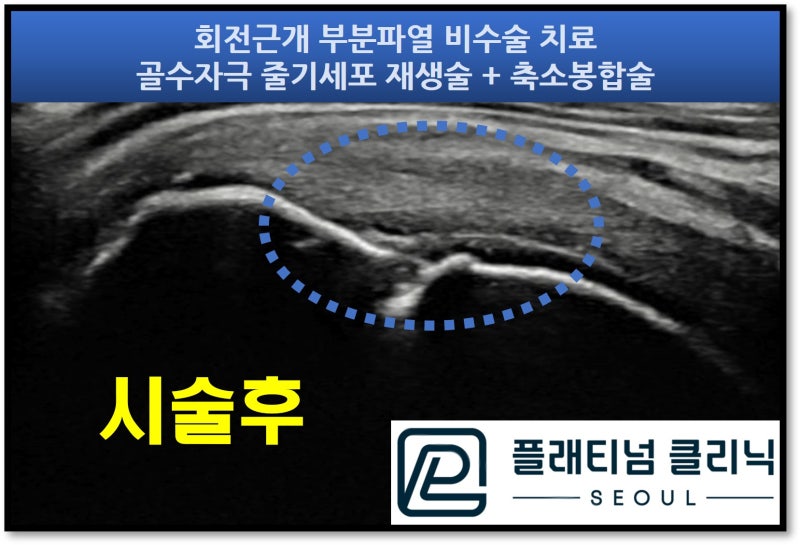
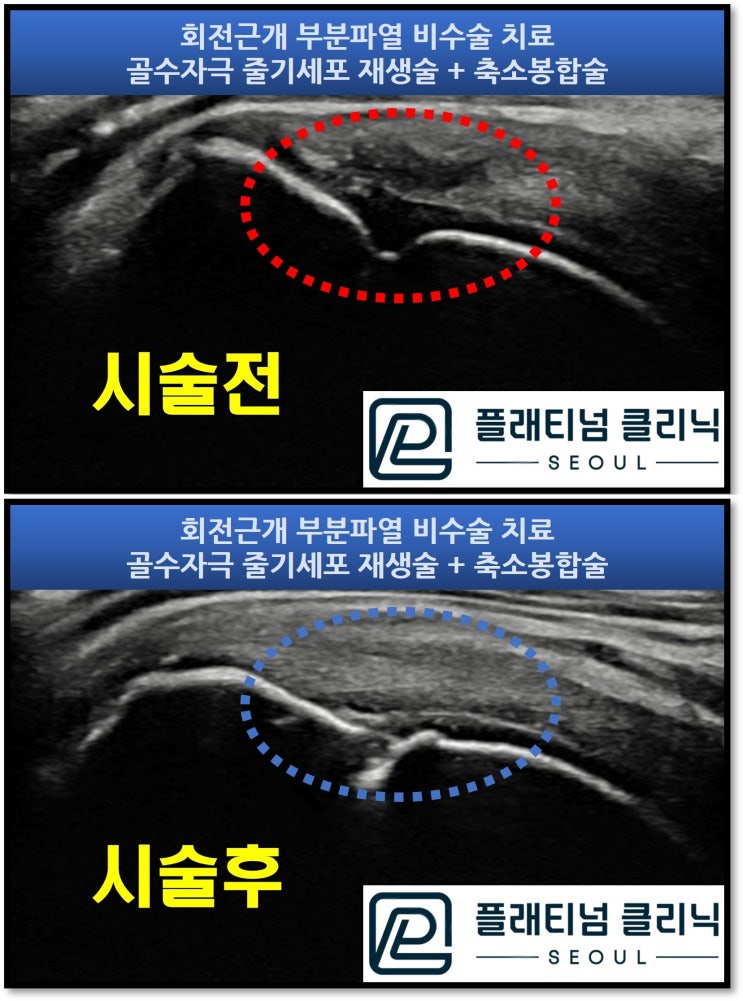
The area of the partial rotator cuff tear seen before the procedure has healed by the 3-month follow-up. As you can see within the blue circle, the dark areas have disappeared, filled in with white tissue, and the original fibrous texture has been restored.
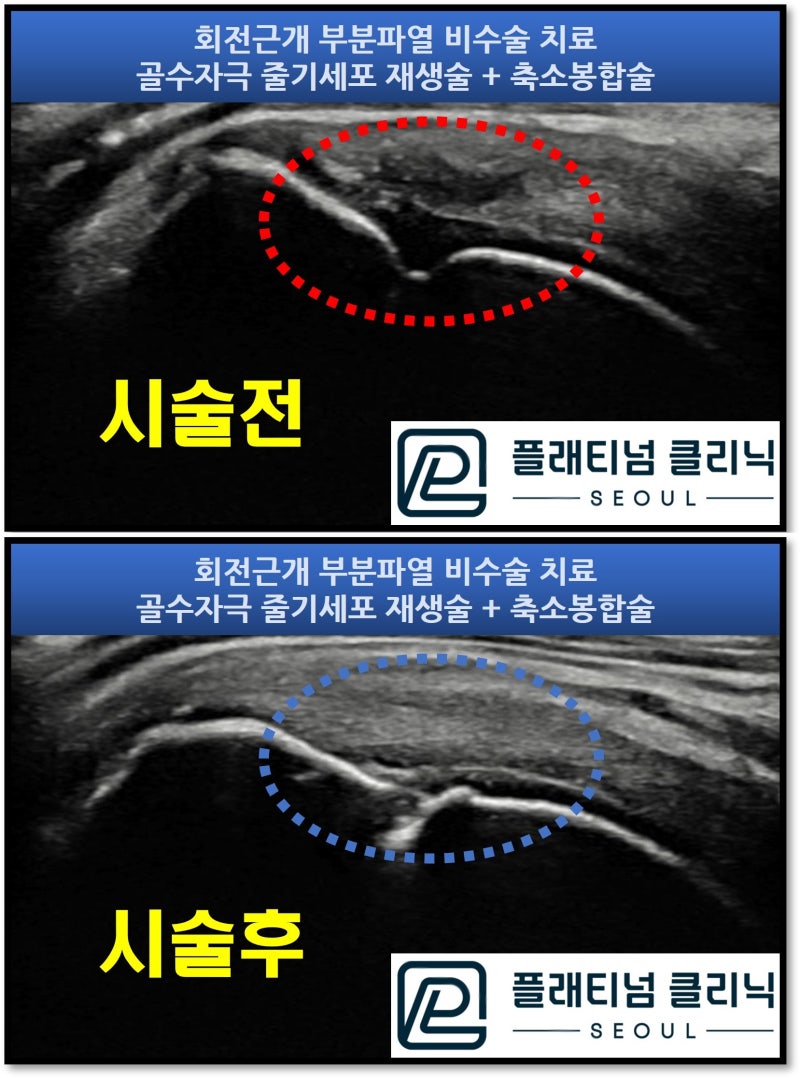
Looking at the before and after images, the recovery is even more clearly evident. The patient traveled abroad for business after the procedure and told me it was so comfortable that they couldn't believe it. They said they were incredibly grateful. They even said that from now on, whenever something hurts, they'll come straight to me. I told them that not needing to see me is actually a sign of good health, and wished them well. I believe this type of non-surgical treatment can truly help patients whose partial rotator cuff tears haven't responded well to other treatments.
Treatment for Partial Rotator Cuff Tears Bone Marrow Stimulation Stem Cell Therapy Reduction Suture Repair