Hello, I'm Dr. Dongkyu Lee, a board-certified orthopedic surgeon. Many patients suffer from excruciating pain caused by shoulder calcific tendinitis. Many of you are already aware that shoulder calcific tendinitis can be treated without surgery. As I mentioned in a previous post, there is a treatment method that even doctors themselves undergo. It's called calcification crushing and aspiration. https://blog.naver.com/9690067/223489728110
🔗 https://blog.naver.com/9690067/223489728110The calcification crushing and aspiration procedure I perform removes the calcification in a single session, regardless of its type or size. Based on over a decade of experience and research, I crush and remove calcifications whether they are hard or sticky and paste-like. This is not something that requires multiple sessions — a single procedure frees you from the agony of calcific tendinitis. One patient came to me saying they had previously undergone a procedure at another hospital where the calcification was supposedly broken up with a needle and aspirated, but the calcification wasn't actually removed — it was only partially broken. After that, their pain became even worse and unbearable. They were also told that simply breaking up the calcification would cause it to be reabsorbed, so they should endure the pain. If that's the case, it should be called calcification breaking, not calcification crushing and aspiration (though I doubt the calcification was truly broken up either)... This patient told me that when they received my calcification crushing and aspiration procedure, they thought they were undergoing actual surgery. I can understand why they might feel that way. First, I completely control the patient's pain during the procedure by performing a brachial plexus nerve block, so the patient feels no discomfort. Then, to prevent infection, sterile drapes are used to expose only the shoulder area, and the procedure is conducted under completely sterile conditions. Additionally, a specially designed guide and drill are used to crush the calcification, and you can hear the sound of the drill during the crushing process. To remove the crushed calcification, multiple syringes are alternated to extract as much calcification as possible. Seeing and experiencing all of this, the patient thought it was a surgical procedure. But the only wound is a single needle-like mark where the guide was inserted. I'm not sure how other hospitals perform their version of calcification procedures. However, based on what patients have told me after having procedures at other hospitals, it seems that no one else yet performs a procedure like mine — truly crushing the calcification and aspirating it out. Let me show you a case.
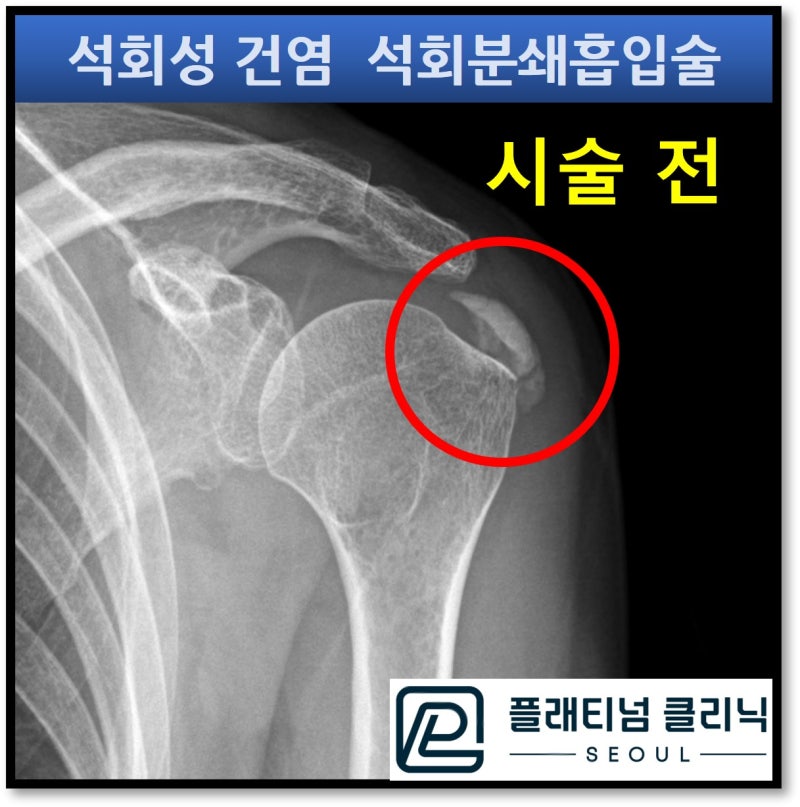
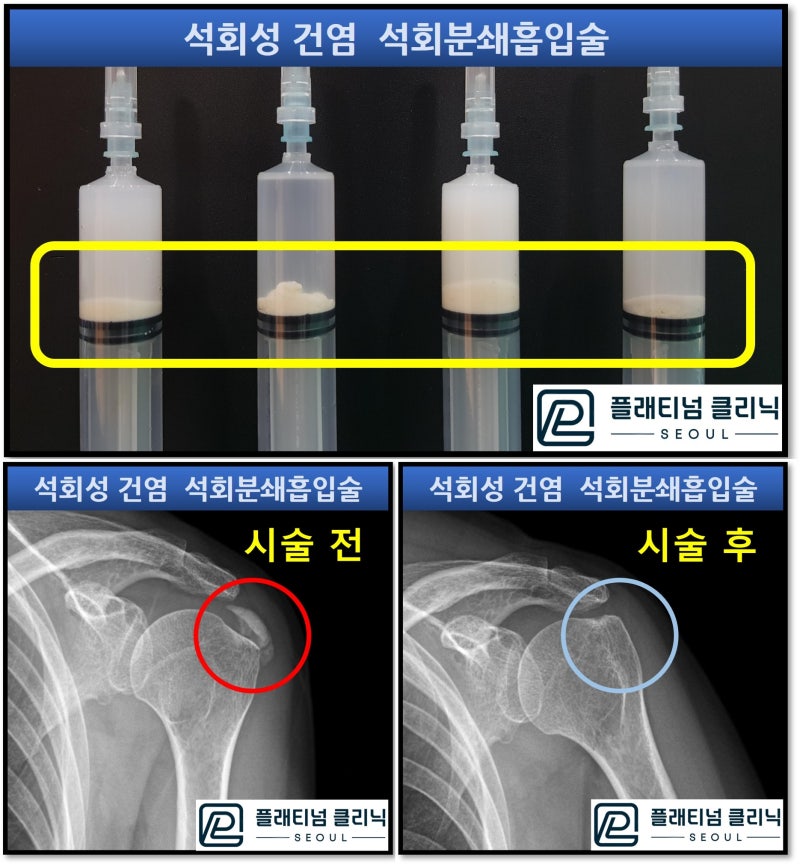
On the X-ray, a massive calcification can be seen inside the red circle. I also checked the size and characteristics with ultrasound.
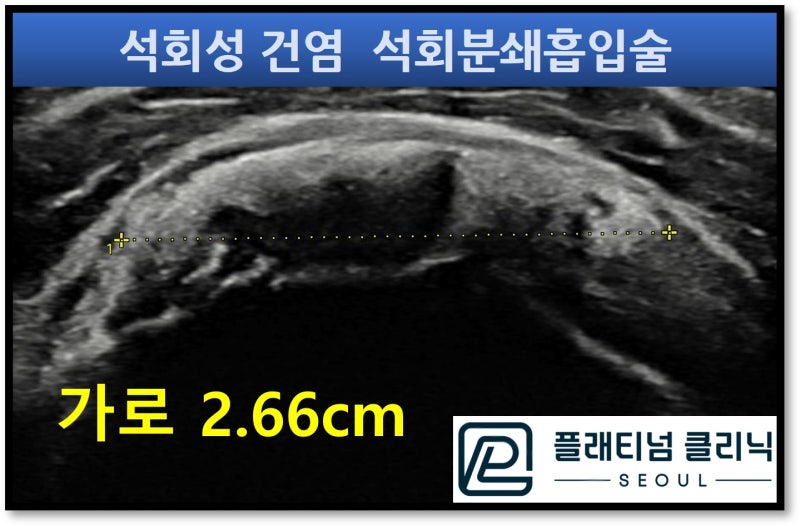
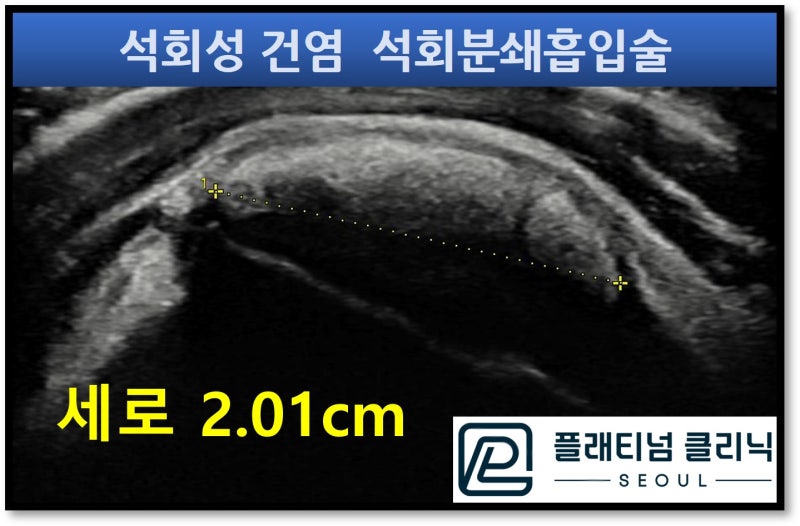
An enormous calcification measuring 2.66 x 2.01 cm was observed. Considering that the supraspinatus tendon in East Asians is typically 2.5 to 3.0 cm wide, the calcification occupied nearly the entire width of the supraspinatus. The patient was in so much pain that they couldn't even move their arm. They said they had undergone a needle aspiration procedure at another hospital, but the calcification wasn't removed, and they were told that surgery was necessary because it was too large. As I've mentioned before, calcific tendinitis can be treated without surgery. I performed the calcification crushing and aspiration procedure.
In the video, you can see the cheese-like calcification being aspirated into the syringe.
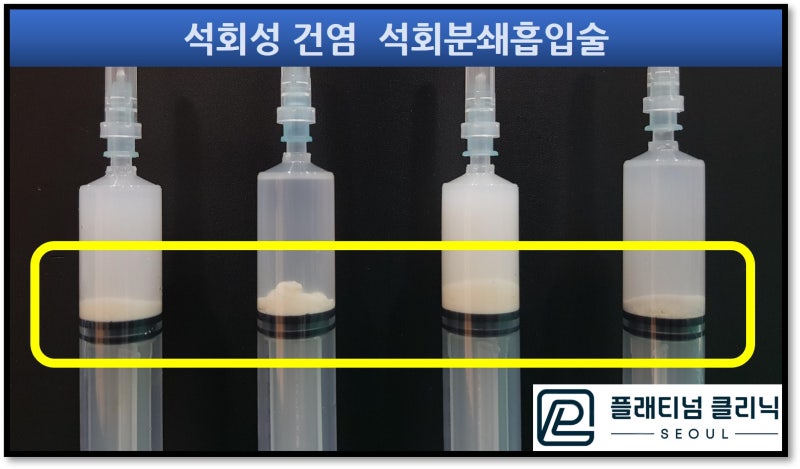
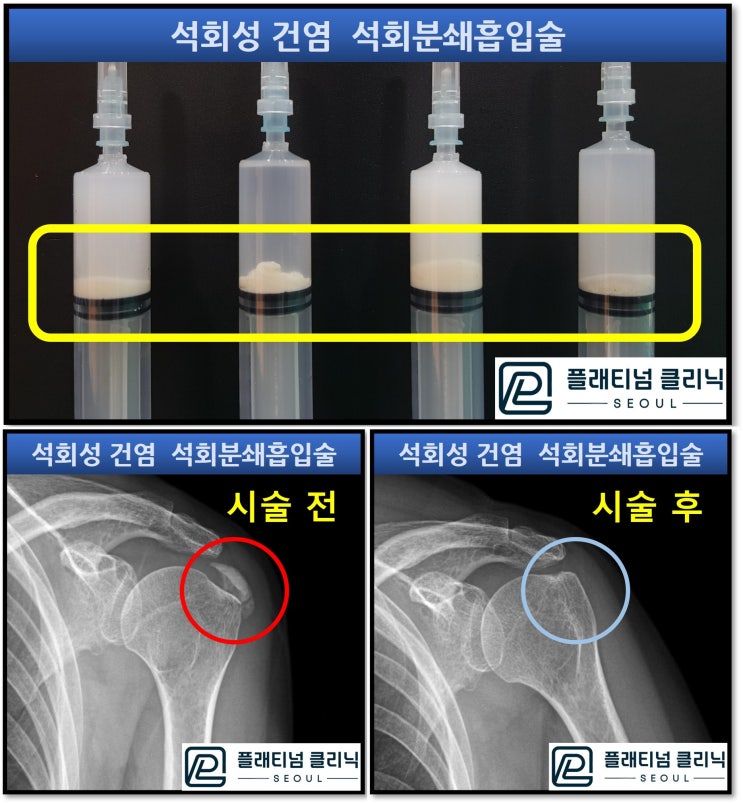
Looking at the post-procedure syringe photos, the second syringe contains the sticky calcification seen in the video. The remaining syringes contain calcification that was crushed with the special drill and then aspirated out, beyond what came out as the paste-like material. An enormous amount of calcification was removed.
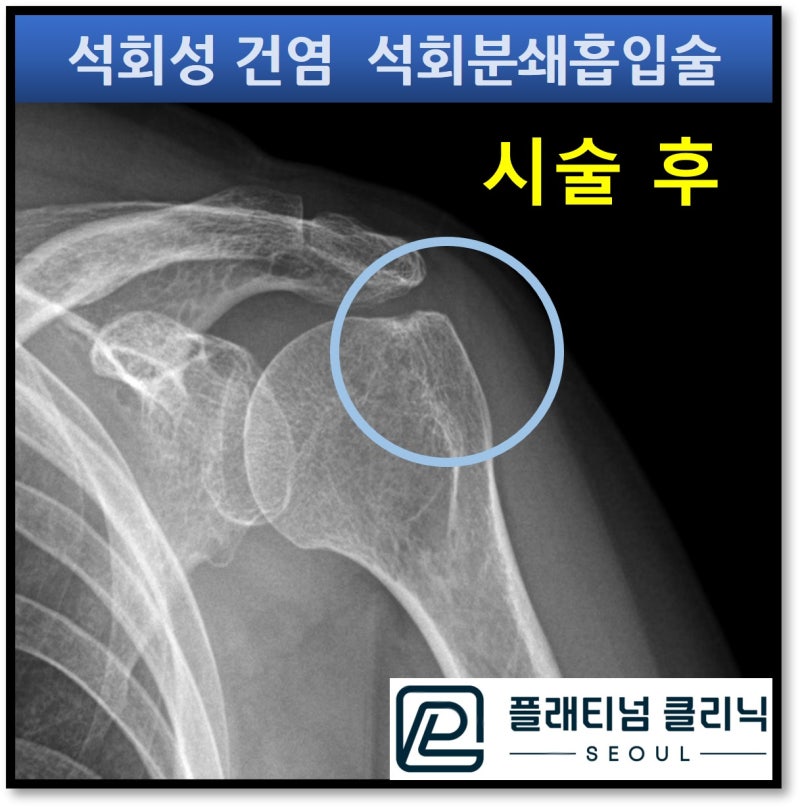
On the post-procedure X-ray, you can see that the previously enormous calcification has disappeared. I also checked the patient's range of motion after the procedure.
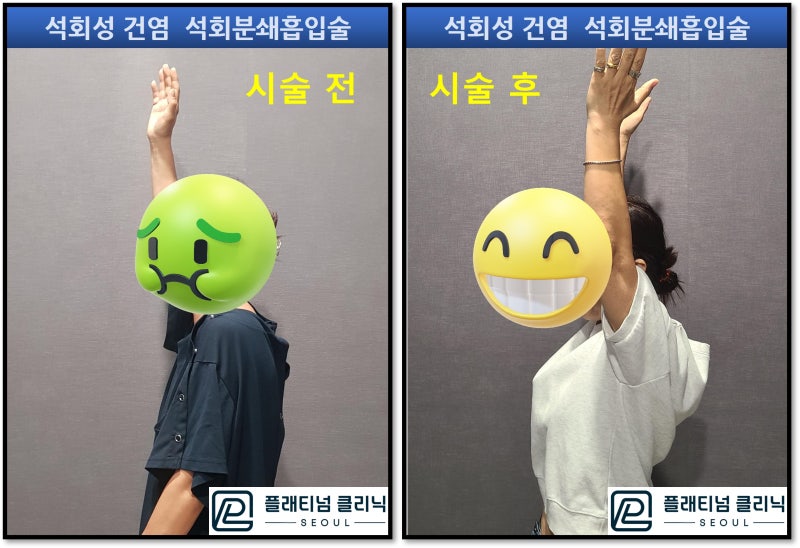
The procedure was performed on the left shoulder. Before the procedure, the patient couldn't even move their arm due to pain, but afterward, they were able to move it naturally and without any discomfort.
Calcification crushing and aspiration, as the name implies, is a procedure that crushes the calcification and aspirates it out, physically removing the calcification itself. Simply breaking the calcification with a syringe and waiting for the body to reabsorb it is an incredibly painful ordeal for patients. Furthermore, there's no telling how long that process might take, and there's no guarantee the calcification will be fully absorbed. The pain caused by calcification is unimaginably severe. From the patient's perspective, the best approach is to remove the calcification as thoroughly as possible. That's why some patients even opt for surgery. The calcification crushing and aspiration procedure I perform is carried out at a near-surgical level, yet it removes the calcification with less damage to the rotator cuff than surgery. The procedure is performed under regional anesthesia, so the patient feels no pain. When needed, sedation is also administered so the patient can simply fall asleep briefly and wake up without anxiety. That's why patient satisfaction after the procedure is exceptionally high. There is no disruption to daily life, only a single day is needed for treatment, and the pain improves dramatically right after the procedure.
Calcification crushing and aspiration. Please make sure you get treated at a hospital that does it properly.