Hello, I'm Dr. Dongkyu Lee, a board-certified orthopedic surgeon. Shoulder calcific tendinitis causes excruciating shoulder pain. Of course, the severity of the pain can vary depending on the stage and characteristics, but most patients who have experienced it say it is far worse than the pain from any other condition. So how should you treat this extremely painful calcific tendinitis? The treatment for calcific tendinitis is to remove the calcification. It's a very simple and straightforward approach. That's why some cases are treated surgically. But what if the calcification could be removed without surgery? Non-surgical removal of calcification offers many advantages over surgery. First, surgery requires hospitalization, which creates a significant time burden. However, the non-surgical procedure can be done on the same day, eliminating this concern. For patients who cannot take time off work for hospitalization, the same-day procedure removes the calcification and resolves the pain right away. Second, surgery involves a procedure similar to rotator cuff repair, which requires wearing a brace for 4 to 6 weeks. This creates significant daily inconvenience, and the rehabilitation period to recover lost muscle strength and function becomes much longer. In contrast, the non-surgical procedure requires no brace, and you can return to your normal daily activities the very next day. Third, surgery causes damage to the rotator cuff, which then requires repair suturing. The non-surgical treatment, however, removes only the calcification without damaging the rotator cuff, helping maintain a healthier tendon. Fourth, the pain from surgery itself can be quite severe and may persist for a long time. The non-surgical treatment only targets the calcification, resulting in far less pain than surgery, and the pain caused by the calcification can be eliminated immediately. Fifth, surgery requires deeper anesthesia, which carries its own risks. The non-surgical procedure takes an average of only 20 to 25 minutes, so lighter anesthesia can be used, minimizing the risk of complications or side effects from anesthesia. So what is this non-surgical procedure that treats shoulder calcific tendinitis? It's called calcification crushing and aspiration. For a detailed explanation of the procedure, please refer to the link below. https://blog.naver.com/9690067/223380095028
🔗 https://blog.naver.com/9690067/223380095028The patient I'm showing you today is a dentist who had been suffering from calcific tendinitis for two years. This dentist runs their own practice, and despite the severe pain from calcific tendinitis, they were unable to cancel patient appointments. So they endured it with medication and injections. (As a fellow practitioner, I deeply empathize with this situation...) Let's take a look at their condition.
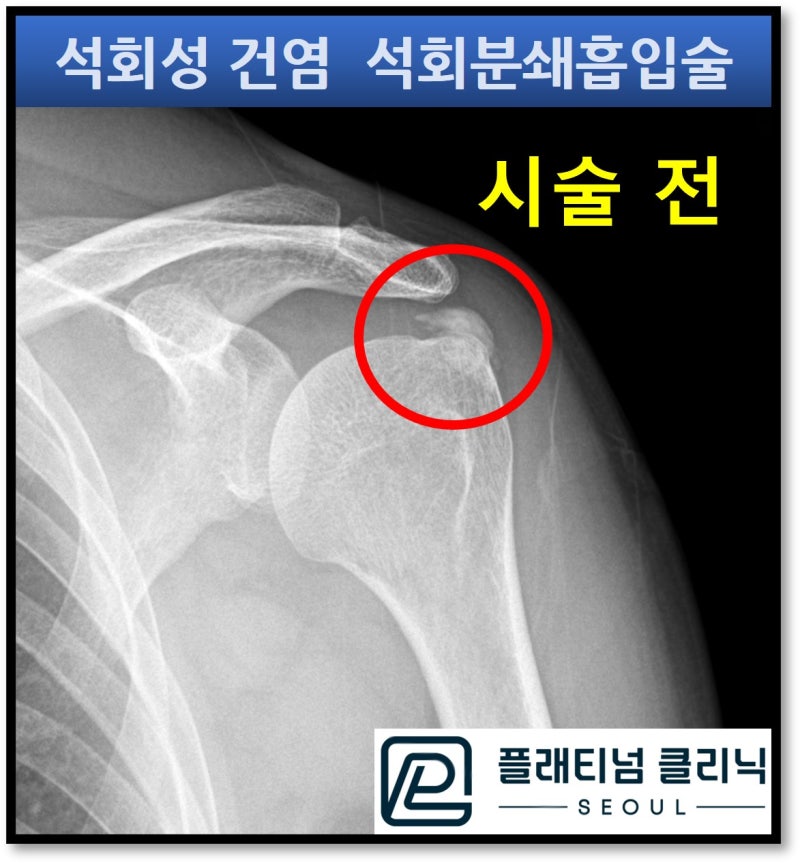
On the X-ray, a large calcification is visible inside the red circle.
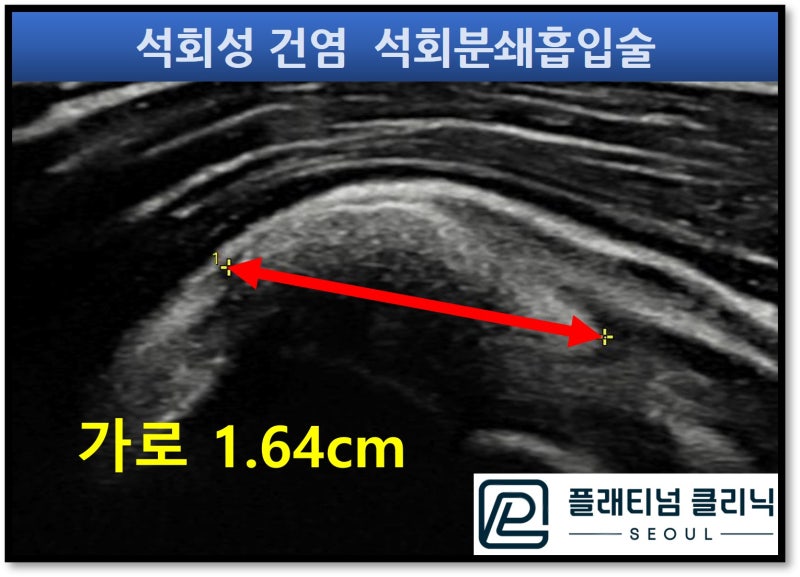
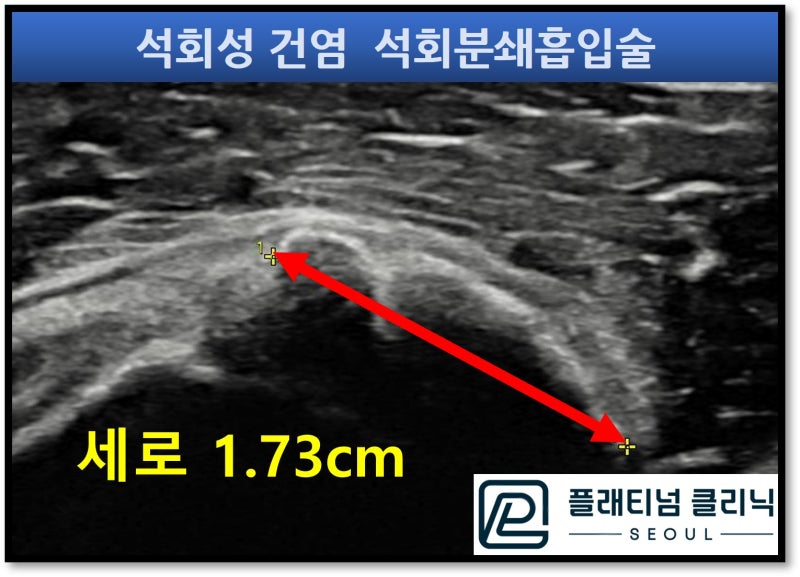
I checked the size and characteristics of the calcification with ultrasound. A large calcification measuring 1.64 x 1.73 cm was observed, showing a somewhat paste-like consistency. The patient asked whether non-surgical treatment was possible and whether they could use their arm the next day, as they had patients to treat. I explained that there might be some post-procedure discomfort, but it should not interfere with clinical work. We then proceeded with the procedure. The calcification was removed through calcification crushing and aspiration.
In the video, you can see crushed calcification particles being extracted through the syringe. The initially clear fluid inside the syringe gradually turns cloudy. The crushed calcification is being removed very effectively.
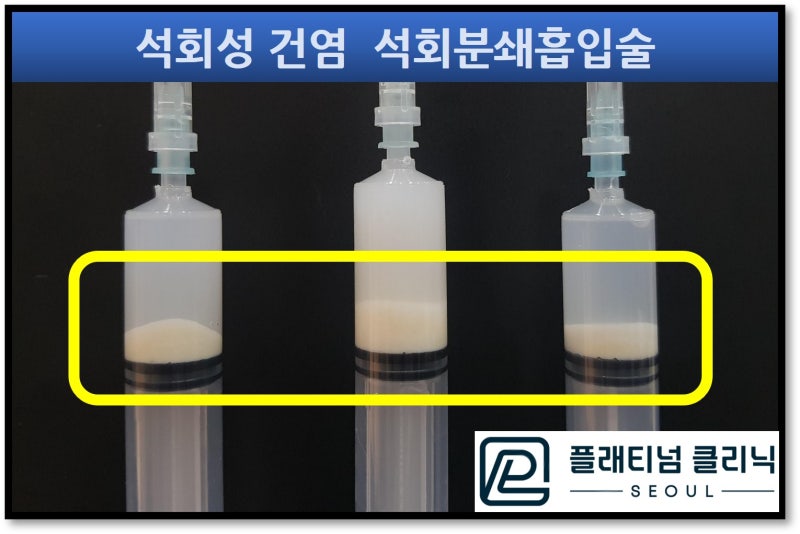
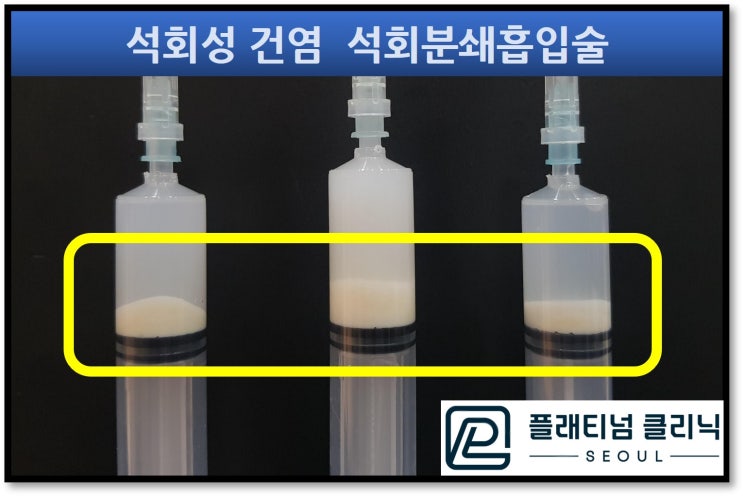
Here is the syringe photo taken after the procedure. The white material settled at the bottom of the syringe is the calcification. An enormous amount — nearly 5 to 6 cc — of calcification was removed.
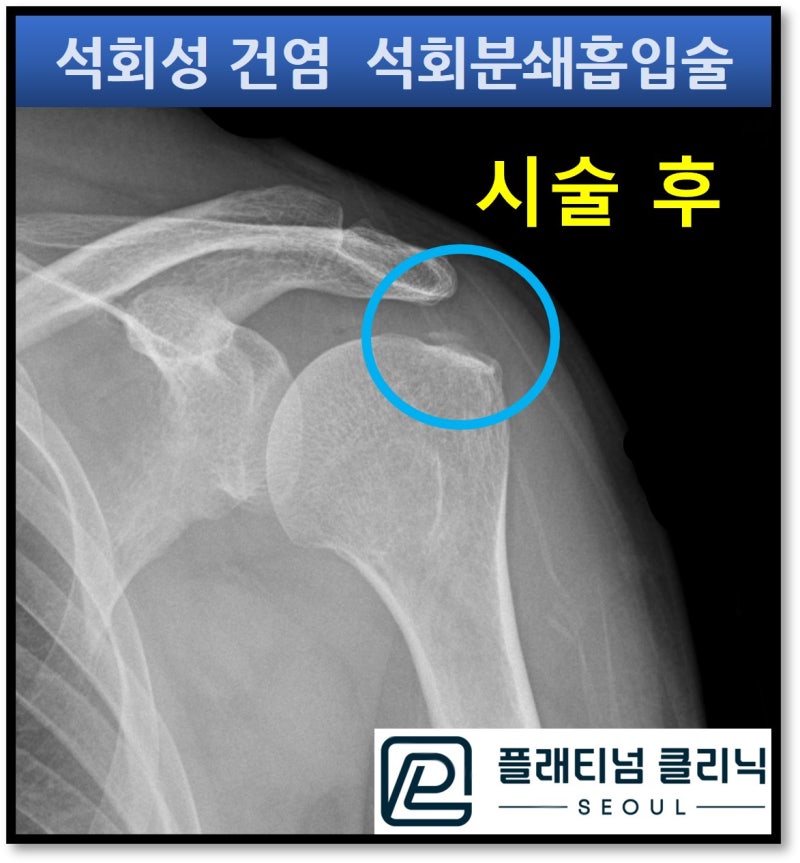
On the post-procedure X-ray, you can see that the large, white calcification visible in the circle has been almost completely removed.
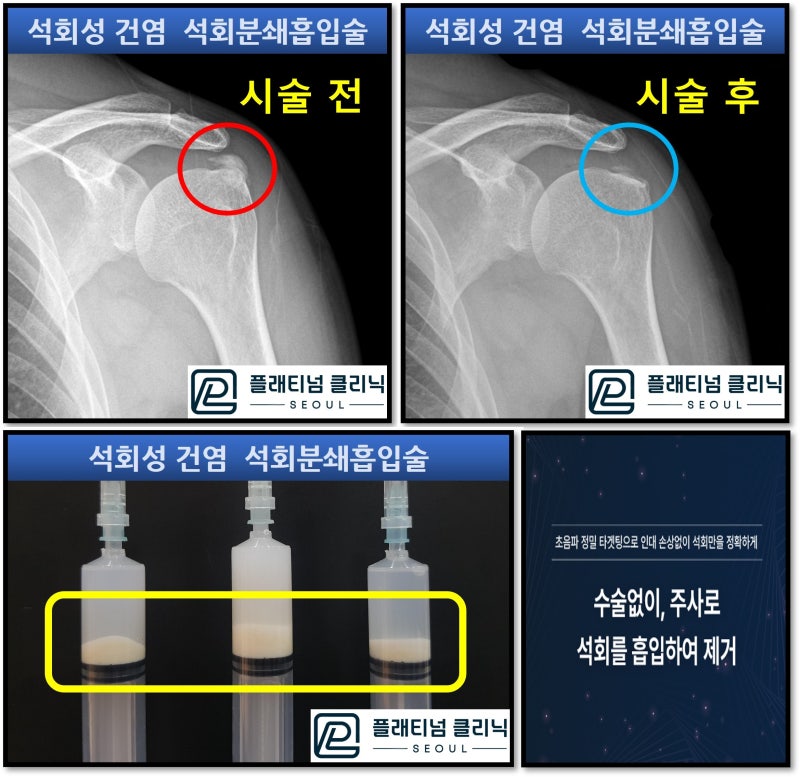
Comparing the before and after images makes it even clearer how well the calcification was removed. At the one-week follow-up, the patient returned and said the pain had disappeared like magic starting the very next day. They had no trouble treating their patients the following day. From time to time, I also treat fellow physicians — neurosurgeons, neurologists, dentists, dermatologists, plastic surgeons, and more. Even doctors are not immune to the pain of calcific tendinitis. It saddens me to see fellow practitioners who, despite being in pain, have to open their clinics and see patients. As someone who runs a clinic myself, I deeply relate to this. Fortunately, I'm glad that when it comes to calcific tendinitis, I can truly make a difference for them.
For severe shoulder pain caused by calcific tendinitis, the non-surgical treatment even doctors choose is calcification crushing and aspiration.