Hello, I'm Dr. Dongkyu Lee, a board-certified orthopedic surgeon. Today, I'm writing with a somewhat frustrated heart. A patient came to see me saying their shoulder pain had persisted for a very long time, and despite years of injections, shockwave therapy, and manual therapy at their regular hospital, nothing had improved. When I asked what diagnosis they had received and what treatments were done, they said they were told there was inflammation in the rotator cuff with some partial damage. They had been receiving tendon-strengthening injections and anti-inflammatory injections continuously. They felt a brief improvement after each injection, but the pain always returned. Now, even the injections no longer helped with the persistent pain. Their range of motion had also become severely limited, making daily life difficult. They were deeply distressed about why the pain persisted despite all the treatment. They came to me pleading — please tell me why I'm in pain, please make the pain go away. On physical examination, there was significant limitation in range of motion, and the empty can test was positive. Suspraspinatus damage was suspected, so I performed an ultrasound examination.
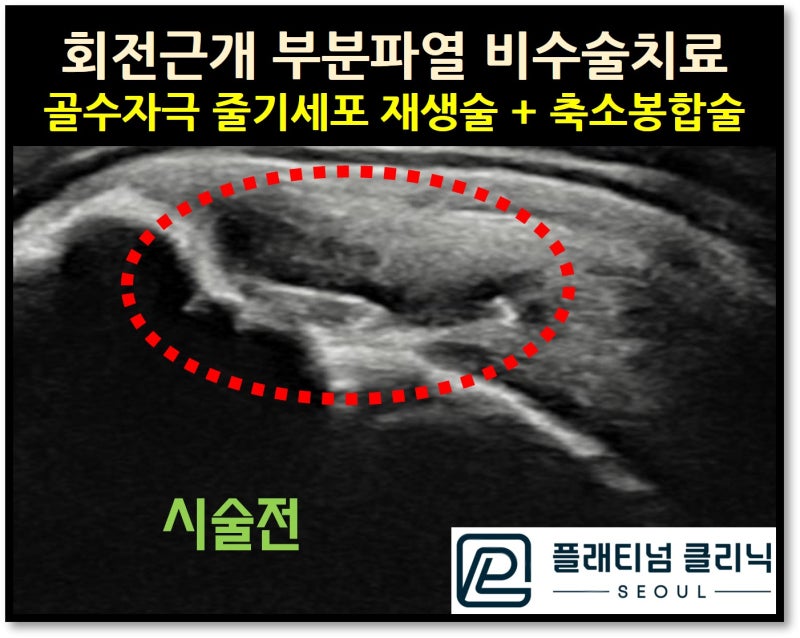
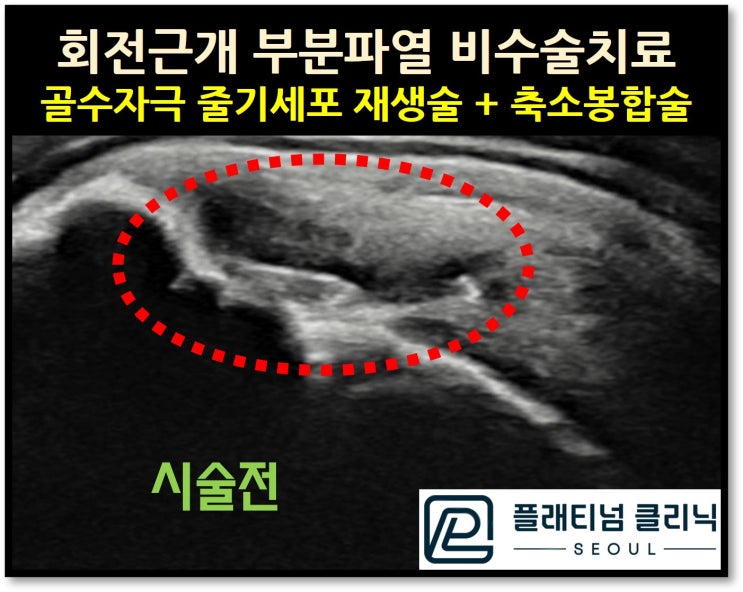
The ultrasound revealed a severe partial tear of the supraspinatus. It was torn so extensively that it was nearly a full-thickness tear, with ragged edges throughout. The injections must have been administered under ultrasound guidance — how could such a tear go unaddressed for years with nothing but injections... Rotator cuff tears are progressive conditions. As I've explained before, tendons connect muscle to bone, so the condition inevitably worsens over time. When initial injection therapy successfully heals the tissue, that's truly the best outcome. But when it doesn't, continuing injections indefinitely not only wastes the patient's time and money, but also allows the tissue to undergo further degenerative changes, worsening the condition and leading to poorer treatment outcomes. Returning to this patient's story. Given the severity of the partial tear and the significant range of motion limitation, I decided on a more invasive treatment approach. For cases where the partial tear is severe or conservative treatments like injections have failed to produce improvement, there is a treatment option available. It's bone marrow stimulation stem cell therapy combined with reduction suture repair. I've explained these in detail in the link below. https://blog.naver.com/9690067/223251719566
🔗 https://blog.naver.com/9690067/223251719566The patient had traveled from outside the city and said they couldn't come back frequently, so they asked if the procedure could be done that day. I adjusted my schedule to make it happen.
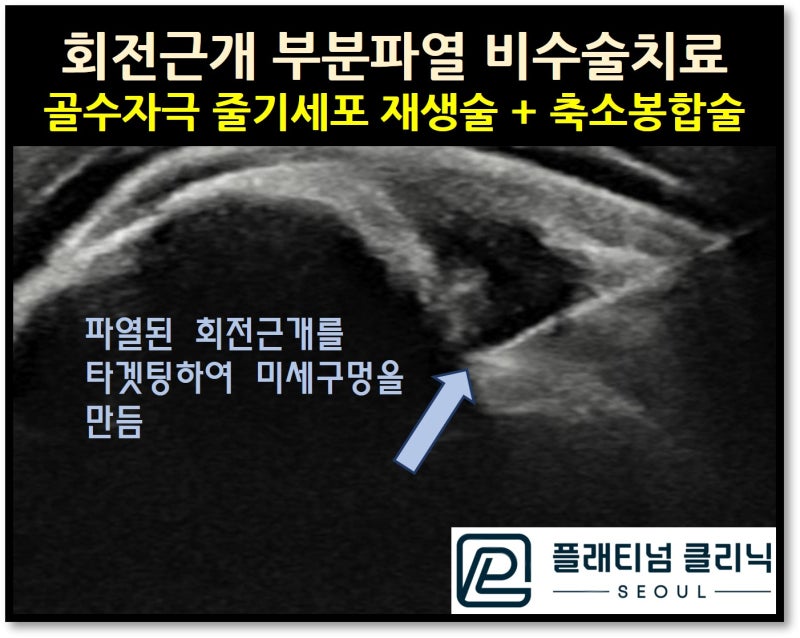
After performing a brachial plexus nerve block and administering sedation to control pain, I proceeded with the procedure. As seen on ultrasound, I precisely targeted the torn rotator cuff and created micro-holes. Through these micro-holes, bone marrow flows out, and the stem cells and healing factors within it work to repair the tissue. In this patient's case, the partial tear was so ragged that reduction suture repair was also performed simultaneously.
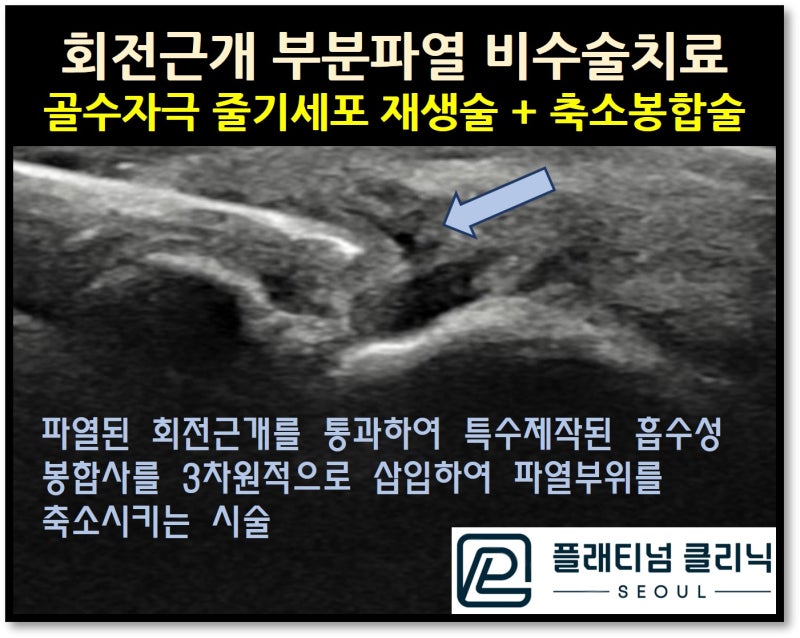
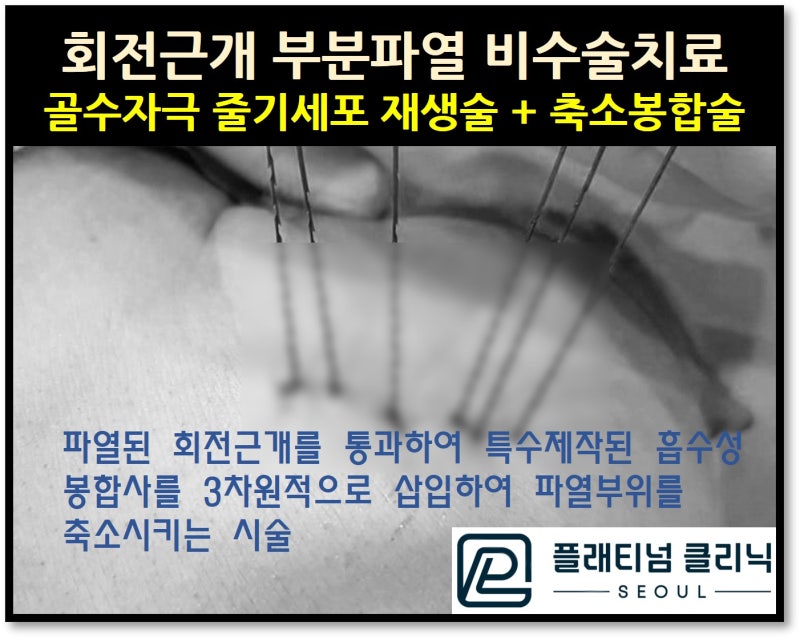
Reduction suture repair is a procedure where a specially designed absorbable suture is threaded three-dimensionally through the torn rotator cuff under ultrasound guidance, reducing the tear size and firmly securing it to prevent further progression of the tear.
Tissue healing takes approximately 3 months, and the patient returned for a follow-up at the 3-month mark. When I asked how they had been doing, they said the pain had gradually improved and was now almost completely gone. Their range of motion had also recovered, and they had absolutely no issues with daily life. After years of suffering, they were thrilled to have recovered in just 3 months. I encouraged them to continue with their rehabilitation exercises to prevent recurrence.
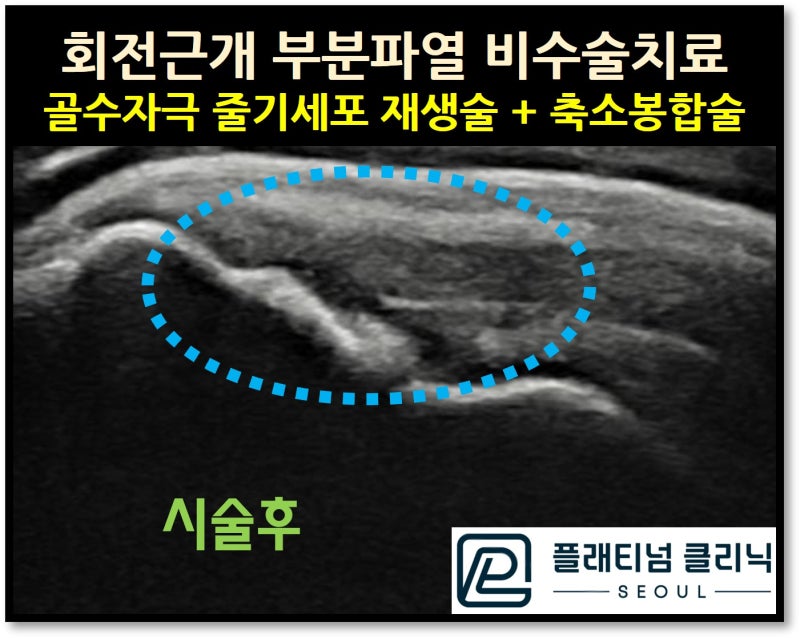
The 3-month follow-up ultrasound showed that the previously ragged torn area had healed nicely. When the patient saw that the dark areas of the tear had filled in with white tissue, they grumbled about having wasted time on ineffective treatments all these years when such a good option existed.
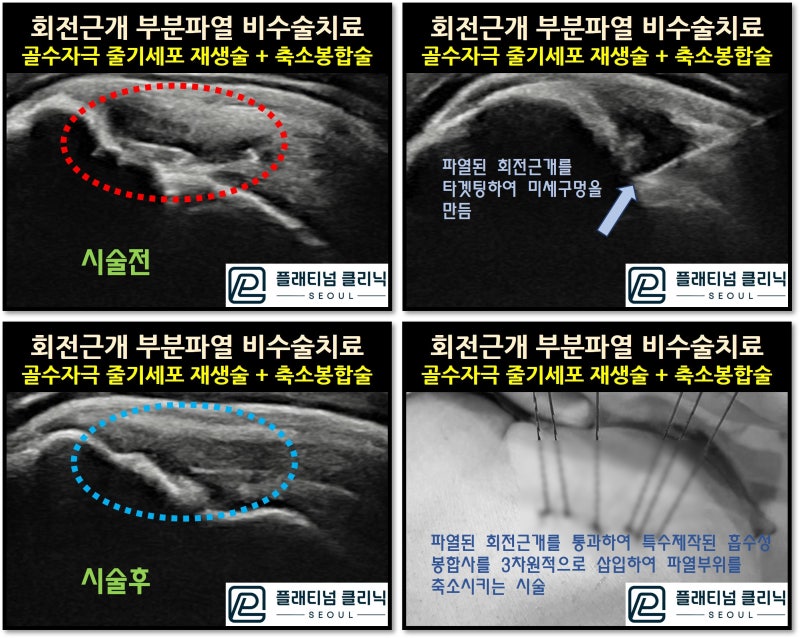
Looking at the overall comparison, you can see how the dark, ragged partial rotator cuff tear before the procedure has been restored to white, healthy tissue after bone marrow stimulation stem cell therapy and reduction suture repair. With rotator cuff conditions, getting an accurate diagnosis first is critical. Sometimes patients come to me not knowing why they're in pain or what their diagnosis is. Others have received different diagnoses from different hospitals and are confused. An accurate diagnosis must come first so a proper treatment plan can be established. If treatment isn't working, you should decisively pursue more aggressive options. If you miss the right window for treatment, what could have been resolved with a small effort may end up requiring a much larger intervention. Fortunately, this patient came to me before their tear progressed to a complete rupture, so we were able to treat it without surgery.
Rotator cuff conditions require an accurate diagnosis first. If treatment isn't improving your condition, you need to pursue more aggressive treatment. Dr. Dongkyu Lee