
Hello, I'm Dr. Dongkyu Lee, a board-certified orthopedic surgeon. So many patients receive one treatment after another for partial rotator cuff tears. Many patients undergo various injection therapies — prolotherapy, regenerative injections, proliferation therapy, DNA injections, and more — for months or even years. When the treatment works and patients return to their normal lives, that's wonderful. But there are quite a few cases where, despite all these treatments, symptoms don't improve and continue to worsen, eventually leading to surgery. Rotator cuff conditions are progressive, meaning that without effective treatment, the tear will continue to grow. Once it progresses to a complete tear, surgery becomes unavoidable. So many of the patients who come to see me have endured years of shoulder pain and countless injection treatments without any improvement, telling me how much they've suffered. Of course, some patients do get better with injection therapy alone. So how long should injection therapy be continued? Let me explain the general guidelines. Proliferation therapy (I'll use this term to refer to all regenerative injection treatments, including prolotherapy) is typically administered once a week for 4 to 6 sessions. All proliferation therapy should be performed under ultrasound guidance to precisely target the damaged area and to monitor tissue healing throughout the treatment process. After completing all injection treatments, approximately 4 weeks of tissue healing time is needed, after which the tissue's healing progress is reassessed. So if you consider 4 to 6 proliferation therapy sessions plus a 4-week healing period, you can assess the results of proliferation therapy in about 2 and a half months. Based on the results: if healing went well, treatment is concluded; if some healing occurred, additional proliferation therapy may be considered; if healing is poor or there's no improvement, then alternative treatments should be explored. Repeated injection therapy without proper assessment can cause you to miss the right treatment window, potentially leading to a situation where surgery becomes necessary. So what should be done when injection therapy has been extensive yet symptoms haven't improved and the partial rotator cuff tear continues to progress? When the tear isn't severe enough for surgery but injections haven't helped and there's a risk of the tear progressing to a complete rupture, a more invasive treatment approach is needed. These are "bone marrow stimulation stem cell therapy" and "reduction suture repair." Bone marrow stimulation stem cell therapy involves precisely targeting the torn rotator cuff under ultrasound guidance and using a specially designed guide and drill to create micro-holes in the bone beneath the damaged area. Bone marrow flows through these micro-holes, releasing large quantities of stem cells, platelets, and growth factors that heal the tissue. Reduction suture repair uses specially designed absorbable sutures to reduce the tear size and prevent the tear from progressing. The specially designed absorbable sutures maintain their strength in the body for 3 months, and when absorbed, they promote collagen formation to aid in tissue healing. All procedures are performed under regional anesthesia (brachial plexus nerve block) targeting only the shoulder area, with optional sedation available for anxious patients. The average procedure time varies depending on the severity and type of condition, but is typically around 25 to 30 minutes. For more details, please refer to the link below. https://blog.naver.com/9690067/223251719566
🔗 https://blog.naver.com/9690067/223251719566One patient traveled from Incheon and had been suffering from shoulder pain for a staggering 8 years. After being told they had a partial rotator cuff injury, they received what they describe as dozens to hundreds of injection treatments. But the symptoms only got progressively worse, reaching a point where daily life had become unbearable. That's when they came to see me. When they arrived, it wasn't just the pain — their range of motion was severely limited, and above all, they were deeply depressed and could no longer sleep due to the pain. After years of suffering, they were exhausted both emotionally and physically. Let me examine their condition.
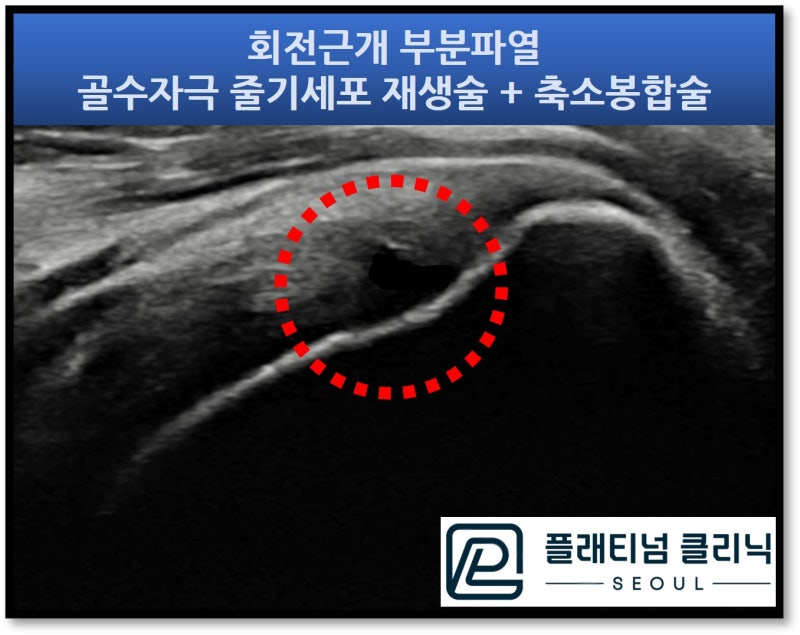
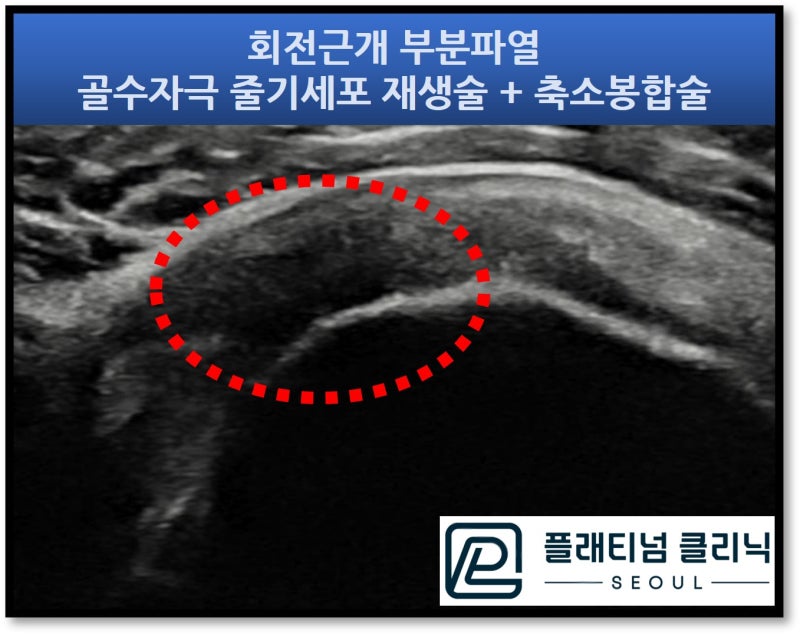
On the ultrasound images, the area inside the red circle — where a healthy rotator cuff should appear white and filled — is generally dark throughout. This indicates that the partial tear has progressed significantly and the rotator cuff is in a ragged, deteriorated state. After such a long period of injection therapy with no further improvement and worsening symptoms, we decided to pursue a more invasive and fundamental treatment approach. We performed bone marrow stimulation stem cell therapy combined with reduction suture repair.
The procedure was performed under ultrasound guidance. As shown in the ultrasound video, bone marrow stimulation stem cell therapy was performed first, followed by reduction suture repair. Additional proliferation therapy was also administered to further support tissue regeneration and healing. A 3-month period of healing and rehabilitation followed the procedure. As I've mentioned before, rehabilitation is extremely important. Even though the structural problem (partial rotator cuff tear) has been addressed, the function and strength of the rotator cuff have not yet fully recovered. Rehabilitation is needed to restore these functional aspects to achieve a truly complete recovery. A follow-up ultrasound examination was performed 3 months after the procedure.
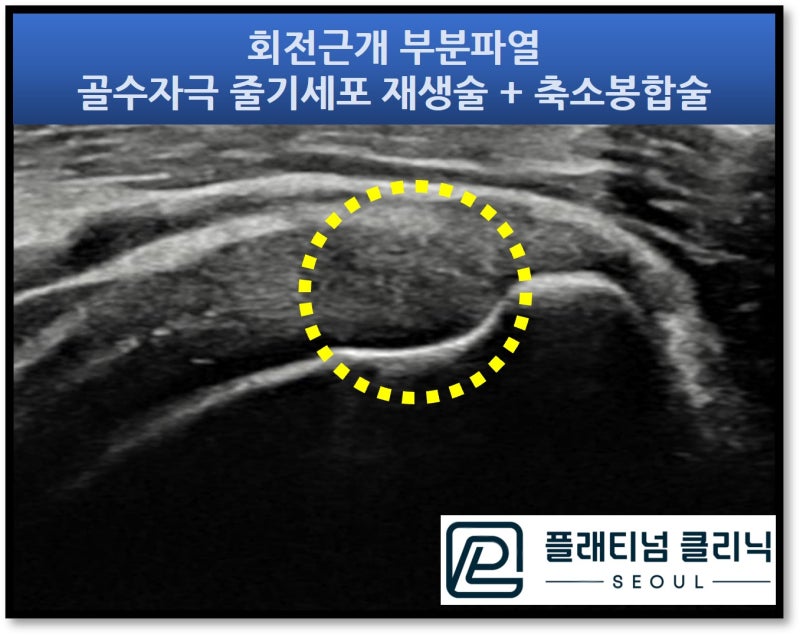
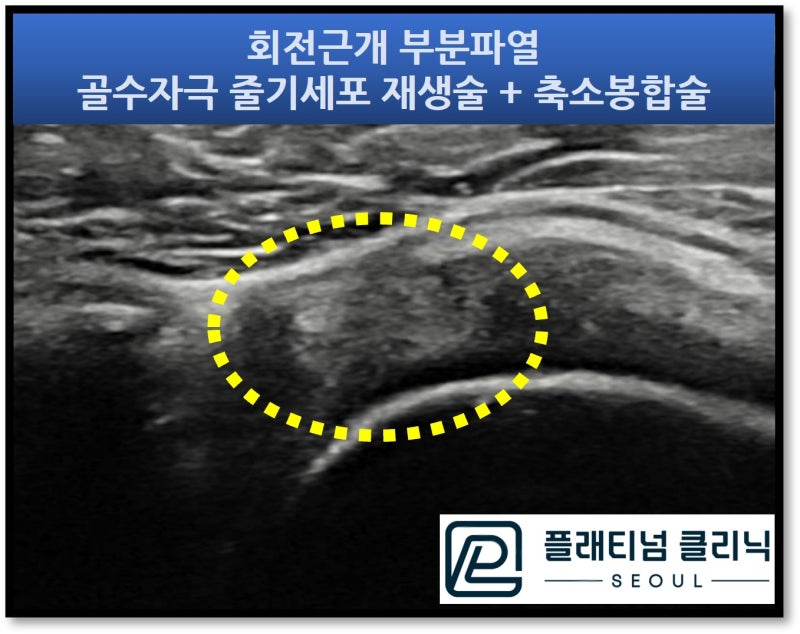
The area that previously appeared dark within the red circle now shows regenerated rotator cuff tissue that has turned white within the yellow circle at the 3-month follow-up.
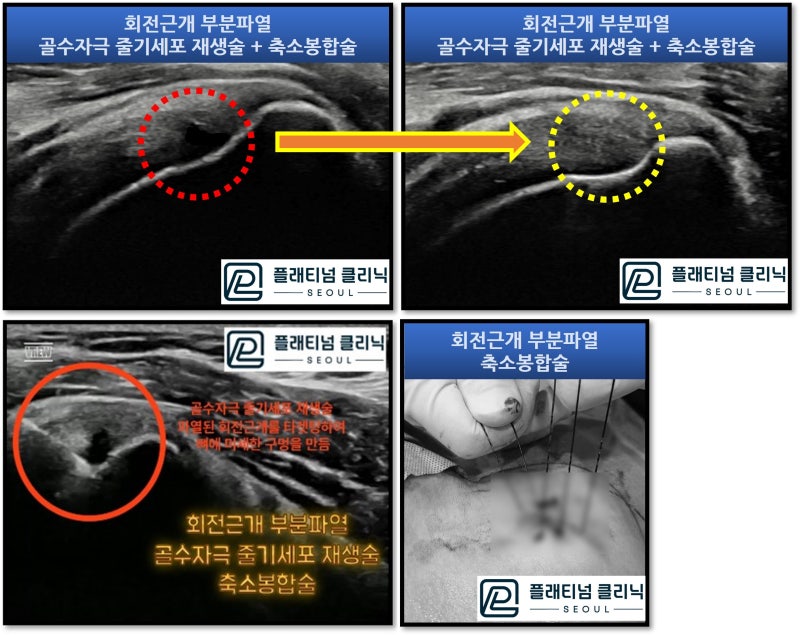
The side-by-side comparison makes the healing of the rotator cuff even more clearly evident. The patient said they had some pain right after the procedure, but symptoms gradually improved. From about one month later, they were able to do their rehabilitation with almost no pain at all. I told them they no longer needed to come to the hospital — they had officially graduated! The patient was absolutely delighted.
Treating partial rotator cuff tears is challenging. The right treatment at the right time is essential. Don't keep clinging only to injection therapy. Pursue a more fundamental treatment approach. Bone Marrow Stimulation Stem Cell Therapy Reduction Suture Repair Dr. Dongkyu Lee