Hello, I'm Dr. Dongkyu Lee, an orthopedic specialist. Partial rotator cuff tears — they can be truly difficult to treat. Surgery may seem like too much, yet injection therapy alone often falls short. The rotator cuff is a tendon — the tissue that connects muscle to bone. That's why leaving a rotator cuff tear untreated allows the tear to progressively worsen over time. If a partial tear isn't properly treated, it can eventually progress into a full-thickness tear requiring surgery. The first line of treatment for partial tears is typically injection therapy. This involves using agents designed to promote tissue healing, such as proliferation therapy (prolotherapy). While it would be wonderful if these treatments always healed the tissue, the reality is that rotator cuff tendons often resist healing due to their inherent nature. So what can be done when the tear is too small for surgery but injection therapy alone isn't working? Let me introduce a procedure that can help in these situations. It's called bone marrow stimulation stem cell regeneration combined with reduction suture. Please refer to the link below for more detailed information. https://blog.naver.com/9690067/223251719566
🔗 https://blog.naver.com/9690067/223251719566Now, let me show you a case. This patient is a male in his 30s who developed shoulder pain during exercise and had been treated at another hospital. He was diagnosed with a partial rotator cuff tear and received dozens of injection treatments over more than two years, but the tear never healed and his pain only worsened — which is when he came to see me. Let's take a look at his condition.
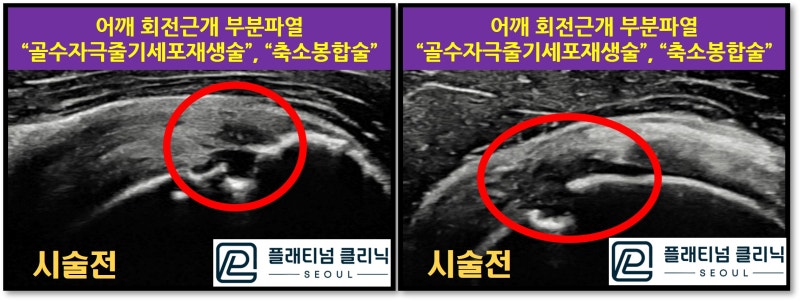
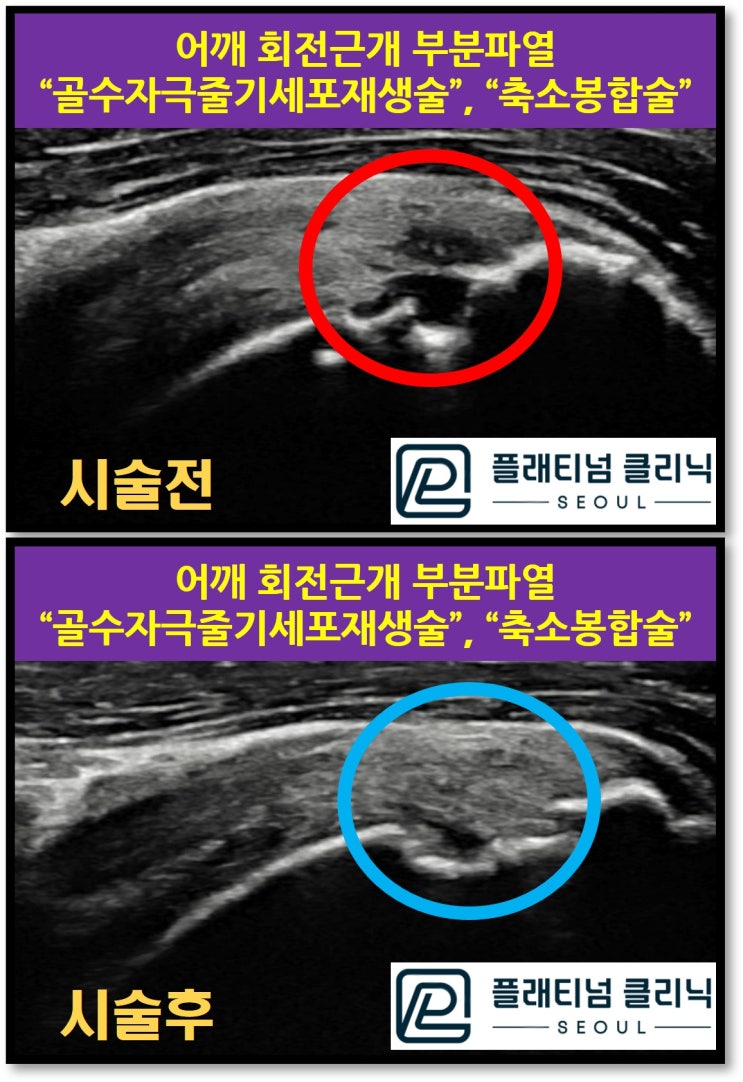
On ultrasound, the dark area within the red circle shows where the rotator cuff has partially torn. You can see that the tear has progressed to the point where even the continuity of the bone surface has been compromised. Although it was a partial tear, the appearance was concerning. Considering that prolonged injection therapy had failed to produce improvement, I performed bone marrow stimulation stem cell regeneration combined with reduction suture.
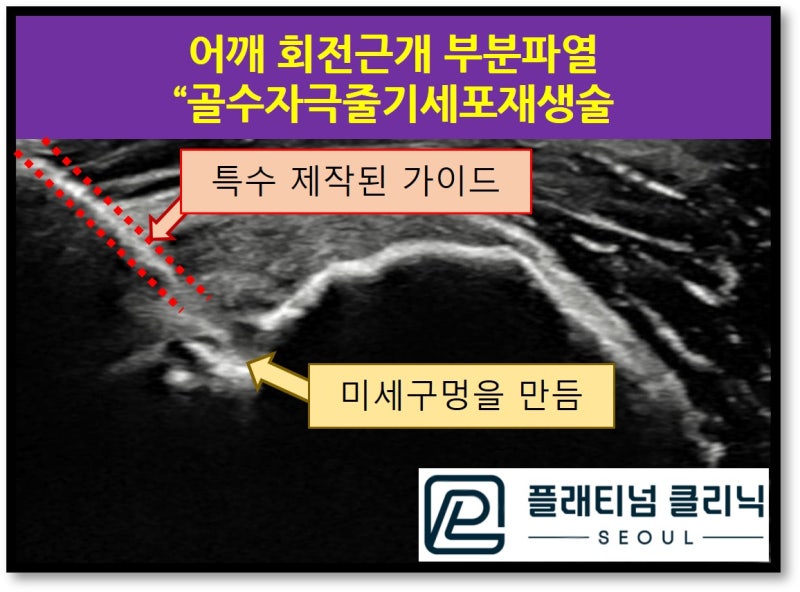
Bone marrow stimulation stem cell regeneration involves precisely targeting the torn area of the rotator cuff with a specially designed guide, then creating tiny holes in the bone. When multiple micro-holes are made in the area, bone marrow flows out through these holes, releasing a rich concentration of stem cells, platelets, growth factors, and other healing agents that promote tissue repair.
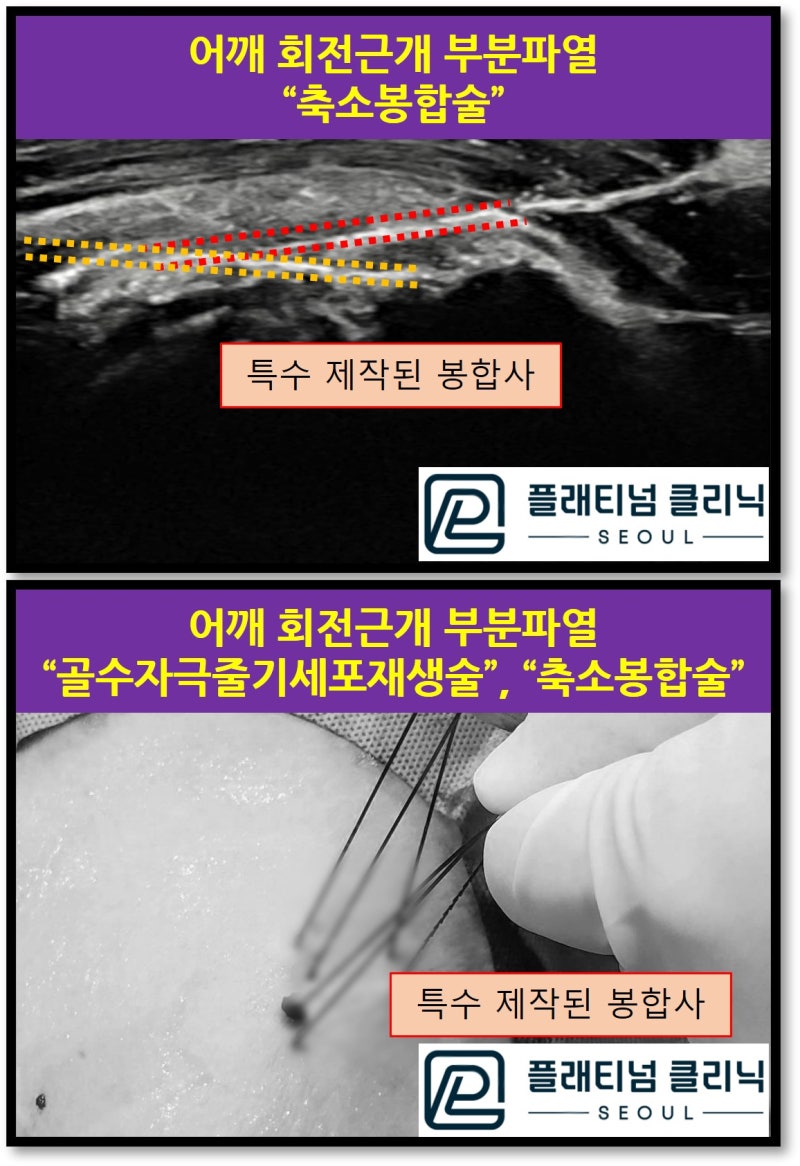
The reduction suture technique uses a specially designed absorbable suture that is threaded through the torn area and secured in place. When tension is applied, it reduces the size of the tear and prevents further progression. Additionally, by combining an intra-tendon suture technique with a bone tunnel technique — where the suture passes through the bone and connects to the tendon — we can achieve a more secure and stable reduction of the torn rotator cuff. This technique was developed by me and has shown excellent results in many patients. Tissue healing takes approximately three months. We performed an ultrasound examination three months after the procedure.
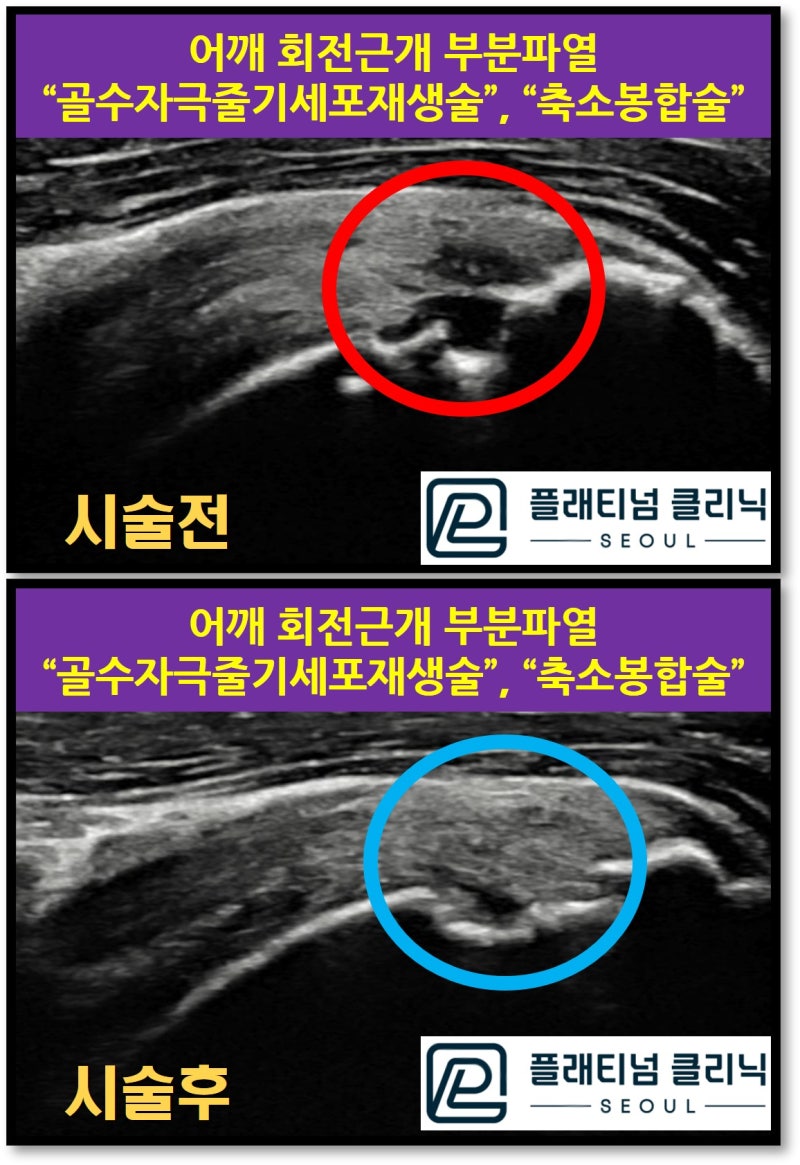
Comparing the before and after ultrasound images, you can see that the dark space within the red circle has turned white in the blue circle — indicating that the tendon has regenerated.
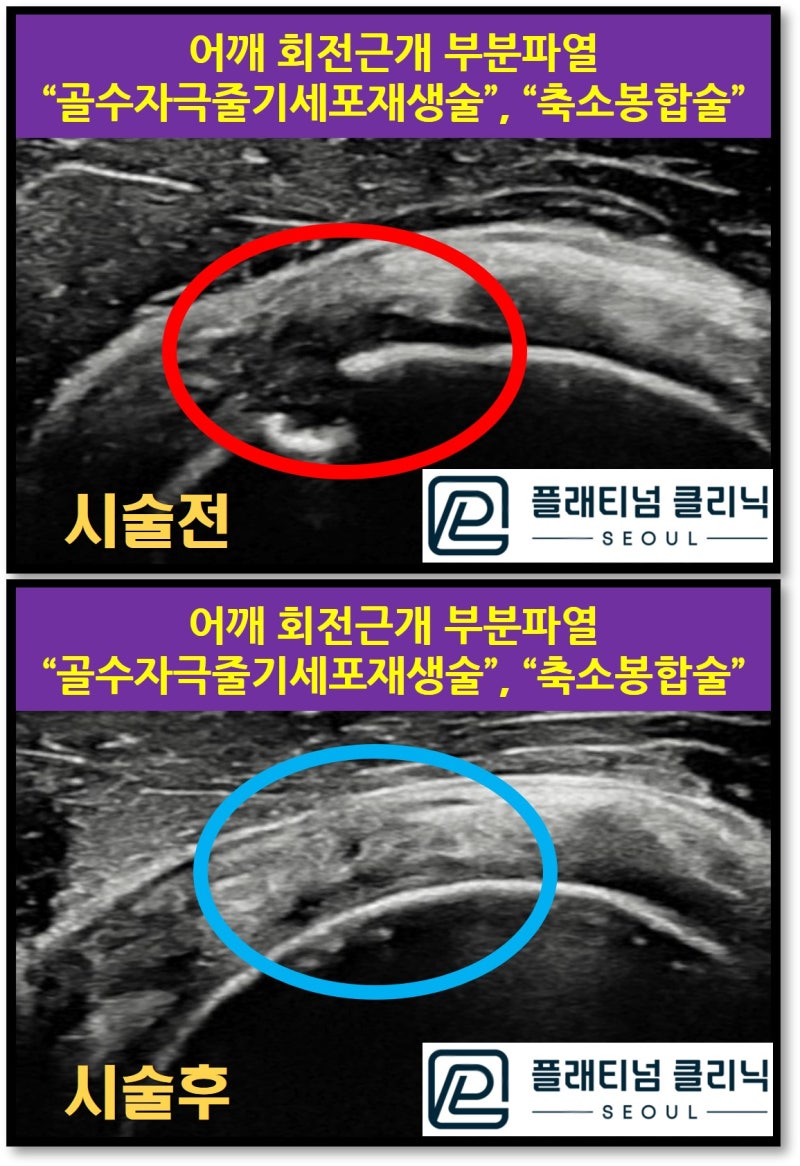
Ultrasound images taken from a different angle also show that the dark torn area within the red circle has turned white within the blue circle, with the bone surface continuity restored as well. The patient continued rehabilitation diligently for six months after the procedure and has now returned to his previous exercise routine, doing very well.
When a partial rotator cuff tear isn't responding to other treatments, bone marrow stimulation stem cell regeneration and reduction suture can be an excellent treatment option. Dr. Dongkyu Lee