Hello, I'm Dr. Dongkyu Lee, an orthopedic specialist. Many people inquire about calcific deposit crushing and aspiration, the non-surgical treatment for calcific tendinitis. For detailed information, please refer to the link below. https://blog.naver.com/9690067/223214782578
🔗 https://blog.naver.com/9690067/223214782578Calcific deposit crushing and aspiration is not surgery. It is a non-surgical procedure that treats calcific tendinitis. I once had a patient who was battling end-stage renal failure and also developed calcific tendinitis, causing tremendous pain. When she went to a university hospital for treatment, they told her she needed surgery, but due to her medical condition, neither anesthesia nor surgery was possible. After extensive searching, she found her way to me. I performed the calcific deposit crushing and aspiration procedure for her, and the pain relief was truly dramatic. She expressed deep gratitude, saying that she had been told her body couldn't handle surgery, yet here she was — pain-free and her calcific tendinitis resolved without any surgical intervention. Calcific deposit crushing and aspiration is performed under simple regional anesthesia, so there's no need to worry about anesthesia-related side effects. Also, since it's not surgery, there's no risk of bleeding or surgical complications. Only a guide (about the size of a syringe) needs to be inserted to crush and aspirate the calcium, so there's no wound left behind. The case I'd like to share today also involves a patient who was in very poor health due to an underlying condition. Due to her illness, she had very limited mobility and poor overall condition, so surgery was completely out of the question. She had been diagnosed with calcific tendinitis and had only been receiving injection therapy and shockwave treatment for years. However, her symptoms kept worsening — the pain intensified, and combined with other factors, she was struggling immensely. She came to me asking to at least resolve the pain. Let's take a look at her condition.
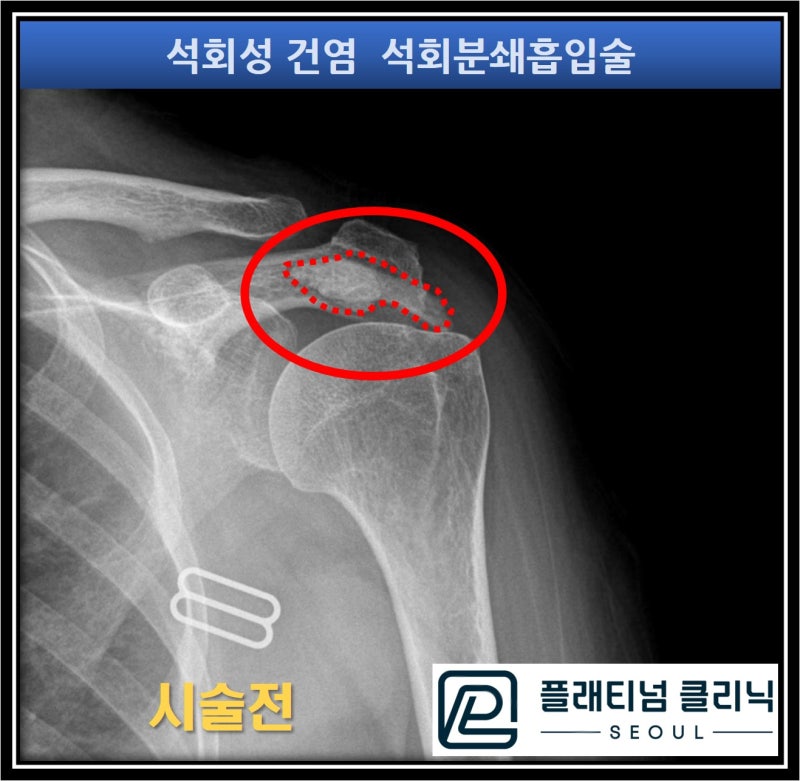
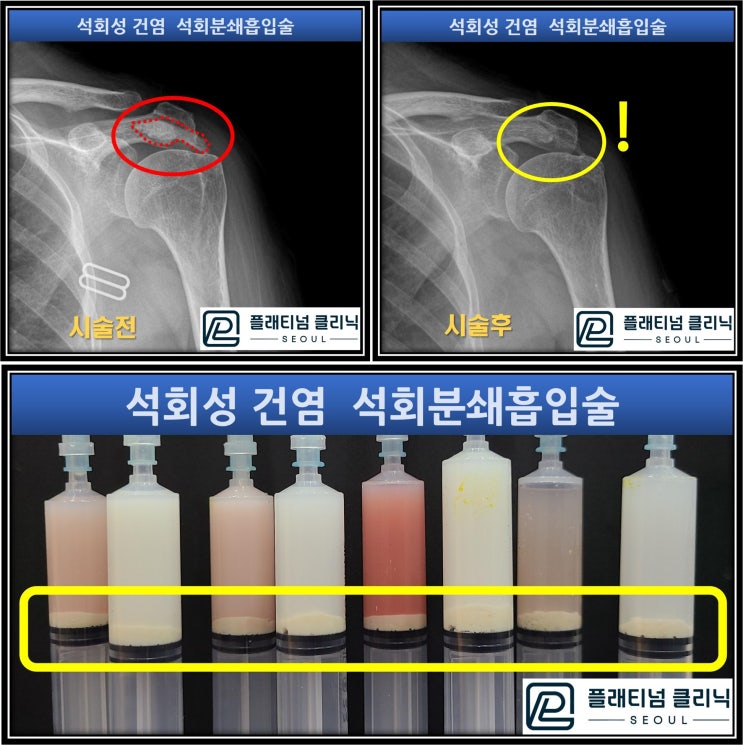
On the X-ray, the area within the red circle outlined by the red dotted line shows where the calcium deposit is located. An enormously large deposit is visible, and she had been told at her previous hospital that surgery was necessary. Since I fundamentally believe that calcific tendinitis can be treated without surgery, I performed the calcific deposit crushing and aspiration procedure.
As you can see in the video, the initially clear fluid inside the syringe gradually turns whiter with each cycle of crushing and aspiration — eventually resembling milk. Given the enormous amount of calcium, the procedure was repeated multiple times.
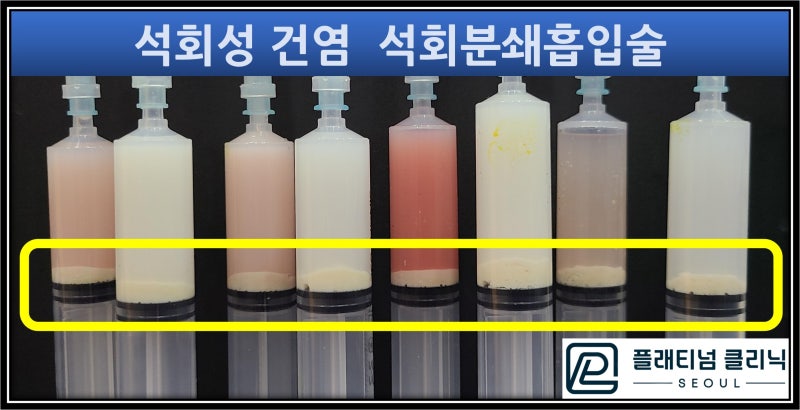
Looking at the post-procedure syringe photo, you can see an enormous amount of calcium settled at the bottom of the syringe, within the yellow outline. Now let's look at the post-procedure X-ray.
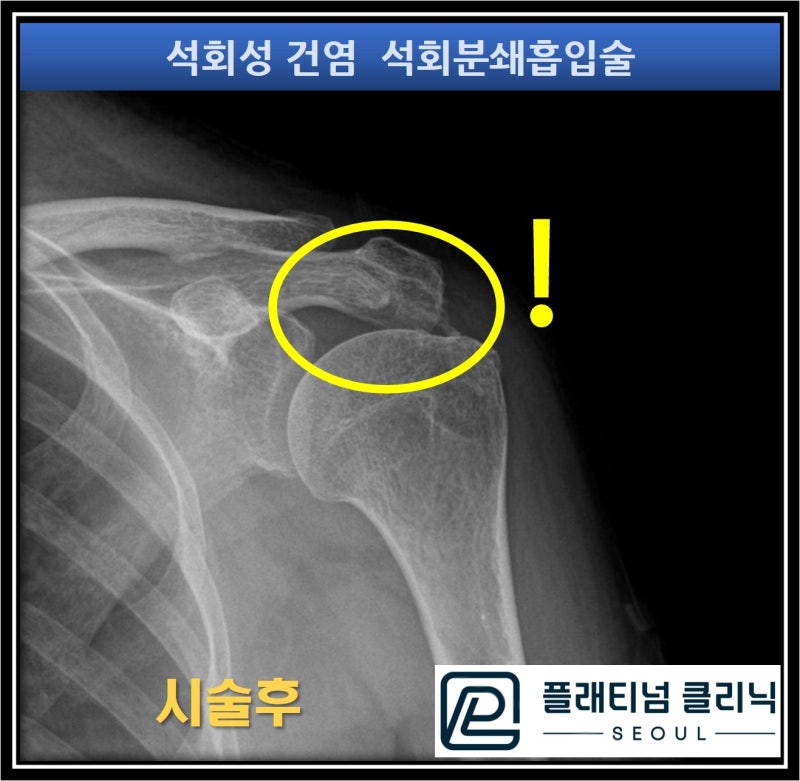
The massive calcium deposit visible before the procedure has been almost completely aspirated. Let's compare the images side by side once more.
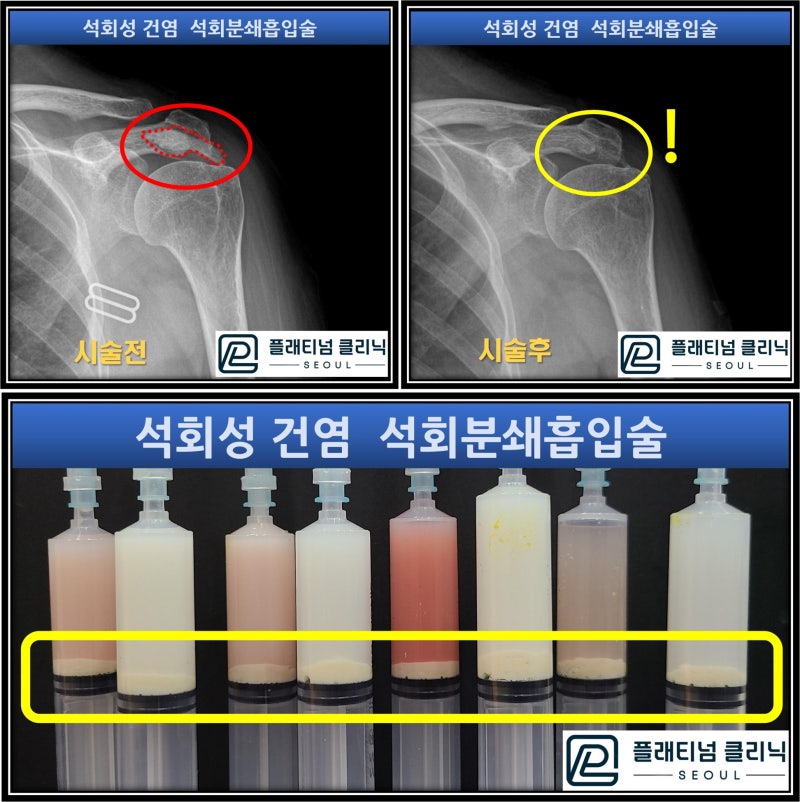
Comparing the before and after X-ray images, the removal of the calcium deposit is strikingly clear. Calcium deposits cannot be removed 100% completely. Since calcium is densely embedded within the tissue, attempting to remove every last bit could damage healthy tissue. That's why we focus on crushing and aspirating only the interior of the deposit as thoroughly as possible. The small amount of remaining calcium can be effectively absorbed through extracorporeal shockwave therapy after the procedure. When the patient returned to the clinic a few days later, she said that for the first time in a long while, she was able to sleep well without being kept awake by pain — and she was deeply grateful. Moments like these bring me such joy and fulfillment.
Calcific deposit crushing and aspiration is not surgery. It is a non-surgical procedure that treats calcific tendinitis. Dr. Dongkyu Lee