Hello, I'm Dr. Dongkyu Lee, an orthopedic specialist. Rotator cuff tear — can it be treated without surgery? To give you the answer upfront: it depends on the nature and size of the tear. If a full-thickness (complete) tear has occurred, non-surgical treatment cannot fundamentally repair the torn rotator cuff. In such cases, surgical treatment is necessary. But what about a partial tear — one that hasn't torn all the way through? For partial tears, there are several non-surgical treatment options available. Injection therapies (proliferation therapy, prolotherapy, DNA injections, collagen injections, etc.) can be effective when the tear is very small or minimal. Rehabilitation to strengthen the rotator cuff and surrounding tissues and restore function is also a very important part of treatment. But what if the rotator cuff tear isn't healing despite these injections and continues to worsen? Should you have surgery? Or should you try more injections? A partial tear that's too small for surgery, yet too stubborn for injections alone — this is truly a challenging situation for both patients and doctors alike. Let me introduce an effective non-surgical treatment for exactly these cases. It's called bone marrow stimulation stem cell regeneration combined with reduction suture. Please refer to the link below for more details. https://blog.naver.com/9690067/223251719566
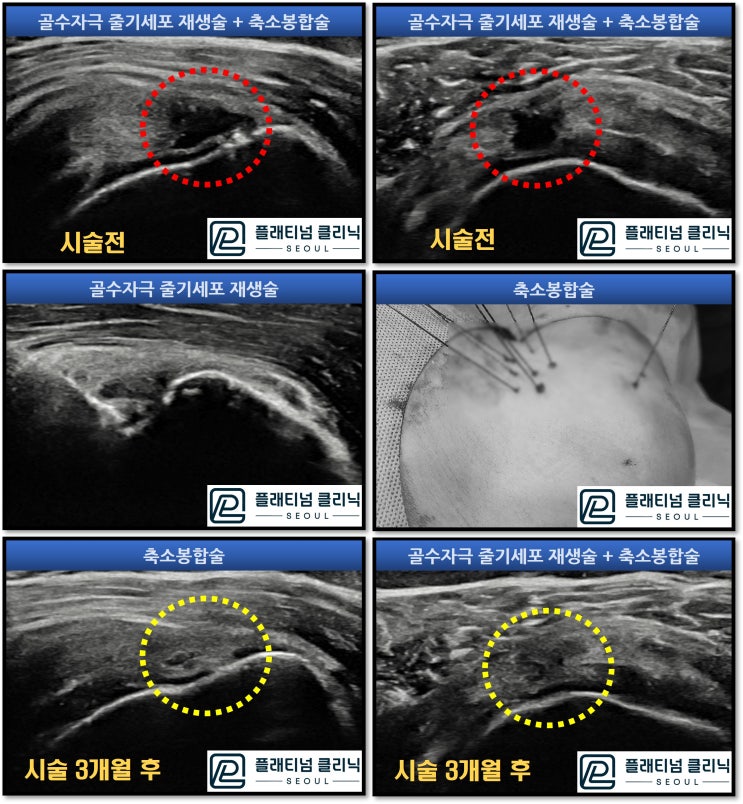
🔗 https://blog.naver.com/9690067/223251719566Let me show you a case. This patient is a woman in her late 40s who had been diagnosed with a partial rotator cuff tear and received dozens of injection treatments over approximately two years. Despite all that treatment, her symptoms kept worsening — her shoulder became more restricted in movement and her pain intensified. That's when she came to see me. Her previous doctor had told her that surgery was now necessary. On physical examination, the Empty Can Test (a test for supraspinatus injury) showed clearly positive findings, and her range of motion was significantly limited. I checked her condition with ultrasound.
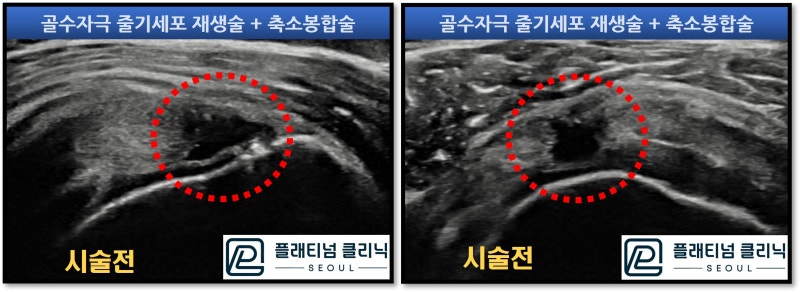
On the left ultrasound image, taken along the length of the supraspinatus, the dark void within the red circle represents the torn rotator cuff. The right ultrasound image shows the cross-section, where the same dark void is visible. The tear measured 0.55 cm and was very close to a full-thickness (complete) tear. I performed bone marrow stimulation stem cell regeneration combined with reduction suture.
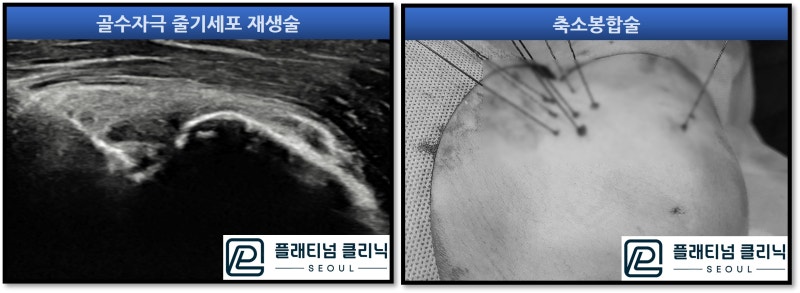
The procedure is performed under a brachial plexus block (regional anesthesia — an injection at the neck to numb only the shoulder area). Using real-time ultrasound guidance to precisely target the location, a special guide is inserted. Then, a specially designed drill creates micro-holes in the bone (bone marrow stimulation stem cell regeneration). Next, a specially designed absorbable suture (which dissolves in the body over time) is used to reduce and close the torn rotator cuff (reduction suture). Additionally, polynucleotide and collagen agents that promote tendon healing are injected to effectively accelerate tissue repair. Tissue healing takes approximately three months, during which consistent rehabilitation is performed to improve function. A follow-up ultrasound was performed three months later.
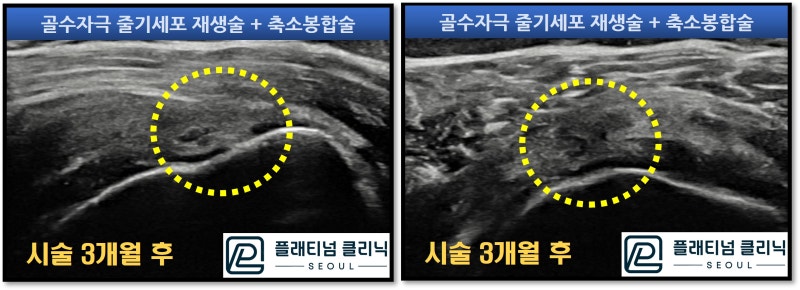
The area that previously appeared dark and void has now recovered to its normal tendon appearance.
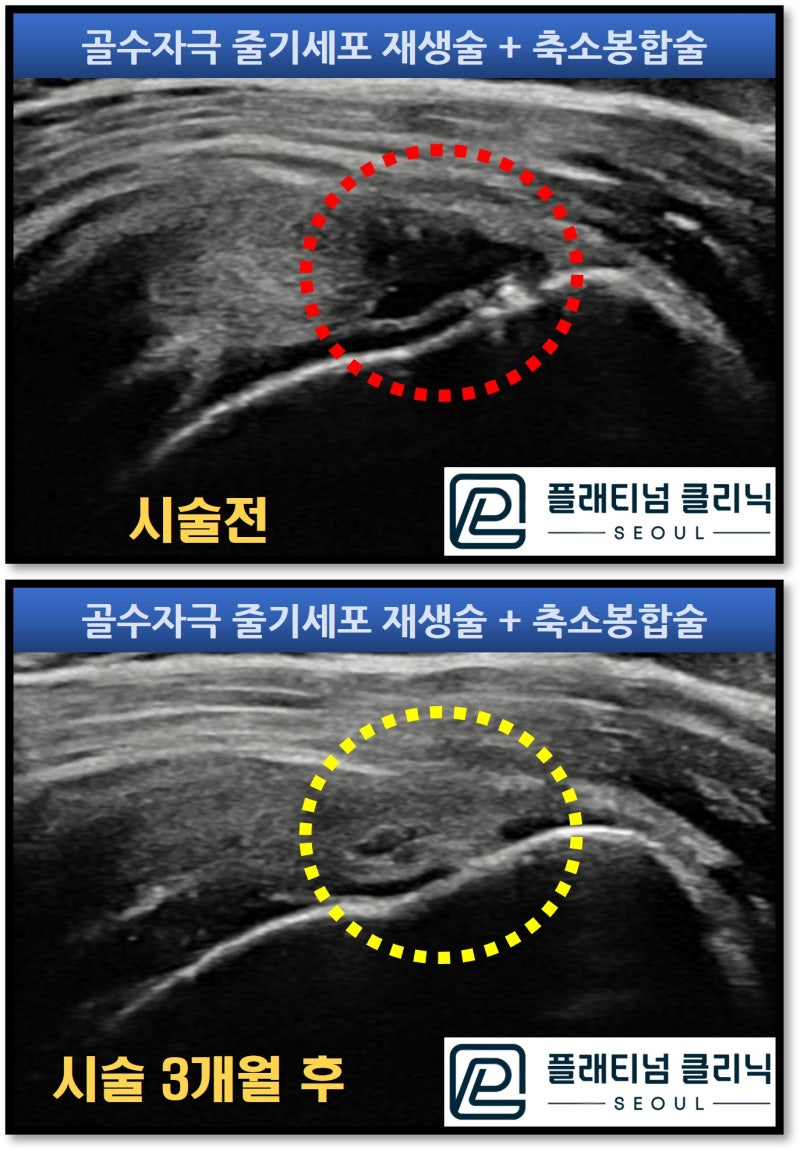
Comparing the before and after ultrasound images makes the improvement even more apparent. Let's also look at the cross-sectional ultrasound view.
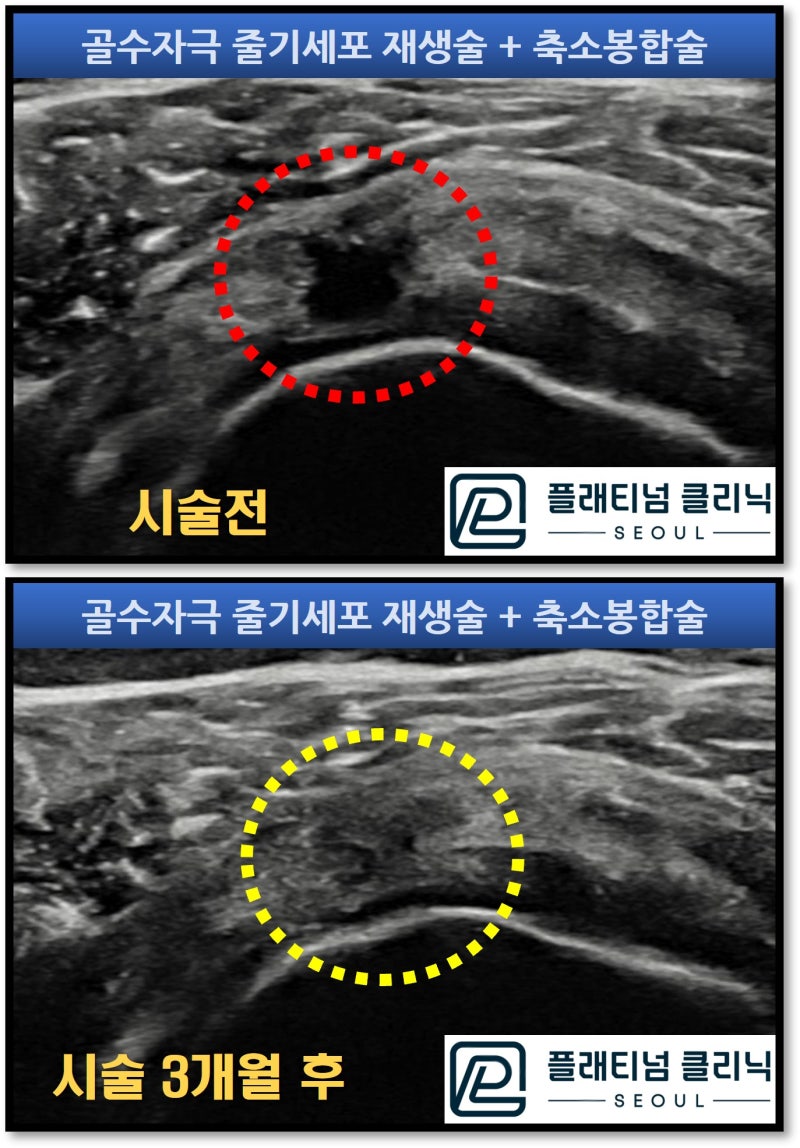
Here too, the previously dark torn area of the rotator cuff has healed into normal tendon tissue.
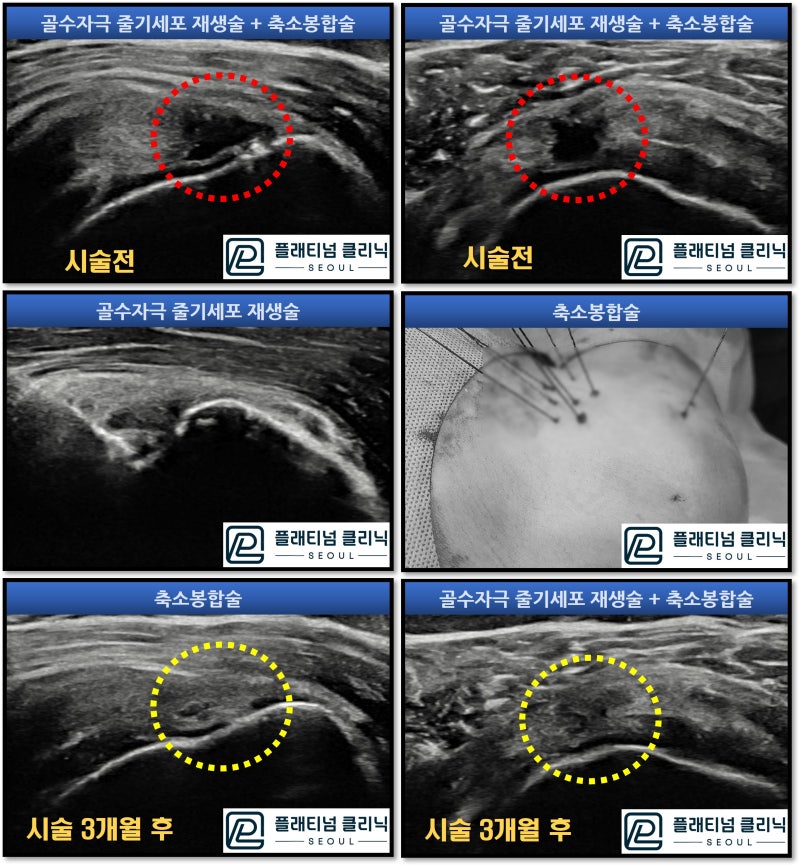
The patient was very pleased that within just three months, her pain had resolved and her range of motion had recovered. She was also amazed to see the healed tear on the ultrasound images. This procedure requires not only precise ultrasound manipulation but is performed through tiny openings (about the size of a needle hole), so it can only be performed by a highly experienced physician.
If you have a partial rotator cuff tear that hasn't improved despite extensive injection therapy, please consider these treatment options. Dr. Dongkyu Lee