
Hello, I'm Dr. Dongkyu Lee, an orthopedic specialist. Previously, I showed you a case involving the removal of a thick, toothpaste-like calcium deposit. https://blog.naver.com/9690067/223214782578
🔗 https://blog.naver.com/9690067/223214782578Today, let's look at how we treat hard calcium deposits. Calcium deposits exist in various forms, ranging from hard to thick and viscous, depending on their stage. When calcium deposits are hard and large, shockwave therapy often fails to break them down, no matter how many sessions are performed. Patients with these hard deposits typically start with pain-relief injections and extracorporeal shockwave therapy. Many of you may have experienced this firsthand — no matter how much shockwave therapy you receive, very hard deposits simply don't respond in most cases. And once the effect of the pain injection wears off, the calcific tendinitis pain returns. This cycle of treatment and recurrence can be extremely exhausting for patients. The case I'd like to present today involves a patient with a large, hard calcium deposit who had been receiving injections and shockwave therapy for years, enduring repeated flare-ups and severe pain. The patient said she had tried every treatment except surgery. The recurring episodes of excruciating pain, progressively decreasing range of motion, and drastically reduced quality of life were making her life truly miserable. Let's take a look at her condition.
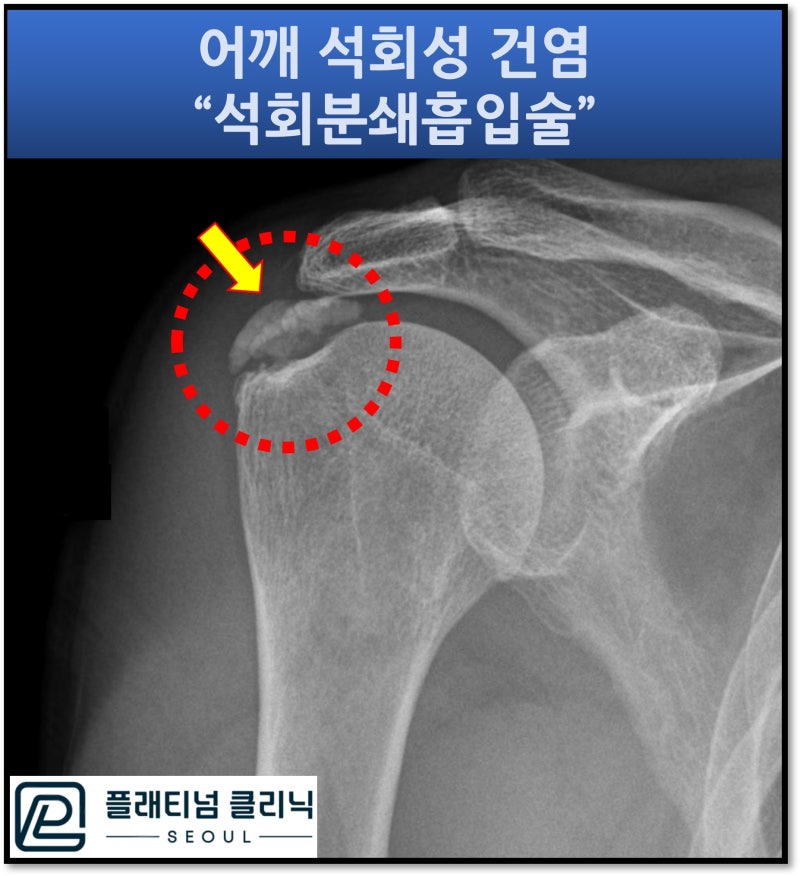
On the X-ray, a large white calcium deposit is visible within the red circle. Since the fundamental treatment is removing the calcium, I performed calcific deposit crushing and aspiration.
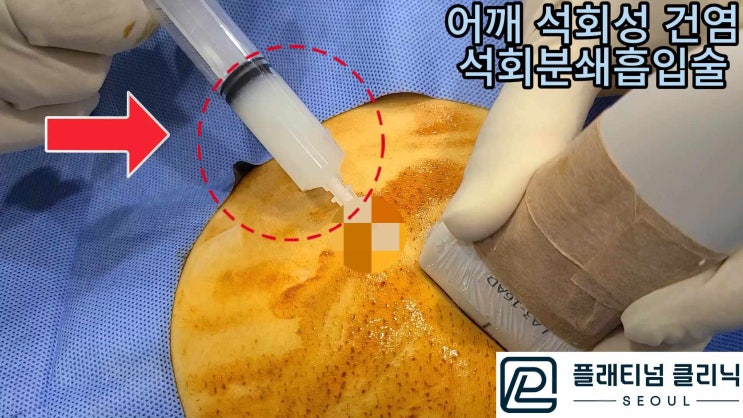
For hard deposits like this, simple aspiration is not possible. A specially designed guide and drill are used to first crush the hard calcium. Then, as shown in the video, sterile saline is repeatedly injected and withdrawn in a flushing motion to remove the crushed calcium fragments. In the video, you can see that the initially crystal-clear saline gradually becomes cloudier, eventually turning white like milk — that's the crushed calcium being drawn into the syringe.
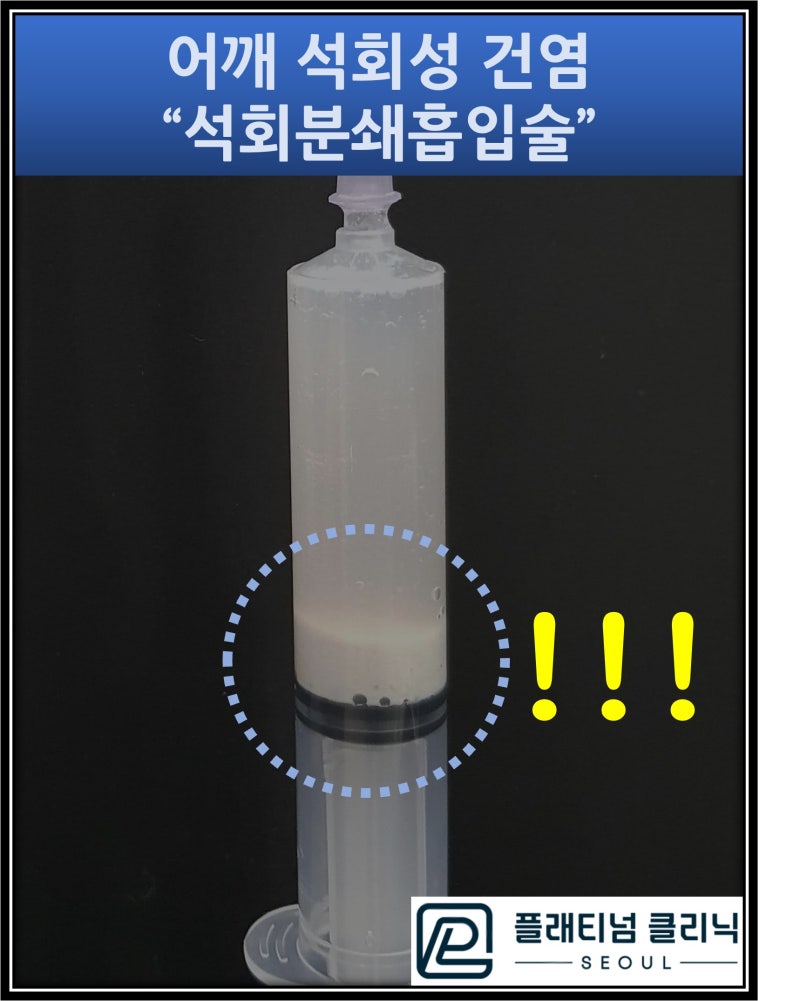
Looking at the post-procedure syringe, the white material settled at the bottom is the removed calcium. Let's look at the post-procedure X-ray.
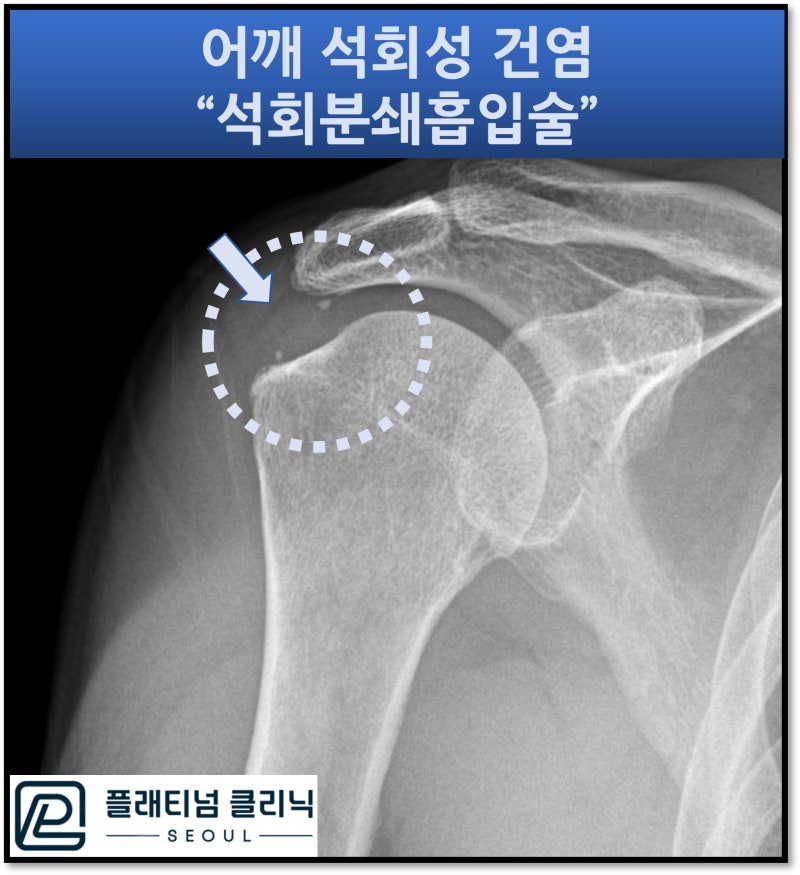
The large white calcium deposit visible before the procedure is now almost entirely gone.
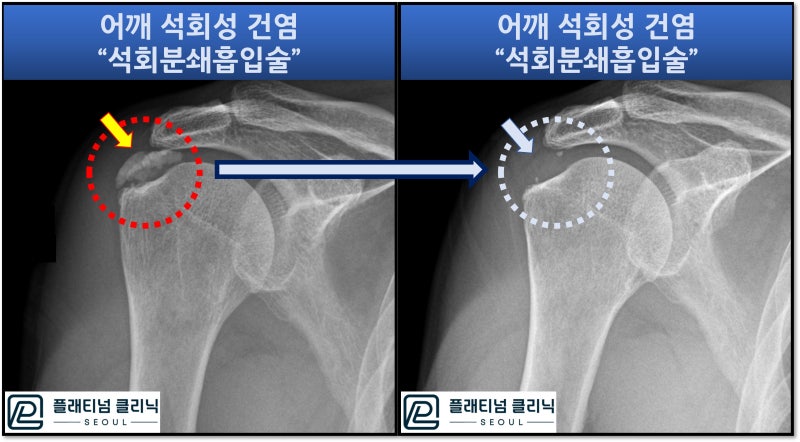
Comparing the before and after X-ray images side by side, the removal of the calcium deposit is strikingly clear.
The treatment for shoulder calcific tendinitis is straightforward. Removing the calcium deposit is the fundamental cure.
Calcific deposit crushing and aspiration is a procedure that can treat calcific tendinitis non-surgically. Surgical treatment is not necessary. After the procedure, the patient said she was finally free from years of suffering and expressed deep gratitude.
Severe pain, recurring pain from shoulder calcific tendinitis — it can be treated in a single procedure. Dr. Dongkyu Lee, Platinum Clinic