
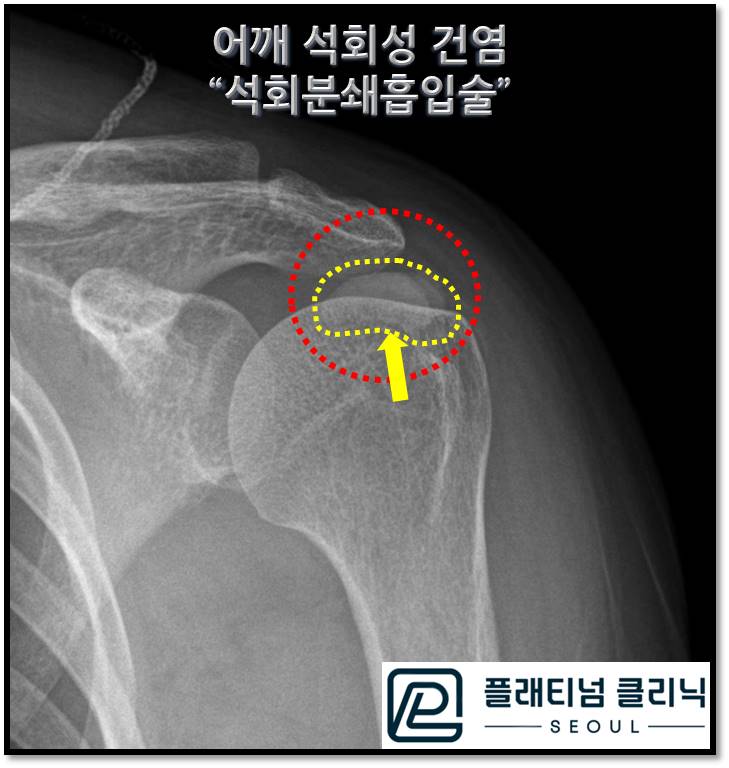
Hello. I'm Dr. Dongkyu Lee, an orthopedic specialist. Patients ask many questions about calcific tendinitis. Does calcific tendinitis always need to be treated by removing the deposit? Why didn't shockwave therapy work? Is surgical treatment the only way to achieve a complete cure? What's the difference between surgery and a procedure? Let me answer each one. Q. Does calcific tendinitis always require removal of the deposit? In calcific tendinitis, pain is caused by severe inflammation from the calcification, which increases pressure within the tendon. This pain can be so extreme that patients describe it as wanting to cut off their shoulder. Therefore, the fundamental treatment for calcific tendinitis is removing the calcification. However, some patients have calcific deposits without any pain. In such cases, no special treatment is needed. Q. Why didn't shockwave therapy eliminate the deposit? The effectiveness of shockwave therapy varies depending on the nature of the deposit. When the calcification is very hard or large, shockwave therapy often fails to eliminate it regardless of how many sessions are performed. Many patients are diagnosed with calcific tendinitis and undergo years of shockwave and injection therapy, yet the deposit doesn't shrink at all and keeps recurring, causing tremendous frustration. In such cases, injection therapy only reduces inflammation and alleviates symptoms temporarily, while the calcification itself remains untreated, leading to repeated flare-ups. Q. Is surgery necessary for a complete cure? Surgery to remove the calcification is one option. However, during surgical removal, the rotator cuff must be cut open to access the internal deposit. The instrument used is called a shaver, which grinds and suctions tissue simultaneously. Using such surgical instruments inevitably damages healthy rotator cuff tissue, weakening the tendon. Additionally, after removing the calcification, the incised rotator cuff must be sutured back together. In other words, the entire process is very similar to surgical treatment for a rotator cuff tear, requiring a brace and healing time. Q. What's the difference between surgery and a procedure? I've already answered the question about surgical treatment in detail above. The procedure is called calcific deposit aspiration, which is a non-surgical approach that uses a specially designed guide and drill to crush the calcification without any incision, then aspirates the crushed deposits through the guide. Think of the guide as a somewhat thicker needle. This allows minimizing rotator cuff damage when treating calcific tendinitis, and with sufficient technical experience, the calcification can be removed without any tendon damage. Furthermore, since the procedure (calcific deposit aspiration) can be done as a same-day treatment, patients can return to daily activities the next day, and since there is no tendon damage, no special brace or activity restrictions are needed. Due to the nature of calcific tendinitis, symptoms disappear immediately once the deposit is removed, providing instant relief from pain. In terms of recovery time and rotator cuff preservation, the procedure offers significantly more advantages than surgery. Did this help answer your questions? Now let me show you a calcific tendinitis case. This patient was also diagnosed with calcific tendinitis years ago and had been receiving injections and shockwave therapy whenever the pain flared up. However, after a certain period, the extreme pain would return, and the cycle of injections and shockwave therapy would repeat. After years of this recurring pain and treatment, the patient was exhausted and sleep-deprived from shoulder pain, leading to deteriorating health and even depression. Quality of life had dropped severely, and when the pain recently became extreme again, the treating hospital suggested it was time for surgery. The patient didn't want surgery and felt frustrated that if surgery was needed anyway, it should have been recommended from the start, rather than making them suffer for years. That's when they came to see me. Let's check the condition.
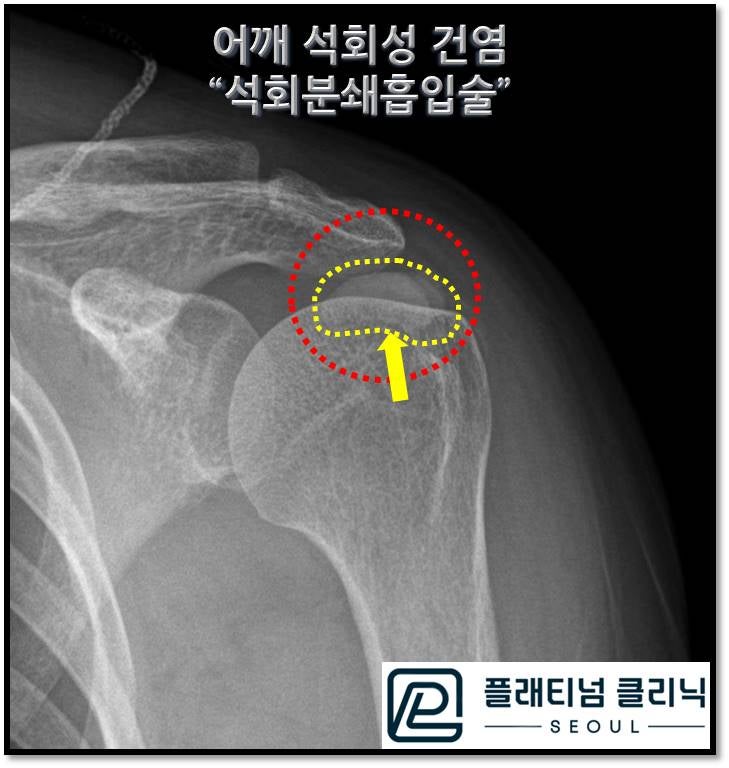
On the X-ray, the white area marked with yellow dashed lines within the red circle is the calcification. A very large deposit is confirmed. Ultrasound was used to confirm the exact size, nature, and location of the deposit.
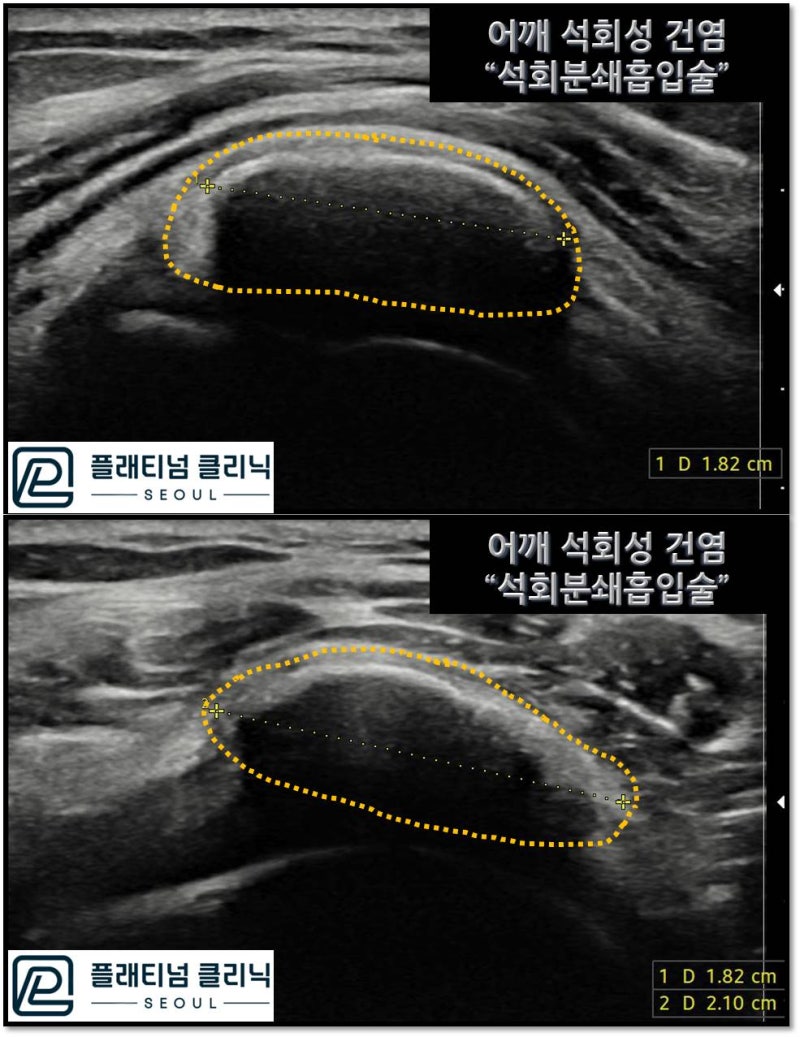
On ultrasound, a massive calcific deposit measuring approximately 2.10 x 1.82 cm was observed, nearly covering the entire supraspinatus. The deposit appears to contain both hard and thick paste-like calcification. Calcific deposit aspiration was performed to remove the calcification. Let me show you the syringe photo after the procedure.
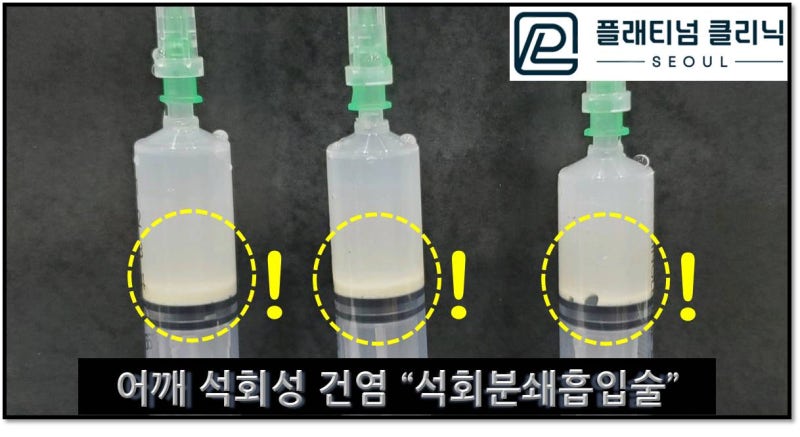
In the syringe photo, the white material settled within the yellow circle is the calcification. Approximately 5cc of calcification was extracted. X-ray imaging was performed immediately after the procedure.
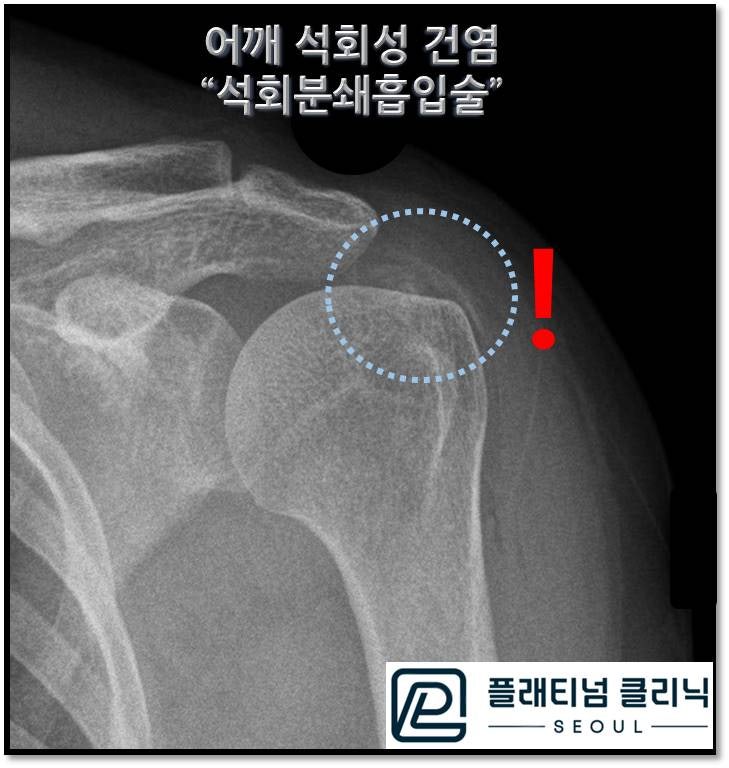
On the post-procedure X-ray, the large calcific mass visible before is no longer present, with only minimal residual calcification observed.
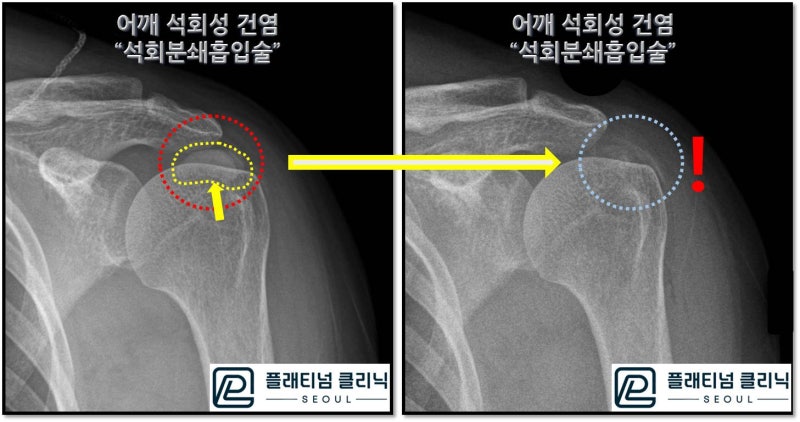
Comparing the before and after X-rays, the aspiration and removal of the calcification is clearly evident. The remaining small amount of calcification can be sufficiently removed and absorbed through extracorporeal shockwave therapy. For information about calcific tendinitis treatment methods, please refer to the link below. https://blog.naver.com/9690067/222801103857
🔗 https://blog.naver.com/9690067/222801103857Calcific deposit aspiration is the definitive non-surgical treatment method for calcific tendinitis.
https://youtu.be/dg1VTELE4tM