Hello. I'm Dr. Dongkyu Lee. Today I'll show you a case of treating a partial rotator cuff tear. The rotator cuff is a tendon. A tendon is tissue that connects bone to muscle. Therefore, when a tear occurs and is left untreated, the muscles continue to be used, pulling on the tear site and causing the tear to progress further. It's rare for a complete tear to occur from the start. In other words, tears begin as micro or partial injuries, and if not properly treated, they gradually progress to a complete tear. Once complete, surgical treatment is required. However, if properly treated while still a partial tear, the tissue can heal and won't progress to a complete tear. Treating partial tears is critically important in rotator cuff management. If the tear is small, prolotherapy or injection treatments can be quite effective. However, if the tear is significant, injection therapy alone is often insufficient. Yet the tear may not be severe enough to warrant surgery. In such cases, bone marrow stimulation stem cell regeneration and reduction suture technique become excellent treatment options. For details on each treatment, please refer to the links below. https://blog.naver.com/9690067/222934136001
🔗 https://blog.naver.com/9690067/222934136001https://blog.naver.com/9690067/222961123101
🔗 https://blog.naver.com/9690067/222961123101The patient in this case was a 35-year-old male who worked as a professional athlete. He was diagnosed with a rotator cuff tear 3 years ago and had received multiple rounds of injection therapy. However, treatment wasn't effective, symptoms kept recurring, and a recent MRI showed that the rotator cuff tear had reached 50%, with a recommendation for surgery. Given his profession, surgery wasn't an option, and he came to me seeking non-surgical treatment. Let's first check the condition.
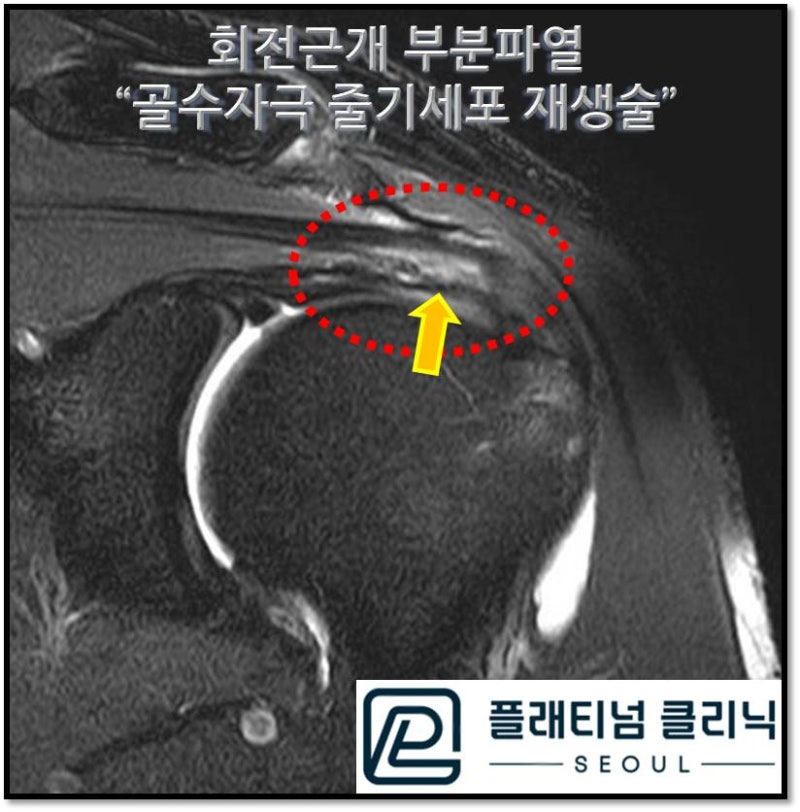
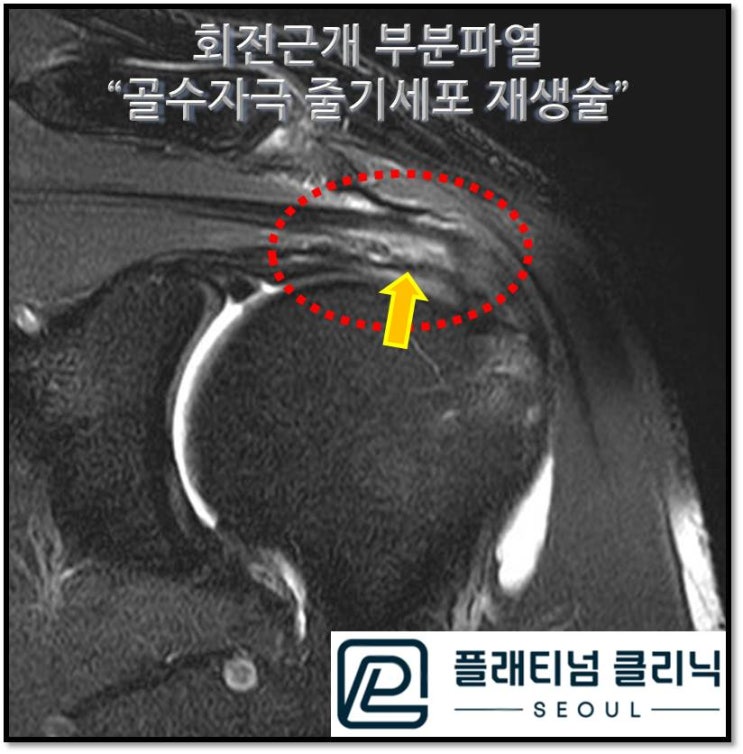
Looking at the MRI, severe intrasubstance tearing of the supraspinatus is observed. It appears to be barely holding together. However, the tendon condition at the humeral attachment site looks relatively good, and with a partial tear of approximately 0.8 cm, it appeared sufficiently treatable through non-surgical means. Bone marrow stimulation regeneration, reduction suture technique, and regenerative therapy (medication therapy) were performed. First, brachial plexus block was administered for pain control, and sedation was provided to reduce anxiety.
This is the ultrasound footage of the bone marrow stimulation stem cell regeneration procedure. The tear site is precisely targeted, a guide is inserted, and a specially designed drill is used to create multiple tiny holes in the bone.
This is the actual ultrasound footage of the reduction suture technique. A specially designed guide and specially made suture are used. The guide is passed through the tear site and inserted into the rotator cuff tendon, then a specially designed suture is inserted. After the guide is removed, the suture remains anchored within the tendon. When the suture is pulled, the tear is reduced. This procedure is repeated 4-6 times in a grid pattern, so the tear is reduced while also preventing further progression. After the procedure, regenerative therapy (medication therapy) to aid tissue healing is performed, completing the treatment. The patient rested for 3 months while undergoing rehabilitation therapy. An MRI was performed 3 months later.
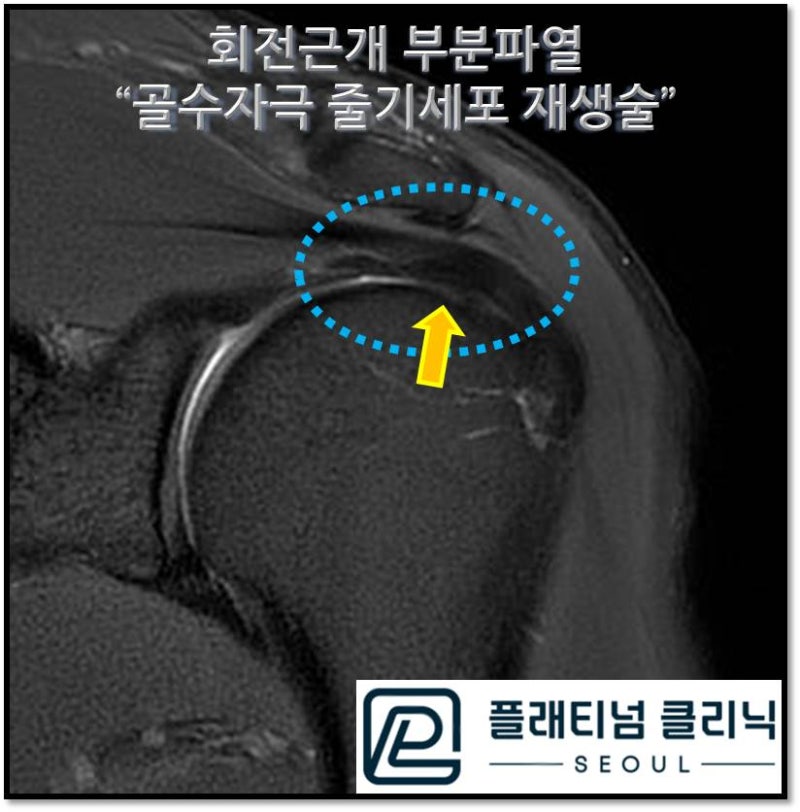
The tear that was previously visible has healed cleanly.
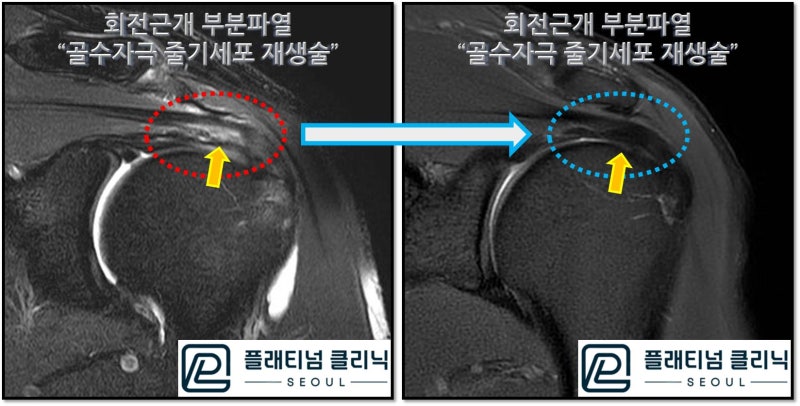
Comparing the before and after MRI, the healing is even more clearly evident. Before the procedure, the severe tearing and inflammation within the tendon appeared white, but 3 months post-procedure, the tendon has healed well and shows normal dark signal intensity. Partial rotator cuff tears can be sufficiently treated non-surgically without surgery. What's unfortunate is that many patients neglect partial rotator cuff tears until they progress to complete tears requiring surgery. If you've been diagnosed with a rotator cuff tear and symptoms aren't improving despite injection therapy, the treatment may not be working. Additionally, the tear may have progressed to a state beyond what injection therapy can repair. If this is the case, please consider bone marrow stimulation stem cell regeneration and reduction suture technique.
https://youtu.be/JjZjpQcvbh0