
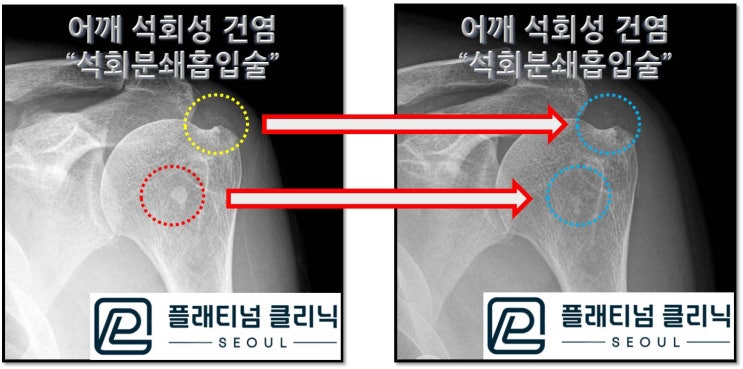
Hello. I'm Dr. Dongkyu Lee. More and more patients are coming in for calcific tendinitis treatment. Many of them have been suffering for a very long time. Today's case involves a patient who suffered from calcific tendinitis for 5 years. The patient was diagnosed with calcific tendinitis and had been receiving injections (pain injections, steroids) and shockwave therapy whenever the pain flared up. After injections, the pain would improve briefly but return severely after 1-2 months. Eventually, injections stopped providing relief, making daily life difficult and drastically reducing quality of life. That's when they came to see me. The treating hospital told them the calcification was in a location that couldn't be surgically treated(?), leaving the patient at a loss for what to do, desperately asking me to please treat them. Let's first look at the condition.
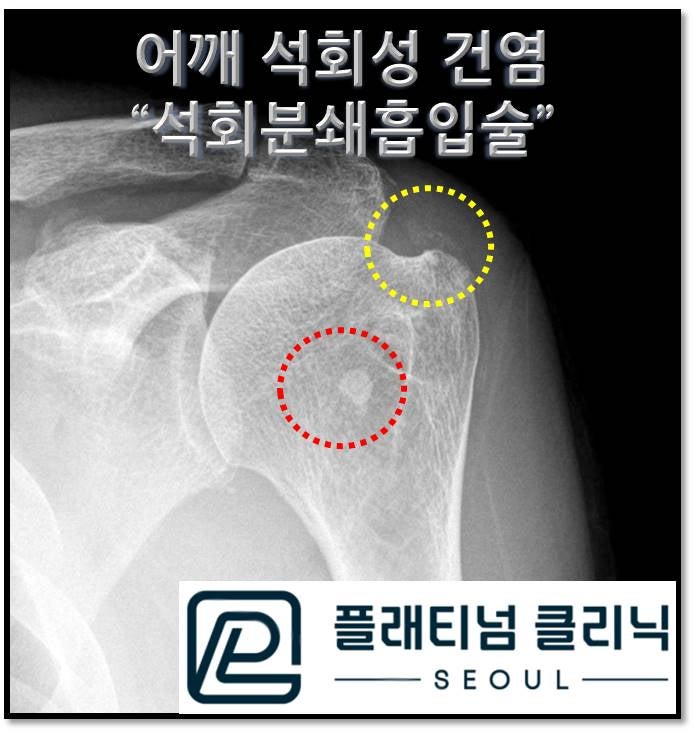
On the X-ray, the white area within the red circle is calcification in the subscapularis, and the faint white area within the yellow circle is calcification in the supraspinatus. I find it hard to understand the claim that this location can't be surgically treated, as it may have been due to limited surgical experience or suboptimal arthroscopic skills. Since calcific tendinitis can be treated non-surgically, I recommended the procedure to the patient. "Calcific deposit aspiration" was performed.
In the video, you can see that the initially clear liquid in the syringe becomes progressively cloudier as the procedure continues. The crushed calcification is flushed and removed using saline solution.
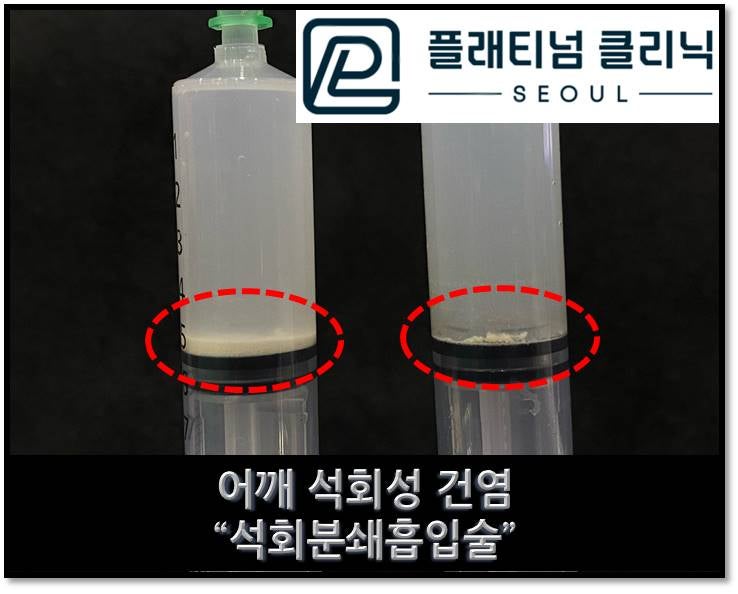
The syringe photo taken after the procedure shows white calcification settled at the bottom of the syringe. A post-procedure X-ray was taken.
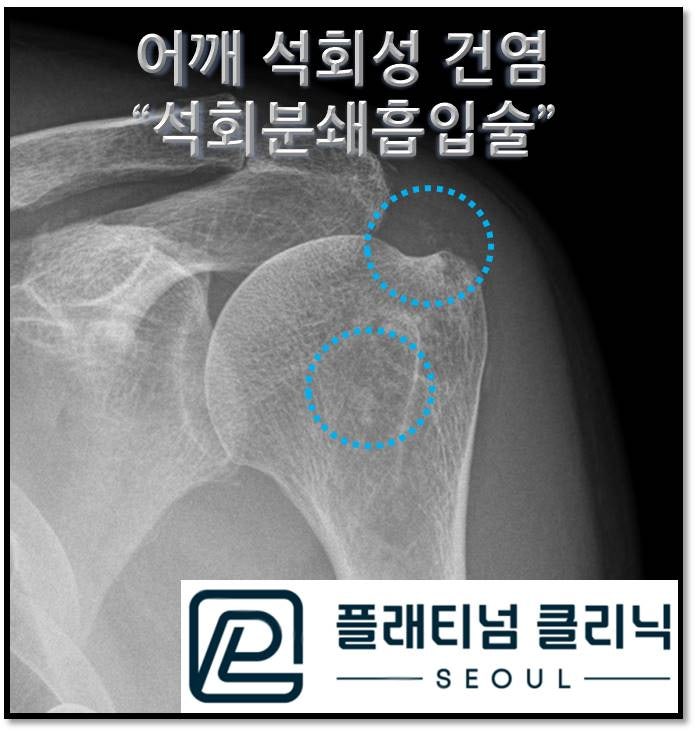
Within the blue circle, the calcification that was previously visible has significantly diminished.
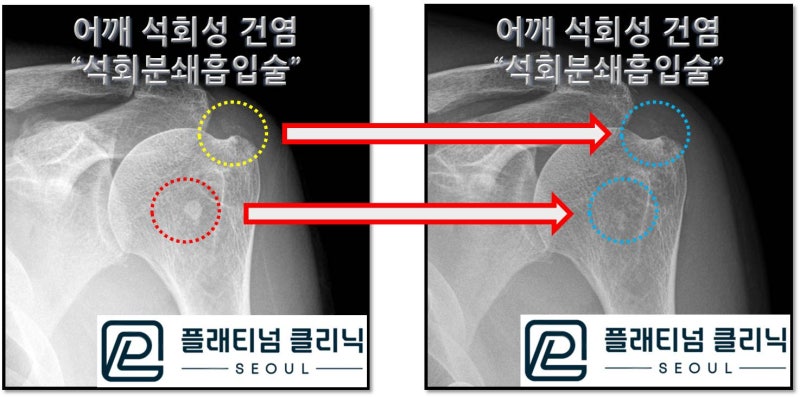
Comparing the before and after images, the calcification in the subscapularis (red circle) is nearly invisible, and the calcification in the supraspinatus (yellow circle) has disappeared. The patient was amazed and delighted looking at this comparison, yet also expressed regret about having suffered for 5 years unnecessarily.
With a single calcific deposit aspiration procedure, the patient was freed from 5 years of suffering. Furthermore, the calcific tendinitis was treated non-surgically.
I hope many patients suffering from calcific tendinitis can now be freed from their pain.