Hello. I'm Dr. Dongkyu Lee, an orthopedic specialist. Many patients suffer from rotator cuff tears. If the tear is complete, surgical treatment is inevitable. However, when a partial tear is properly treated, a healthy shoulder can be maintained without progressing to a complete tear. Unfortunately, far too many partial rotator cuff tears are left untreated. One patient came to me after years of shoulder pain, having been followed at a university hospital where they were told it wasn't severe enough for surgery yet, so they just took medication (anti-inflammatories, muscle relaxants) and endured the pain. Since the rotator cuff is a tendon (tendons connect muscles to bones), continued use means the muscle keeps contracting, gradually enlarging the partial tear until it inevitably becomes a complete tear. Leaving a partial rotator cuff tear untreated essentially means just waiting for surgery while managing pain with medication. So how should a partial rotator cuff tear be treated? First, prolotherapy (tendon-strengthening injections) can be used. For very small tears, this may be sufficient. Personally, when performing prolotherapy, I separately stimulate the periosteum and tendon, and this meticulous technique helps restore blood flow and heal the tissue. However, even partial tears can be too large for injection therapy alone. In such cases, patients feel truly stuck. Not severe enough for surgery, yet injections aren't working either... For these situations, there are non-surgical methods that can effectively treat partial rotator cuff tears. "Bone marrow stimulation stem cell regeneration" and "reduction suture technique." For bone marrow stimulation stem cell regeneration, please refer to the link below. https://blog.naver.com/9690067/222787387767
🔗 https://blog.naver.com/9690067/222787387767For reduction suture technique, please refer to the link below. https://blog.naver.com/9690067/222961123101
🔗 https://blog.naver.com/9690067/222961123101These non-surgical treatments can address partial rotator cuff tears that don't respond to injection therapy, as well as tears that are too small to justify surgical intervention. Let me show you a case. This patient had also been suffering from shoulder pain for nearly 10 years. Despite injection treatments at multiple locations, the pain wouldn't resolve and kept recurring. When the patient considered surgery, they were told the tear wasn't severe enough, leading them to come to me in frustration. Ultrasound was used to check the condition of the rotator cuff tear.
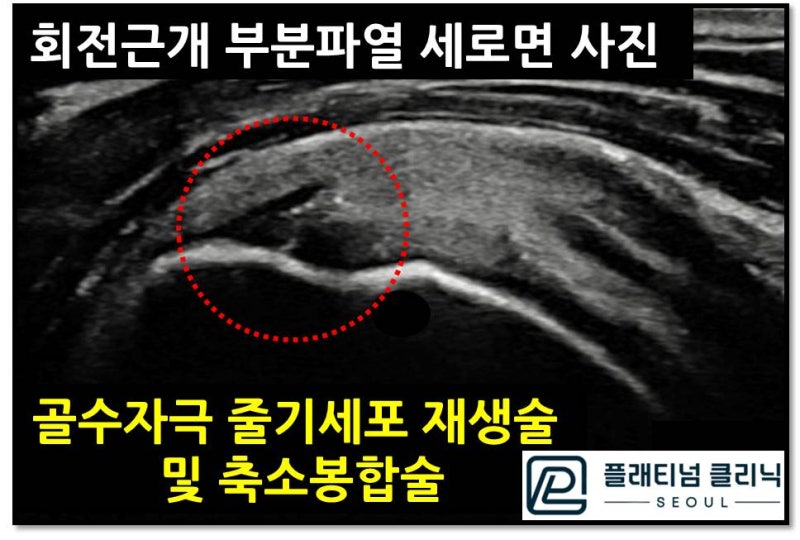
A normal rotator cuff appears white on ultrasound. In the image above, the dark area within the red circle is the partially torn rotator cuff.
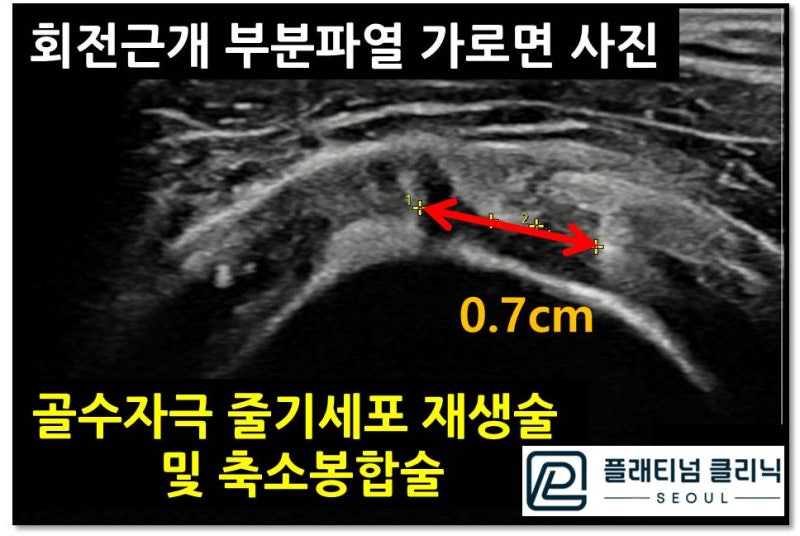
This ultrasound image shows the cross-section of the tear site. The red arrows indicate the tear size, showing an approximately 0.7 cm partial rotator cuff tear. In summary, an approximately 0.7 cm articular-side partial tear was observed in the rotator cuff (supraspinatus). Since years of injection therapy had failed and the tear size was not insignificant, we decided to pursue more aggressive treatment. Bone marrow stimulation stem cell regeneration and reduction suture technique were performed.
In the video, you can see the tear site precisely targeted, a guide inserted, and multiple tiny holes created in the bone. Through these holes, bone marrow is released, and the stem cells, platelets, growth factors, and other components within the marrow are abundantly secreted, promoting tissue healing.
Under ultrasound guidance, a specialized guide is passed through the tear site and a specially designed suture is inserted. The specially designed suture is anchored within the rotator cuff and fixed in a grid pattern around the tear site. The suture is made of absorbable material that dissolves and is absorbed by the body, forming collagen that aids in tissue healing. This reduces the tear size and prevents further progression. Healing of the rotator cuff takes approximately 3 months after the procedure. Let me show you the treatment results after 3 months.
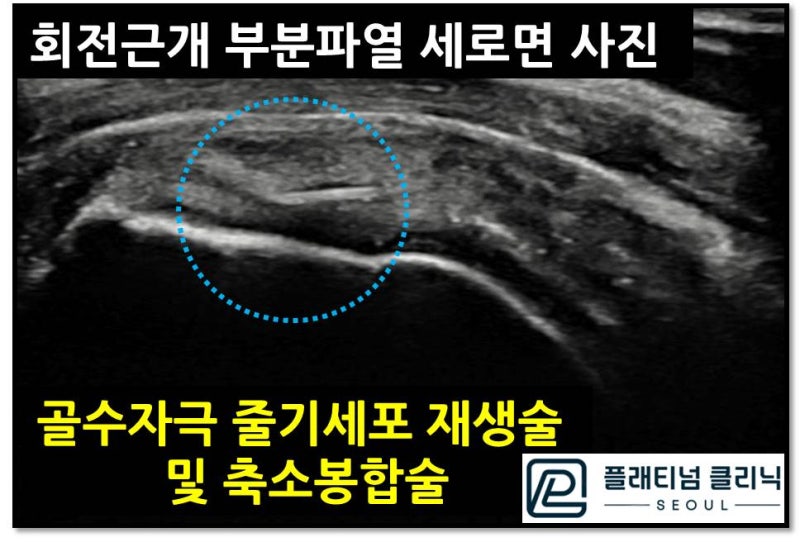
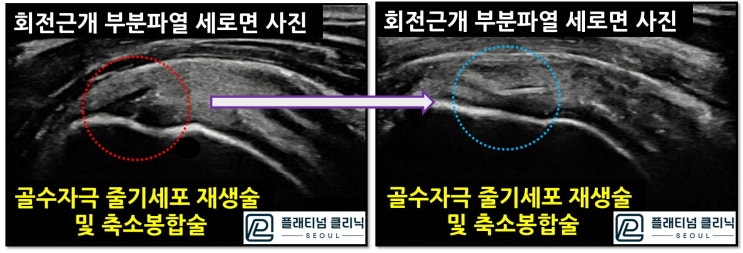
Looking at the ultrasound taken 3 months later, a white line visible within the blue circle shows the previously inserted suture still in place, and the partially torn rotator cuff has healed well, appearing white.
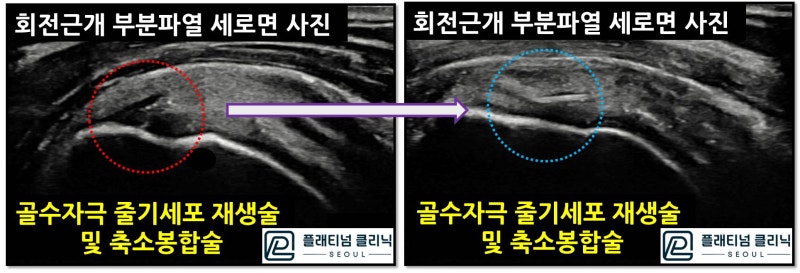
Comparing the before and after images, the area that appeared dark due to the tear (red circle) now shows the tendon well-healed and recovered (blue circle). The patient said they wished they had known about this treatment sooner, feeling frustrated about years of unnecessary suffering. Still, they expressed deep gratitude that the treatment worked so well. Don't neglect a partial rotator cuff tear. If symptoms keep recurring despite injection therapy, the condition may be beyond what injections alone can treat. Many cases can be sufficiently treated non-surgically.
Partial rotator cuff tear: Don't neglect it any longer. Get proper treatment. Bone marrow stimulation stem cell regeneration and reduction suture technique offer non-surgical treatment options.