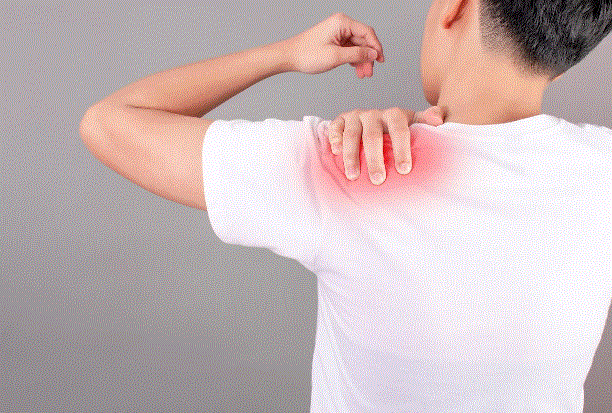
The most freely moving joint in our body is the shoulder. Unlike the knee, ankle, or spine, the shoulder is the only joint capable of 360-degree rotation. Because the shoulder joint has such extensive and free movement, its injury rate is higher than other joints. While many shoulder injuries occur during exercise, shoulder pain from daily activities is also very common. This is because factors beyond exercise — household chores, occupational demands, and repetitive overuse — increase the likelihood of shoulder conditions.

Among the many shoulder conditions, calcific tendinitis — which causes severe shoulder pain — occurs when calcium deposits accumulate in the shoulder tendons. These calcium deposits irritate surrounding tissue, causing inflammation and creating extreme pain. When the rotator cuff tendons degenerate or experience impaired blood flow, calcium components accumulate and transform into calcified material — this is what we call calcium deposits. Calcific tendinitis characteristically causes sudden, severe shoulder pain even when there was no pain previously. Common symptoms include a burning sensation in the shoulder and severe pain when lying on the affected side during sleep. The pain can be so intense that touching the shoulder is impossible. Pain occurs even without excessive arm movement and can radiate from the shoulder to the arm and neck. Night pain is also common. In medicine, pain severity is measured using the VAS Score.

Scored from 0 to 10, where 0 means no pain and 10 means the worst imaginable pain. Childbirth pain typically rates 6-7 on the scale, while calcific tendinitis pain has been reported at 8-9 — even higher than childbirth. Calcific tendinitis causes severe pain at night that can make sleep nearly impossible, while daytime pain is somewhat more manageable. Patients may experience stabbing or sharp, piercing pain, and the pain can appear and disappear intermittently. Raising the affected arm forward or sideways is naturally restricted. Compared to other shoulder conditions, calcific tendinitis has a relatively clear cause, so once properly diagnosed, treatment is straightforward. Treatment involves either removing the calcium deposits or reducing their size so they can be absorbed by cells.

The exact medical reason for calcium formation in the shoulder has not yet been clearly established. However, it is believed to be related to impaired blood circulation in shoulder tendons and micro-damage from repetitive use. When blood circulation to the shoulder is not maintained properly, ligaments degenerate and calcium forms. Calcific tendinitis typically progresses through three stages: formation, maintenance, and absorption. The most painful stage is the absorption phase, when accumulated calcium begins to dissolve. During this phase, chemical substances that cause severe pain are released as the calcium dissolves. As a result, severe pain occurs along with restricted shoulder movement. When calcium enters the absorption phase, its volume expands, pressure within the rotator cuff increases, and pain becomes severe — but if the calcium doesn't fully dissolve, the pain stops. Many patients mistakenly believe they've naturally healed at this point and neglect treatment. However, if the undissolved calcium later re-enters the absorption phase, severe pain can return. That's why treatment should be pursued when symptoms are present. Diagnosis can be made simply with X-ray. However, micro-calcifications in the formation stage or chalk-like consistency may not be visible on X-ray and may require ultrasound for diagnosis.

When no rotator cuff tear is present, most cases of calcific tendinitis can be effectively treated with non-surgical methods. Treatment begins with reducing inflammation caused by calcium and proceeds with removing or promoting absorption of the calcium. For calcium in the formation stage, where pain is severe, barbotage provides the fastest results. Barbotage uses a syringe to extract calcium embedded in the tendon. Using ultrasound, healthy tissue is avoided while precisely targeting only the damaged or calcium-deposited tissue — this is a major advantage. Barbotage is particularly effective when performed during the acute pain phase as calcium dissolves.

Even after barbotage eliminates shoulder pain, relying solely on medication and injections is not sufficient. To prevent and address inflammatory adhesions and joint stiffness caused by calcium, patients must also engage in shoulder stretching and range-of-motion rehabilitation exercises. Additionally, since barbotage cannot remove all calcium from the shoulder, residual deposits should be treated with extracorporeal shockwave therapy to increase blood flow to the tendons and promote faster absorption. In the early stages, calcific tendinitis pain may be mistaken for simple muscle soreness, leading patients to self-treat and neglect symptoms. It can also be confused with other shoulder conditions like rotator cuff tears or frozen shoulder. Self-diagnosis can worsen symptoms and lead to complications from improper treatment, so seeking timely professional treatment is highly recommended.