
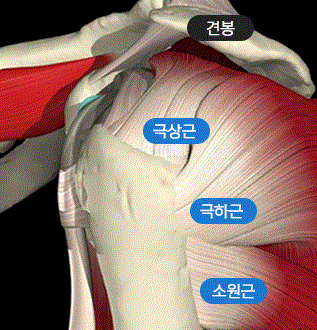
As we age, our bodies weaken and joint usage increases, making us more susceptible to disease. The shoulder is heavily used in daily life and is a joint with significant movement, such as when moving the arms. As usage increases, various shoulder conditions can develop with aging. Calcific tendinitis is a condition where calcium-like calcific deposits form in or around the shoulder tendons. The inflammation caused by these calcific deposits makes it difficult to move the arm and causes severe pain. Typically, when tendons are damaged due to degenerative changes or external trauma, restricted blood flow to the area leads to calcium deposit formation.

With prolonged use, shoulder tendons naturally deteriorate more quickly. People whose jobs require frequent shoulder use, or those who exercise regularly, are at higher risk of developing calcific tendinitis even at a young age. Ignoring shoulder pain and leaving it untreated not only leads to chronic pain but also accelerates the disease, so it is better to visit a hospital rather than making your own judgment. The hallmark symptom of calcific tendinitis is severe shoulder pain caused by the calcific deposits. During the formation phase, there is typically no pain, but as time passes and the calcium deposits begin to be absorbed, shoulder pain develops. Calcific tendinitis can be identified through X-ray imaging alone, which reveals the location, size, and shape of the deposits. Additionally, ultrasound examination can detect calcium deposits hidden behind bone and observe degenerative changes and damage to the tendons, making it easier to plan the treatment approach for calcific tendinitis.

In most cases, calcific tendinitis can be managed without surgery through various non-surgical methods such as physical therapy, injection therapy, and extracorporeal shockwave therapy. Shockwave therapy in particular helps by increasing blood supply to the tendons, causing cells to vibrate and encouraging the body to absorb the calcium deposits. Since the calcium deposits within the rotator cuff tendons are composed of calcium, they can be safely absorbed by the body. Tendon damage caused by calcium deposits can also be treated through injection therapy, medication, and physical therapy. However, if the calcium deposits have already grown large and hardened to the point of dissolving, it may be difficult to expect dramatic results from standard conservative treatment. Also, some patients may not see improvement despite prolonged conservative treatment. In such cases, a more proactive treatment option for calcific tendinitis is percutaneous calcium deposit aspiration (barbotage).
What is Percutaneous Calcium Deposit Aspiration?
Using ultrasound guidance, the exact location of the calcified area within the shoulder tendon is identified. A specialized needle is then inserted under ultrasound guidance to break up the hardened calcium deposits, which are then aspirated (suctioned out) through a syringe.

This is an improved alternative to arthroscopic surgery for calcific tendinitis, allowing treatment in a relatively short time without skin incision or general anesthesia. Same-day procedures are possible, long hospital stays are unnecessary, and patients can return to daily activities immediately. These significant advantages allow many people to receive treatment for calcific tendinitis without the burden of surgery. See calcific tendinitis treatment results without surgery https://blog.naver.com/9690067/222797534991
🔗 https://blog.naver.com/9690067/222797534991