
Hello. I am Dr. Dongkyu Lee, an orthopedic specialist. Today, let's learn about barbotage (percutaneous calcium deposit aspiration), a non-surgical treatment for calcific tendinitis. Barbotage literally means fragmenting and aspirating calcium deposits. Under ultrasound guidance, the calcium deposit is precisely targeted, then a syringe is used to fragment the calcium and wash it out with saline solution for aspiration.
As shown in this video, ultrasound is used to precisely locate the calcium, then a syringe is inserted into the deposit. The calcium is then fragmented using the syringe, followed by washing and aspiration using saline solution.
In the actual procedure video, you can see white material gradually coming out into the syringe. After fragmenting the calcium, saline is pushed in and drawn out multiple times with slight syringe pressure. The initially clear fluid in the syringe becomes increasingly white and cloudy as the calcium is aspirated.
In the ultrasound video during the procedure, you can see something expanding and contracting within the red circle. The white line visible on the right side of the ultrasound image is the syringe inserted into the calcium. Through this syringe, saline is injected and withdrawn to aspirate the calcium. Calcific tendinitis can be treated with barbotage in this way. The results of barbotage can vary depending on the practitioner's experience and skill level. In some cases, the calcium may be too hard to fragment properly, preventing removal, or the deposit may be too large or too small for accurate targeting, leading to suboptimal results.
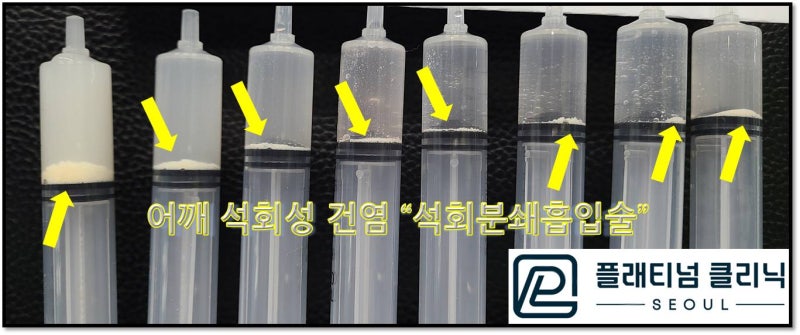
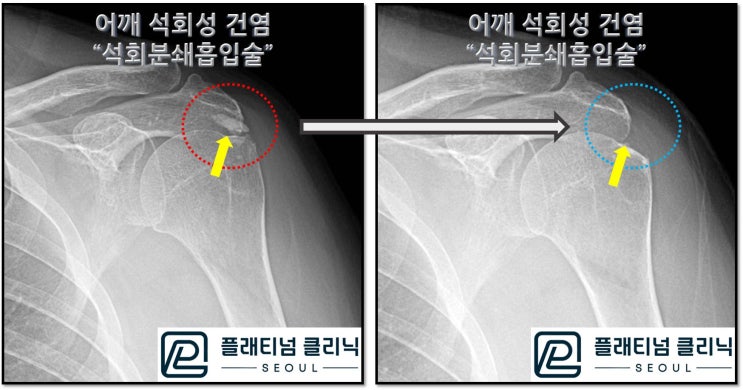
The post-procedure syringe shows calcium deposits indicated by the yellow arrows. Once the calcium is removed, the results can be immediately confirmed on X-ray.
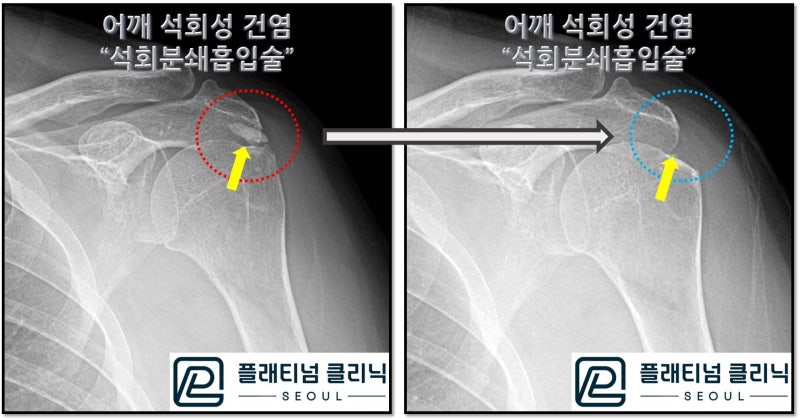
The large, white calcium deposit visible in the red circle on the left (indicated by yellow arrows) is no longer visible in the blue circle on the right.
Calcific tendinitis can be treated with barbotage.