Hello. I am Dr. Dongkyu Lee, an orthopedic specialist. Today, I would like to discuss the treatment of rotator cuff tears. Many patients inquire about bone marrow stem cell regeneration therapy. Questions range from whether it is effective to whether non-surgical treatment is truly possible. I would like to address several of these questions.
First, there is a fundamental principle regarding when surgery is unavoidable. Complete rotator cuff tears (full-thickness tears, large tears) require surgical treatment.
Additionally, bursal-side rotator cuff tears also have a very high likelihood of requiring surgery. (However, depending on the tear size, non-surgical treatment may be possible.)
However, for other types of partial tears -- articular-side tears, small tears, frayed partial tears -- non-surgical treatment is possible.
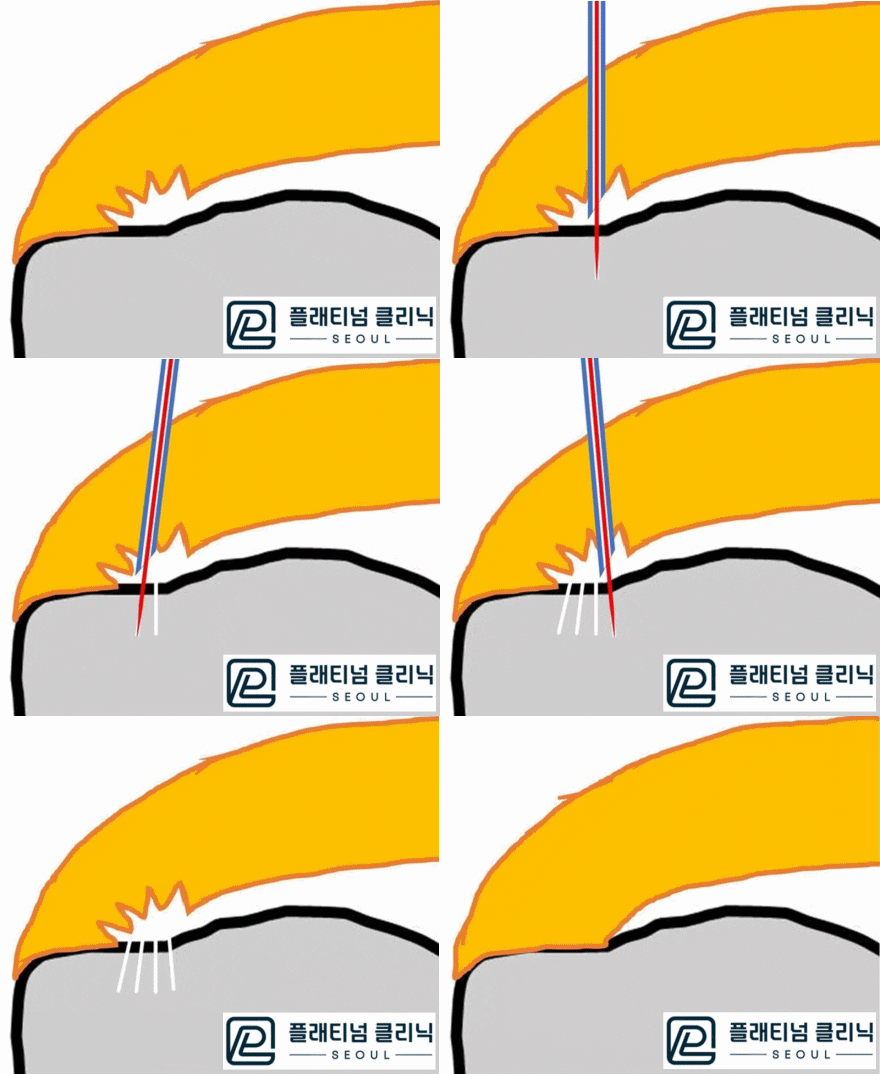
In other words, surgery is necessary when the tear size or characteristics demand it. Claiming to treat surgical-level tears with injections alone would be dishonest. However, except for the few cases where surgery is unavoidable, partial rotator cuff tears can be sufficiently treated and tendon damage repaired through non-surgical methods. Recently, there has been a significant increase in patient inquiries about bone marrow stem cell regeneration therapy combined with ligament-strengthening injections, collagen injections, and prolotherapy. Let me explain what bone marrow stem cell regeneration therapy is and its effectiveness. Bone marrow stimulation involves creating holes in the humerus where the rotator cuff attaches, allowing stem cells and numerous healing factors to flow through these holes and promote rotator cuff healing.
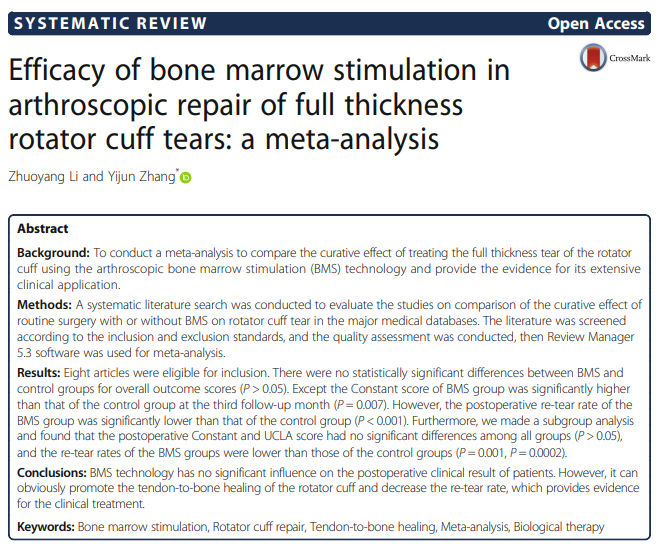
This study examines the effect of bone marrow stimulation during arthroscopic repair of full-thickness rotator cuff tears. In summary, while there were no major differences in pain, range of motion, or UCLA scores between patients who received bone marrow stimulation and those who did not, the study demonstrates that bone marrow stimulation clearly promotes bone-to-tendon healing and reduces re-tear rates.
Bone marrow stimulation: First, clearly promotes bone-to-tendon healing of the rotator cuff, Second, reduces the frequency of re-tears.
Research shows that when arthroscopic surgery is performed with bone marrow stimulation at the rotator cuff attachment site on the humerus before suturing, tendon-to-bone healing improves and the regenerated collagen is of better quality.
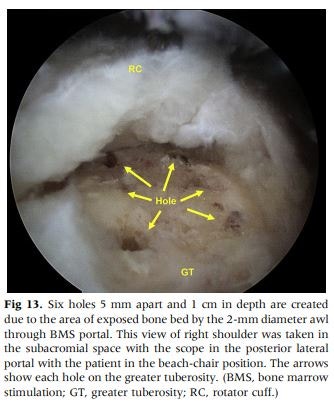
Images from the study show holes drilled at the rotator cuff attachment site, with the rotator cuff sutured over them. Bone marrow flows through these holes, containing stem cells, growth factors, platelets, and other healing-promoting substances.
Published in 2013, this demonstrates that bone marrow stimulation for rotator cuff tears has been practiced for many years. It is a proven, effective treatment that continues to be used in most shoulder surgeries today. So how is non-surgical bone marrow stem cell regeneration therapy performed?

A specialized guide approximately 1.5mm in diameter is inserted at the partial tear site, and through it, a specialized drill creates 5-7 micro-holes at the rotator cuff attachment on the humerus. The guide is gradually repositioned to create multiple holes. Because the guide is in place, healthy rotator cuff tissue is not damaged. I custom-design and manufacture these specialized guides and drills. They are designed to target only the damaged area for bone marrow stimulation without harming healthy rotator cuff tissue. Patients with partial rotator cuff tears that are too small for surgery but have not fully responded to injection therapy often still have residual pain and limited movement despite multiple non-surgical treatments. These are typically the "too small for surgery" partial tear patients. These patients often give up after multiple injection treatments, deciding to wait until the tear worsens enough for surgery. Without treatment, the tear continues to progress. Bone marrow stimulation combined with other non-surgical treatments could sufficiently treat these partial tears. Left untreated, the tear progressively worsens, eventually growing large enough to require surgery.
But there is no point in closing the barn door after the horse has bolted. If treated before the tear progresses, you can maintain a healthy shoulder without surgery.