Hello. I am Dr. Dongkyu Lee, an orthopedic specialist. Let's explore the treatment of rotator cuff tears. Tears can be classified as partial or full-thickness. Simply put, a full-thickness tear means the tendon has completely detached from the humerus, while a partial tear means only part of the tendon is torn. Tears can also be classified by size: small, medium, and large. Rotator cuff tears progress over time, going from small to medium to large. Small tears are usually partial, while large tears are usually full-thickness. Large, full-thickness tears require surgical treatment. However, small, partial tears do not need surgery and are actually too minor for surgical intervention. These small, partial tears are typically treated with injection therapy (prolotherapy) in the outpatient setting. If injection therapy works well, that is great. But some tears do not respond to injection therapy alone due to their size or characteristics. In these cases, patients experience recurring pain despite repeated injections, and as this continues, the tear progressively worsens, frequently leading to eventual surgical treatment. So what can be done for partial rotator cuff tears that do not respond to injection therapy? Should patients simply wait or manage pain until surgery becomes necessary? For cases that do not respond to injection therapy and are too minor for surgery, "bone marrow stem cell regeneration therapy" is an option. Let me explain through a video.
As shown in the video, for partial rotator cuff tears, local anesthesia is administered, then ultrasound precisely locates the tear site. Custom-made specialized needles and tips are used to create micro-holes in the humerus without damaging surrounding tissue. Bone marrow flows through these holes, and the stem cells and healing factors it contains promote repair of the damaged rotator cuff. Here is a patient case.
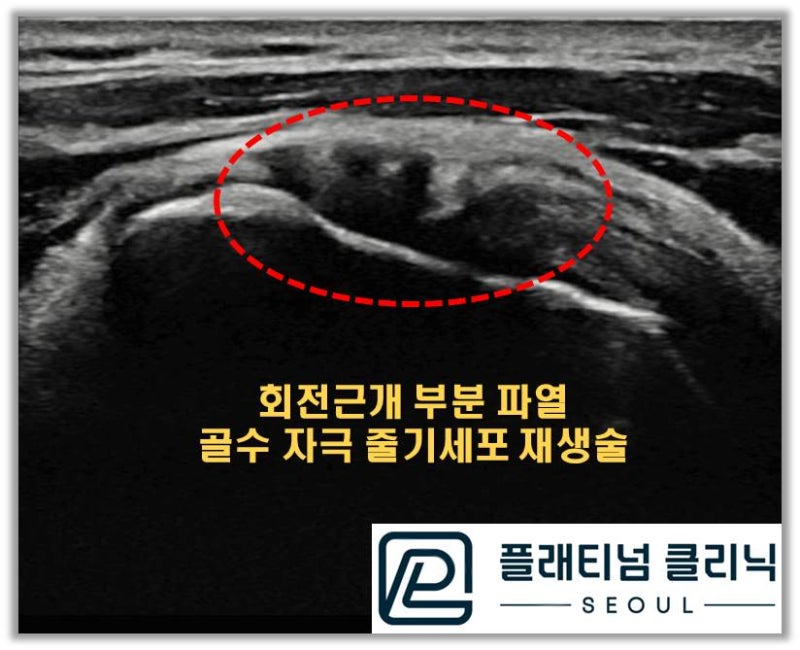
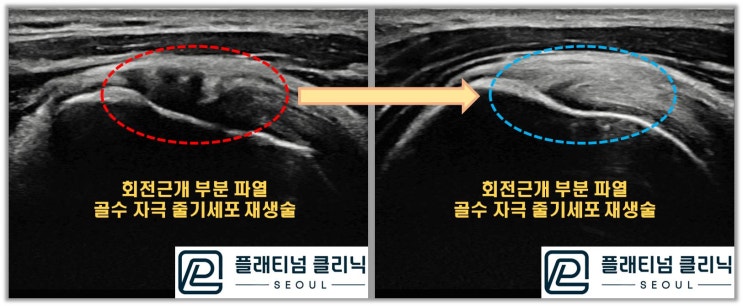
The patient reported receiving pain and prolotherapy treatment at another hospital for nearly 2 years with repeated recurrence. Ultrasound confirmed a partial rotator cuff tear too minor for surgery, and bone marrow stem cell regeneration therapy was planned.

Tissue regeneration takes approximately 4-6 weeks. Additional prolotherapy was performed after the procedure. Ultrasound was repeated at 6 weeks post-procedure.
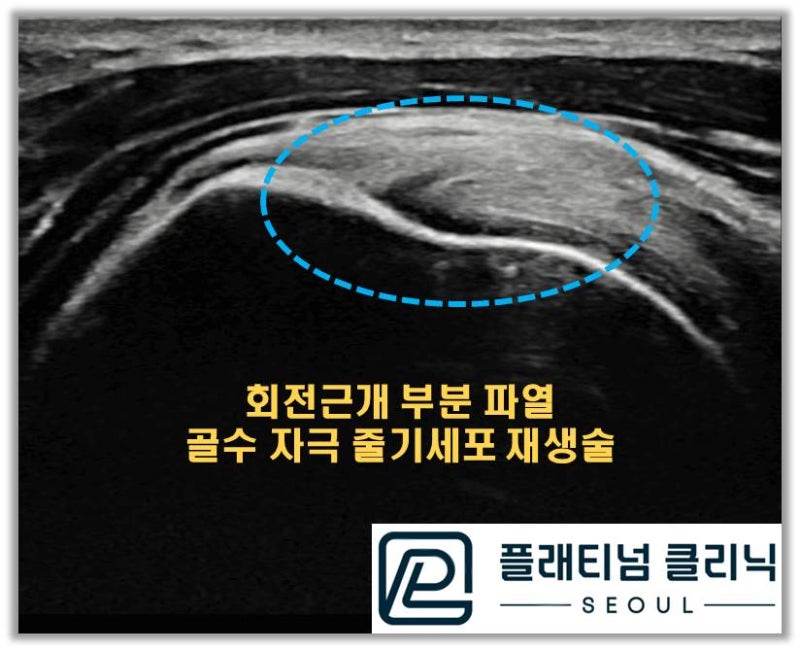
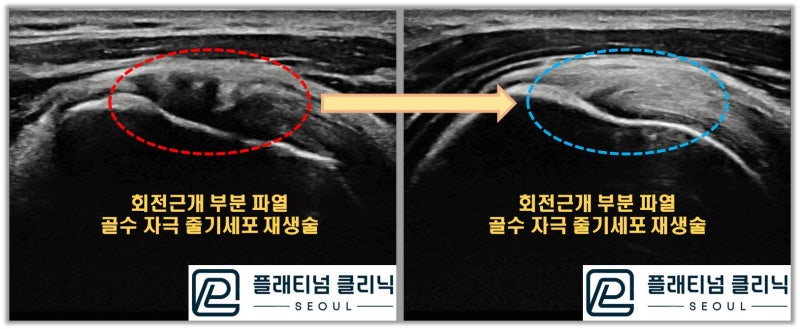
The patient is currently living normally without pain. The challenge with rotator cuff tear treatment lies in partial tears. Left untreated, they progress; yet they are too minor for surgery. It is truly disheartening to see these patients end up in surgery after years of pain injections. Many patients who have seen university hospital doctors report being told that only surgical cases receive surgery, while others are simply given medication and told to return in 6 months or a year. Partial tears that do not warrant surgery are left untreated, and 6 months or a year later, when they become complete tears, surgery is performed...
In this unfortunate reality, bone marrow stem cell regeneration therapy can be a viable treatment option for patients suffering from partial rotator cuff tears.