Massive Rotator Cuff Tear That Can't Be Fully Repaired: Results of Rotator Cuff Repair with Artificial Tendon Augmentation

2021. 10. 25.

Massive Rotator Cuff Tear That Can't Be Fully Repaired: Results of Rotator Cuff Repair with Artificial Tendon Augmentation


Today, let's look at a case where a rotator cuff tear was so old that anatomical restoration wasn't possible, and an artificial tendon (allomend) was used to achieve anatomical restoration. A 66-year-old female patient had long-standing shoulder pain but had only been managing it with injections when it hurt. Empty can test was positive and significant muscle weakness was noted. Let's check the X-ray.
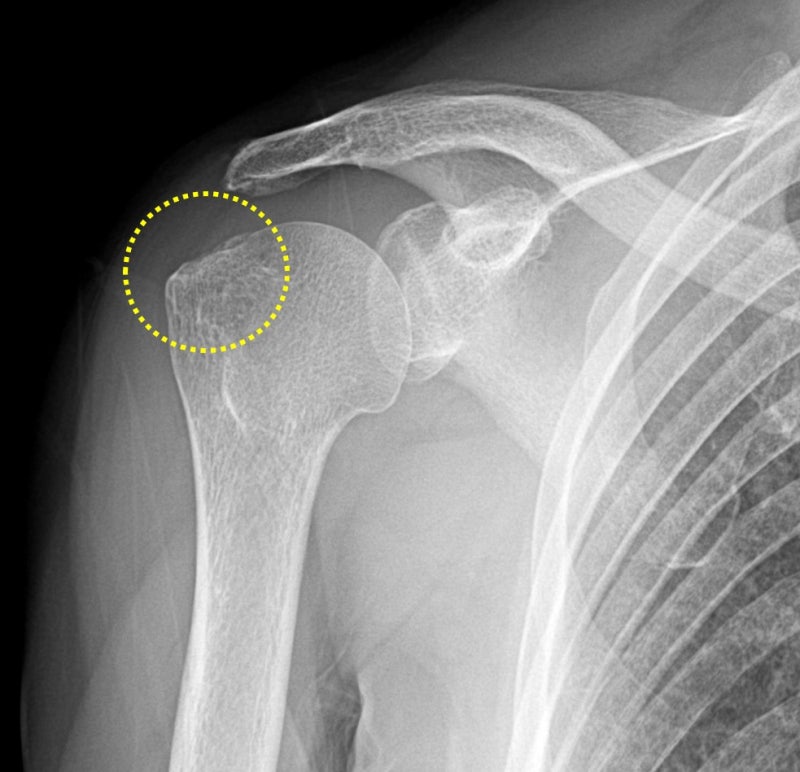
Within the yellow dotted line, the greater tuberosity of the humerus is visible — this is where the rotator cuff attaches. The bone surface appears irregular, which strongly suggests rotator cuff damage.

Given the clinical and X-ray findings strongly suggesting a rotator cuff tear, MRI was performed.
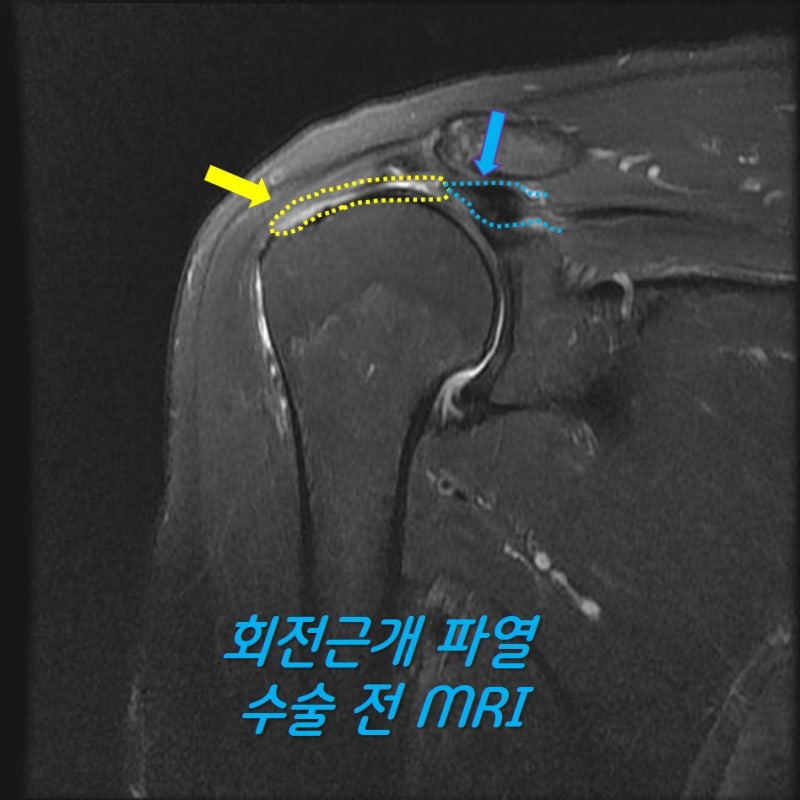
The rotator cuff is completely torn — the tendon that should be within the yellow dotted line has retracted and shortened to the blue dotted line position.

In such cases, the rotator cuff should be restored to the greater tuberosity of the humerus, but there's a high chance it won't reach. The surgical plan was to perform maximum repair and augment any irreparable portion with an artificial tendon (allomend).
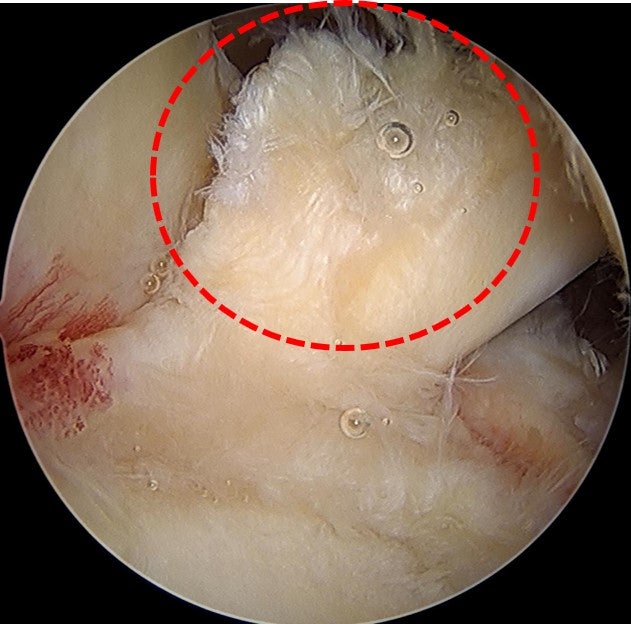
The biceps long head within the red circle shows partial tearing.
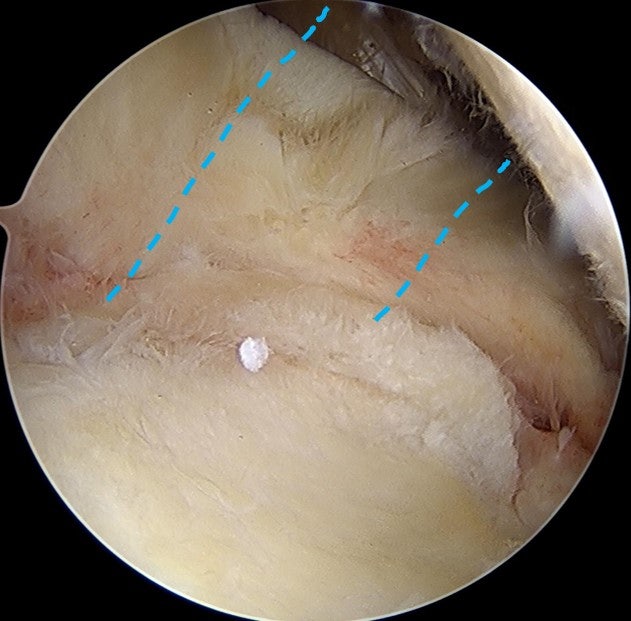
After biceps tenotomy.
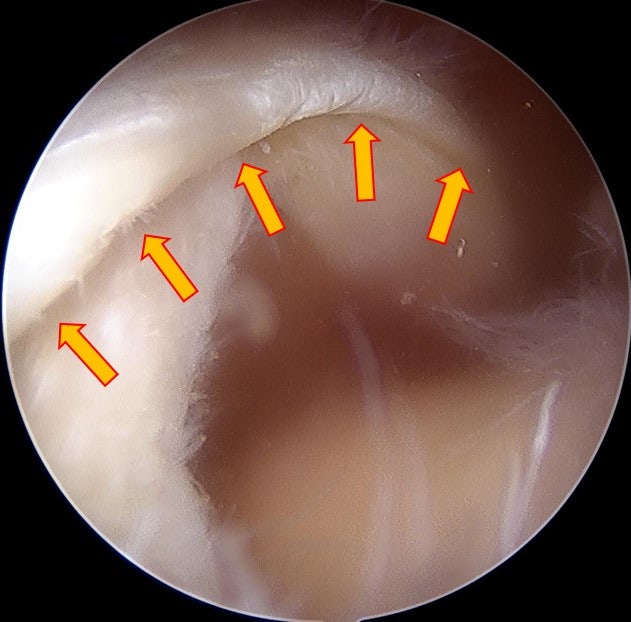
The arrows show the rotator cuff with a massive tear, hanging loose and unable to reach the greater tuberosity for anatomical restoration.
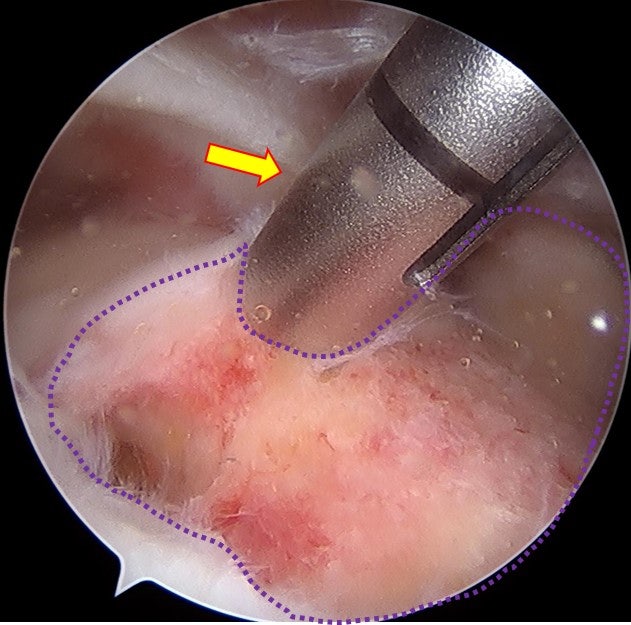
The greater tuberosity is treated to create microfracture bleeding, which plays a crucial role in tissue healing. Suture anchors (arrows) are then secured.
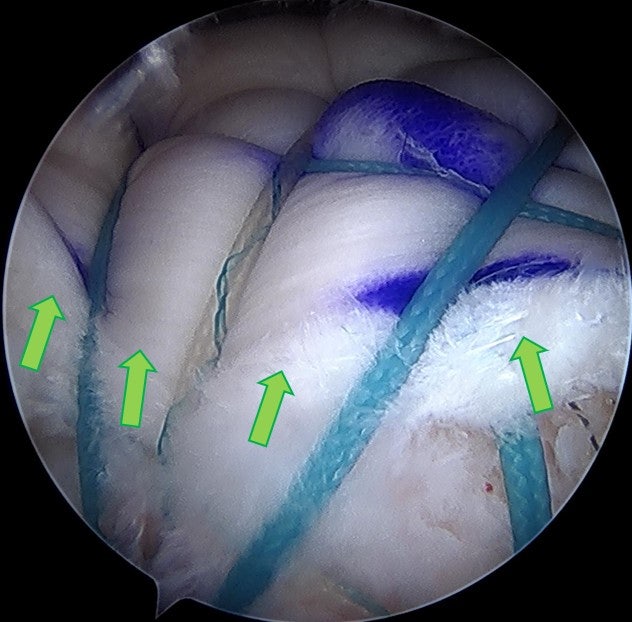
The arrow indicates the artificial tendon (allomend), which will eventually integrate and function like a natural tendon.

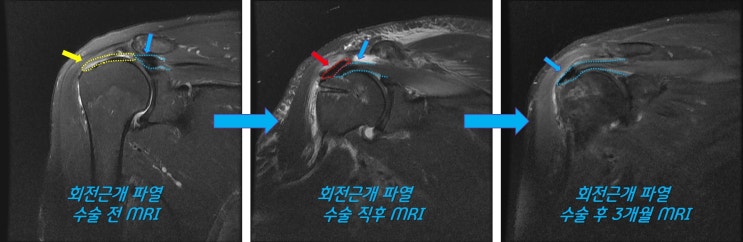
Surgery was performed as planned, with rotator cuff repair and augmentation using allomend. Post-operative MRI was taken to confirm results.
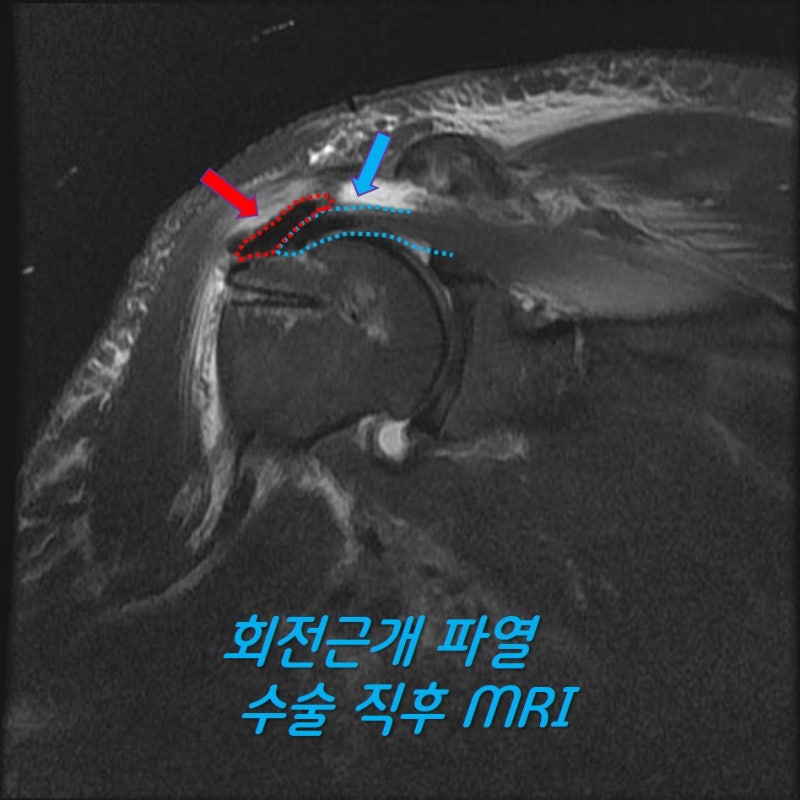
The blue dotted line shows the repaired original rotator cuff, and the red dotted line shows the artificial tendon (allomend).

MRI was taken again at 3 months post-surgery.
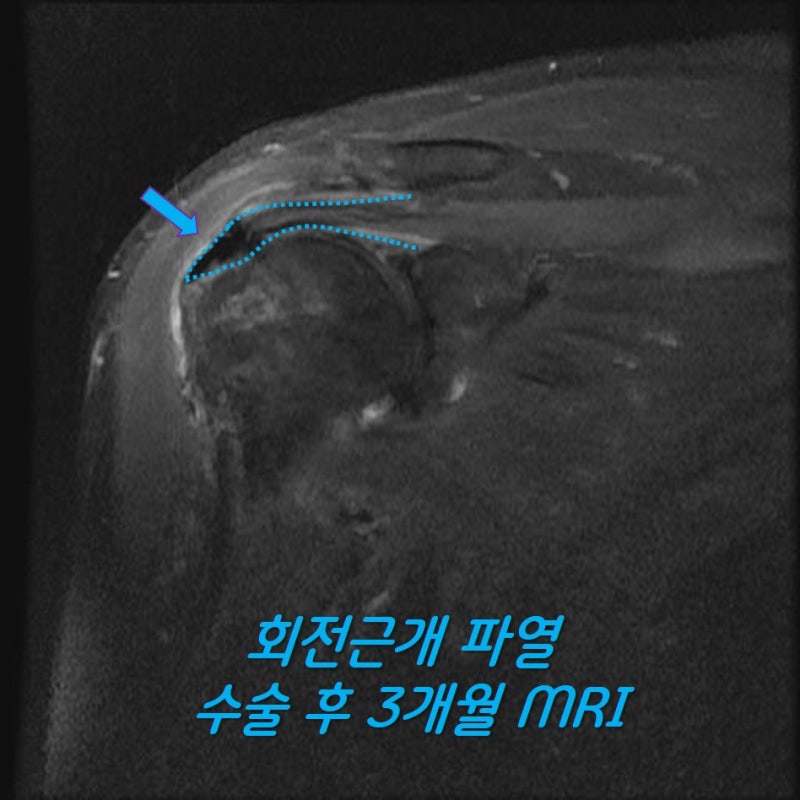
MRI at 3 months post-surgery shows the artificial tendon has fully integrated with the rotator cuff, achieving complete anatomical restoration.

In cases of massive rotator cuff tears, complete anatomical restoration may not always be possible. When only partial repair is performed, the smaller attachment area on the humerus increases the risk of re-tears and may result in incomplete functional recovery. In such cases, augmentation with artificial tendon enables anatomical restoration to the original shape. Artificial tendon augmentation is technically complex and challenging, so it's not offered at many hospitals. The fundamental principle of all surgery is anatomical restoration of damaged tissue. Even when this isn't fully achievable, getting as close to anatomical restoration as possible is crucial for optimal outcomes. The patient is now functioning almost normally and is very satisfied with her results. Even anatomically irreparable massive rotator cuff tears can recover to normal!!!
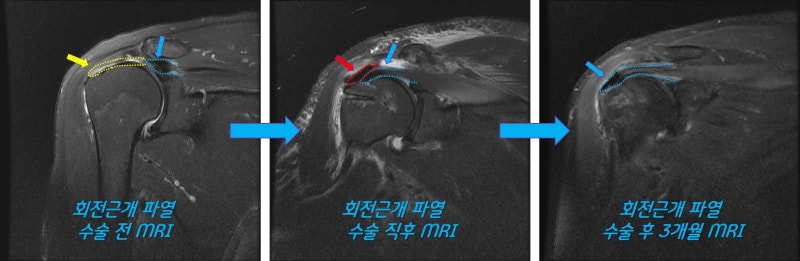

Results of rotator cuff repair and augmentation with artificial tendon for a massive tear that was anatomically irreparable — full anatomical restoration achieved.
Dr. Dongkyu Lee

Dr. Dongkyu Lee

Orthopedic Specialist · Platinum Clinic

Shoulder surgical & non-surgical treatment

Platinum Clinic Orthopedics

Gangnam, Seoul · Dr. Dongkyu Lee

Book a Consultation →
KakaoTalk24/7 AI Chat