
Ankle Ligament Tear: Is Surgery the Answer When It Keeps Recurring? Most ankle ligament tears can be healed with non-surgical treatment. Usually, wearing a cast for about 4 weeks for stable immobilization, followed by rehabilitation to restore ankle function, can return the ankle to its previous state. However, complete tears sometimes require surgical treatment. In these cases, a procedure called the Brostrom repair is commonly performed, where the torn ligament is sutured and then covered with surrounding tissue like the extensor retinaculum for additional protection. Even after successful surgery, rehabilitation is necessary to strengthen the lost ankle muscles and restore range of motion before safely returning to sports. Those who are active in sports often suffer from repeated ligament injuries that become chronic. In these cases, ankle instability (inability to bear weight properly) develops easily, and if left untreated, it can worsen into ankle arthritis. If ligament tear symptoms accompany ankle instability, or if the tear recurs after surgical repair, ligament reconstruction may be the most effective treatment. This patient was very active in rugby, soccer, and taekwondo and had previously undergone Brostrom repair for an ankle ligament tear. A year ago, another sports injury caused a re-tear, but personal circumstances prevented surgery until now. * This post contains actual surgical images.
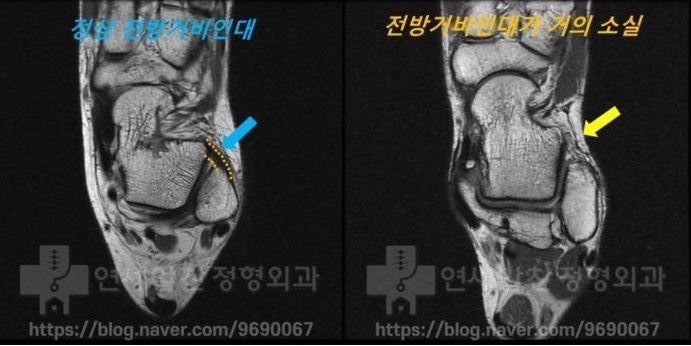
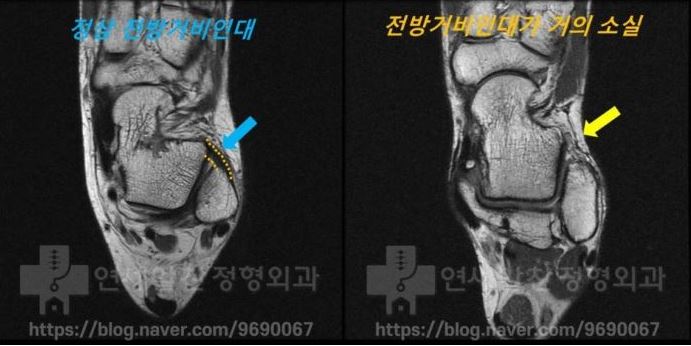
The blue arrow shows a normal anterior talofibular ligament (ATFL) on MRI. Normally, the ligament appears dark and maintains a certain thickness connecting bone to bone. However, as shown by the yellow arrow, the ATFL is barely visible in this patient's MRI. When ankle ligament tears are left untreated and re-tear occurs, a Brostrom repair can no longer be performed because there is barely any ligament left to suture. Ligament reconstruction is needed to create a new ligament.
However, with the recent development of the internal brace technique, recovery time has been shortened and earlier rehabilitation is possible. The internal brace technique involves weaving non-absorbable, unbreakable sutures into a fabric-like structure and connecting it to the fibular and talar attachment sites of the ATFL, providing additional support. Compared to traditional ligament reconstruction, this technique is simpler yet provides secure fixation.
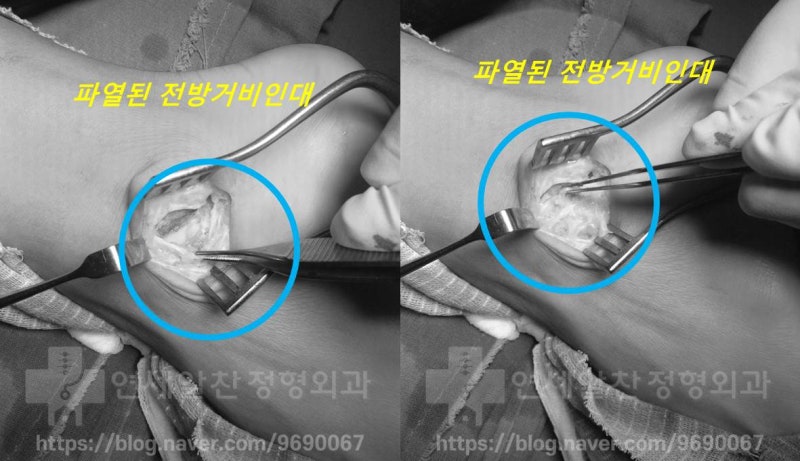
In this patient's surgical photo, the ATFL has degenerated into a thin membrane-like state and is essentially non-functional. If surgery had been performed before the ligament deteriorated this much, a simple Brostrom repair alone would have been sufficient without needing reconstruction or an internal brace. It was unfortunate that the treatment window was missed. Timely treatment could have enabled a simpler procedure with faster recovery.
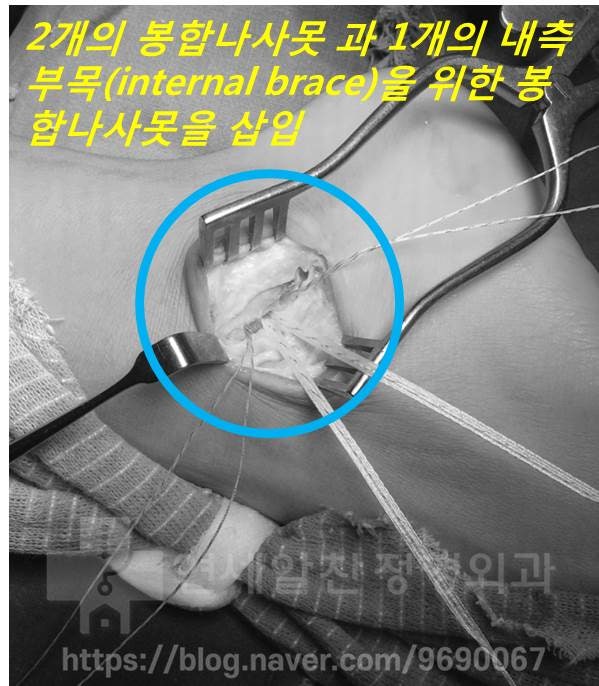
The thick fabric-like material shown in the photo is the internal brace, which serves to securely reconstruct the torn ankle ligament.
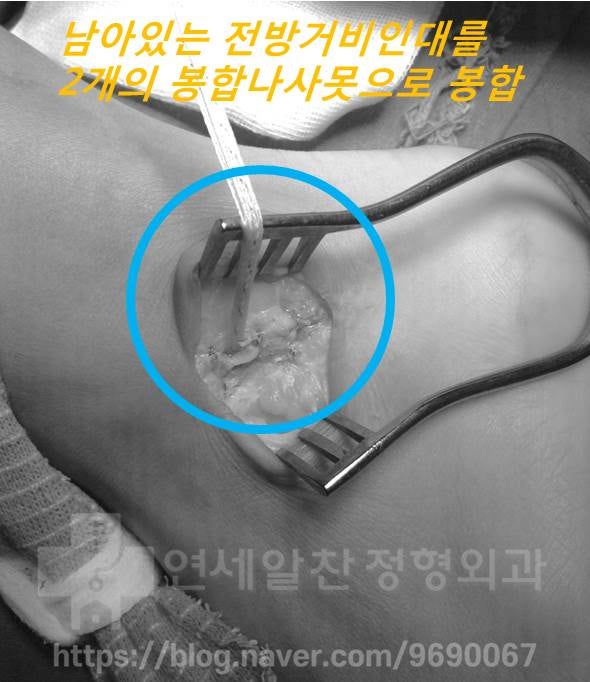
First, the ATFL is sutured with fine sutures to restore its original anatomical length, then the internal brace length must be determined to achieve optimal tension. If the internal brace is too long, the ankle ligament attaches loosely. If too short, the ankle's range of motion becomes restricted, potentially damaging the joint.
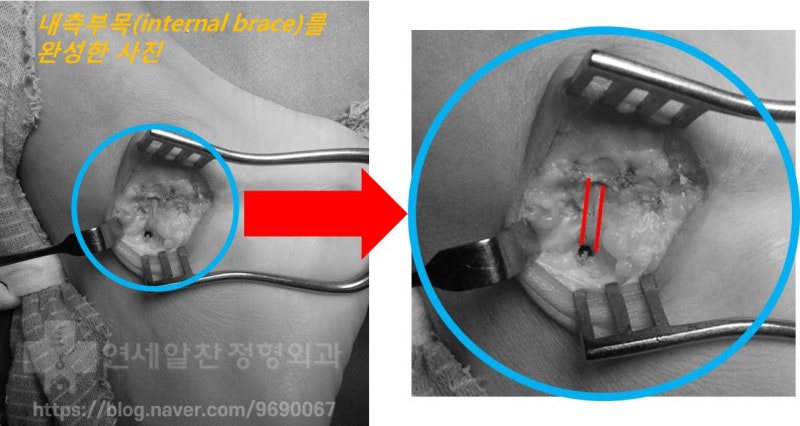
The internal brace is then precisely fixed to the fibular and talar attachment sites of the ligament, as shown. Its strong fixation force plays a significant role in treating ankle instability and restoring ankle function.
After the ankle ligament tear surgery (internal brace), testing ankle joint stability while moving the ankle showed satisfactory results. Surgery is not always necessary for ankle ligament tear recovery. Most cases can be improved with non-surgical treatment. However, if non-surgical treatment fails to improve symptoms, or if complete tear causes instability, it is important to prevent secondary conditions like ankle arthritis through surgery. If surgery is needed but the condition is neglected, continued ligament damage may make repair impossible, or persistent instability may cause ankle arthritis, at which point even the best surgery may not restore the original condition. So if you frequently roll your ankle without trauma, feel dull pain, or sense instability in your ankle, please get an accurate diagnosis first.