
Is MRI Always Necessary for Rotator Cuff Tear Treatment? In conclusion, I believe MRI is an 'option,' not a 'requirement' for treating rotator cuff tears. While MRI provides detailed views of ligaments, tendons, and muscles, the rotator cuff wraps around the humeral head, making it readily diagnosable with ultrasound as well. So why do many hospitals recommend MRI over ultrasound? MRI produces consistent results regardless of who performs the scan as long as the equipment resolution is adequate. Ultrasound, however, can diagnose partial tears and inflammation that may be difficult to identify on MRI, but it requires expertise from the examiner, making it more demanding. Therefore, while ultrasound is technically more challenging, an experienced physician can confidently diagnose rotator cuff tears using ultrasound instead of MRI. A 65-year-old female patient came to our clinic after visiting multiple hospitals for years of shoulder pain. The patient had only received X-rays, was told there was inflammation, and received only medication and physical therapy. For severe pain, she would receive shoulder injections. Physical examination raised suspicion for a rotator cuff tear, so we immediately performed ultrasound.
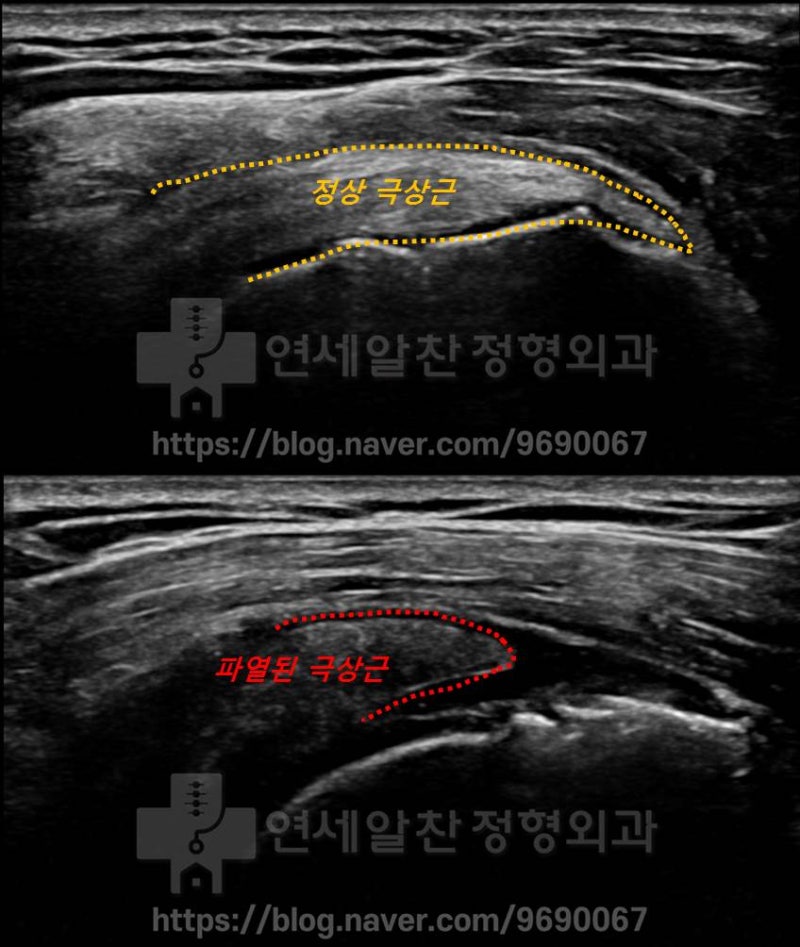
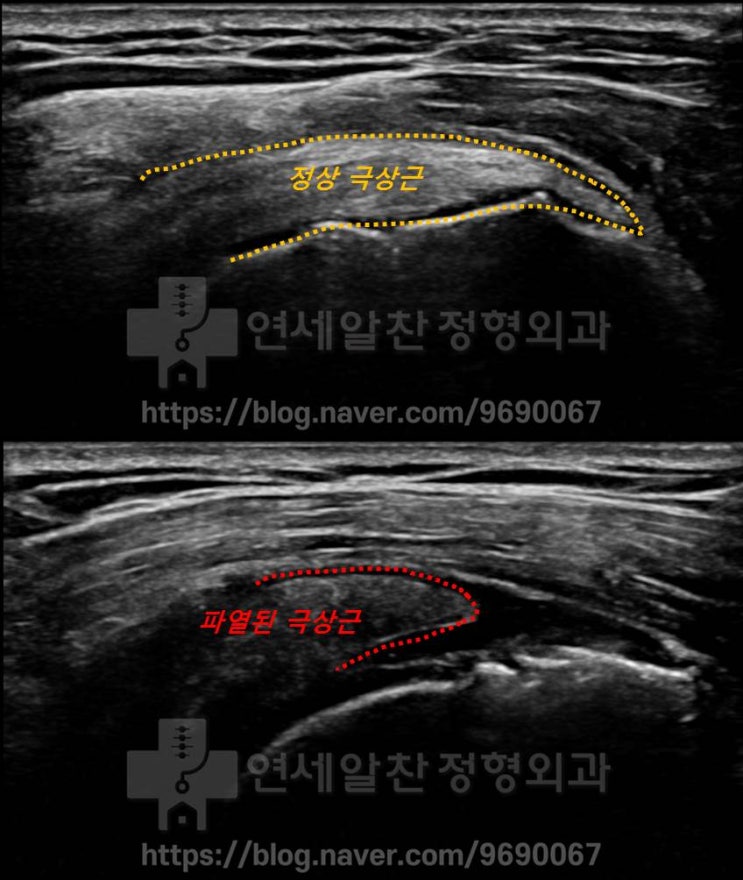
The yellow dotted line outlines the normal supraspinatus appearance -- white and tapering like a bird's beak. The red dotted line below shows the torn supraspinatus detached from the humerus. Even with tears like this, a specialist who understands anatomy and has extensive ultrasound experience can diagnose a rotator cuff tear using ultrasound rather than MRI.
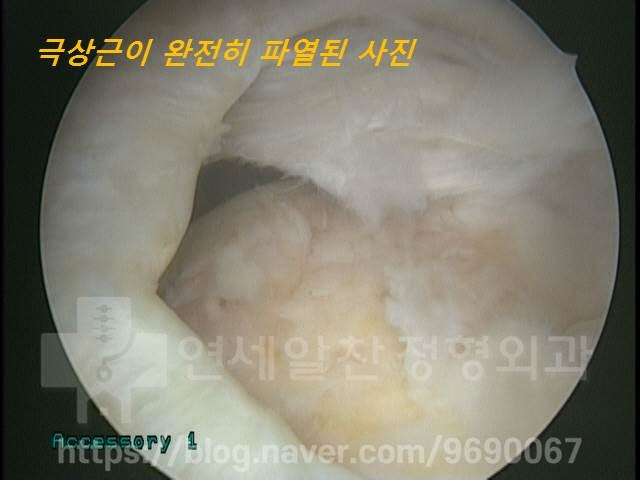
In this patient's case, a rotator cuff tear of approximately 1.5cm was found, and we decided to perform arthroscopic minimally invasive repair. When examining the torn area with the arthroscope, the rotator cuff was found to be completely torn and detached from the humerus.
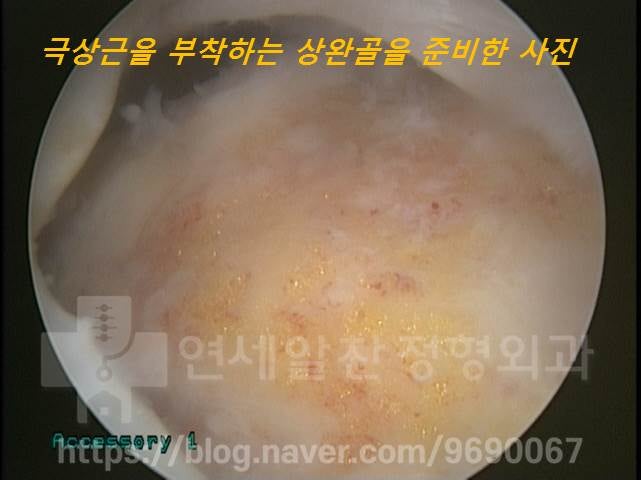
The torn rotator cuff needed to be securely reattached to the bone, so the bone of the humerus was prepared as shown. This step is critical in rotator cuff tear treatment -- proper bone preparation enables normal repair of the torn tendon and allows blood vessels to grow into the repaired tendon for healing (incorporation into adjacent tissue).
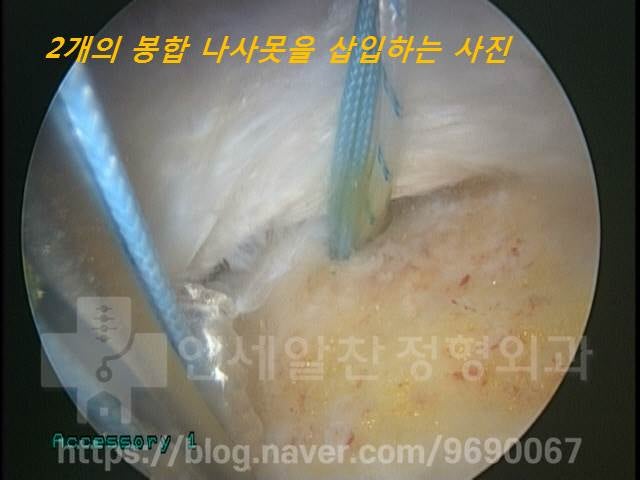
Two suture anchors were inserted into the medial bone for attachment. Suture anchors are used to sew together torn ligaments and cartilage. Larger tears require more suture anchors. In this patient, the tear was not large, so a double-row repair was performed using 2 suture anchors.
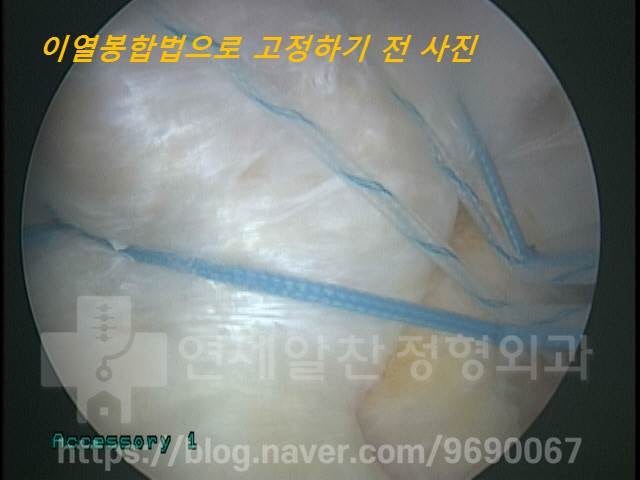
The double-row repair technique commonly used in rotator cuff tear treatment ties the torn tendon to bone in an X-pattern for secure fixation. Compared to single-row repair, it increases the contact area between bone and tendon, enhancing fixation strength and preventing re-tears.
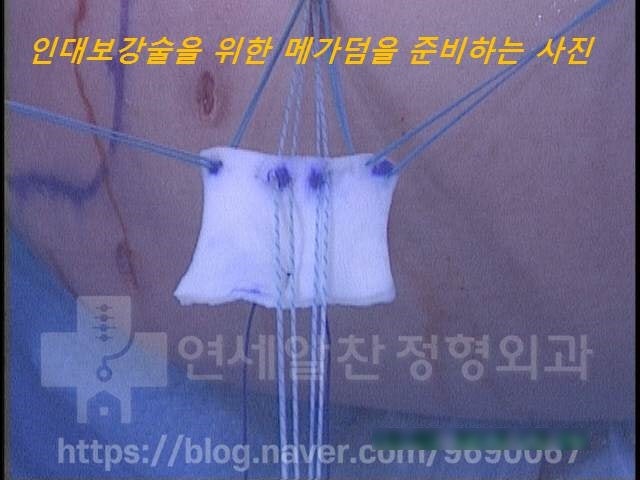
Unfortunately, this patient's initial rotator cuff tear was not properly diagnosed, so the ligament was already severely damaged and weakened. Therefore, to reinforce the ligament weakened by degenerative changes, additional augmentation with MegaDerm (artificial ligament) was necessary. When the ligament is this weakened, even with repair, re-tears occur easily, making MegaDerm augmentation essential for stable repair. Think of it this way: when a hole forms in clothing, patching it with new fabric restores it, but if you try to sew up clothing that is already stretched and unraveling, holes will quickly reappear.
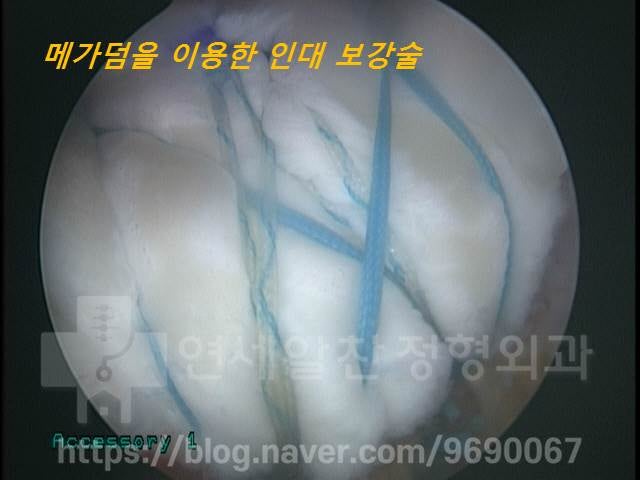
Using the double-row technique with X-pattern fixation and MegaDerm (artificial ligament) augmentation, the rotator cuff tear repair was completed securely without overly stressing the tendon. While I was pleased with the successful treatment, I deeply regret that the initial rotator cuff tear diagnosis was missed. If properly treated when symptoms were mild, the additional ligament augmentation with MegaDerm would not have been needed, and the patient would not have suffered years of shoulder pain. Speaking with the patient, she had been told to get an MRI when treatment was not improving, but the approximately 500,000 won MRI cost was a burden, so she put it off. If ultrasound had been used for diagnosis instead of MRI, the condition would not have progressed to require surgery. I feel deep regret and frustration. Because the initial diagnosis determines the treatment direction and outcome. Without a proper initial diagnosis, even the best treatment will be ineffective -- like pouring water into a bottomless bucket, wasting the patient's effort and time. For successful treatment, an accurate diagnosis is paramount. Lastly, for those being treated for rotator cuff tears who read this: Please remember one thing. Rotator cuff tears can be sufficiently diagnosed with ultrasound, so rather than neglecting them, get a diagnosis from a specialist via ultrasound and pursue appropriate treatment.