
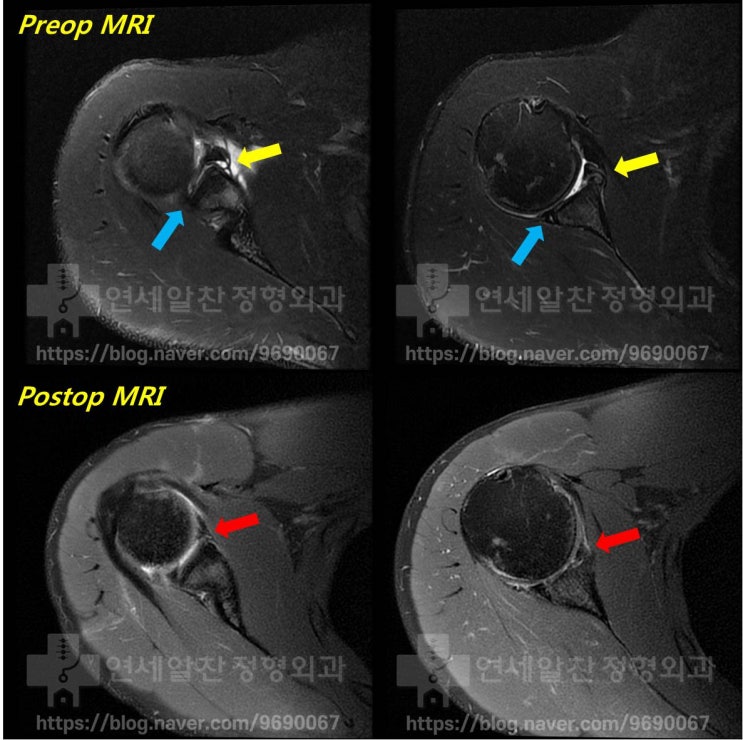
Let's review the results of a patient who underwent anatomical Bankart repair. The patient had a post-operative MRI at 6 weeks after surgery. https://blog.naver.com/9690067/221287854163
🔗 https://blog.naver.com/9690067/221287854163A Bankart lesion refers to a tear of the anterior labrum that occurs when the shoulder dislocates. As shown in the diagram,
A normal joint has a triangular-shaped labrum on both anterior and posterior sides. In a Bankart lesion, the anterior labrum tears and loses its shape.
Looking at this patient's pre-operative MRI,
The blue arrow shows the normal posterior labrum, appearing as a dark triangular shape. However, at the yellow arrow, the anterior labrum is torn and detached from the glenoid, losing its triangular shape.
On the left, the yellow arrow shows the labrum torn and dangling away from the glenoid. On the right arthroscopic image, the red arrow shows where the repair was performed, with the labrum accurately sutured back to the glenoid.
During the 6-week rehabilitation period, there was mild pain but no limitation in range of motion. At 6 weeks, when tissue healing was sufficiently advanced, MRI was performed to assess the repair.
Comparing pre- and post-operative MRI, the previously torn anterior labrum (red arrow) has been accurately restored to a triangular shape anatomically on the glenoid.
Many patients after Bankart repair report that while the shoulder no longer dislocates, the range of motion is not as good as before. Previously, Bankart repairs were often performed by placing the labrum slightly medially on the glenoid rather than in its anatomical position to prevent dislocation. This frequently resulted in limited external rotation. This approach is still used in many cases. If the goal is solely to prevent dislocation, it is sufficient. However, today's patients demand more. They expect not only no dislocation but also return to their previous level of function. As demonstrated in our surgical approach at Platinum Clinic, when anatomical restoration is achieved on the glenoid and healing proceeds well, not only is dislocation prevented but range of motion limitations do not occur either. Beyond surgery, rehabilitation is extremely important. Addressing functional deficits in surrounding tissues is also crucial. I believe this coordinated process, from the surgeon to our rehabilitation therapists at Platinum Clinic, is what produces the best outcomes. I believe this is why patients choose Platinum Clinic, and with that thought, I continue to push forward.