
Frozen Shoulder Treatment: What Is the Most Effective Approach? First, let's learn about frozen shoulder. Also known as adhesive capsulitis, frozen shoulder can be broadly classified into primary and secondary types.
Primary frozen shoulder occurs when inflammation develops in the joint capsule without any specific cause, leading to adhesion. Secondary frozen shoulder occurs when another primary condition such as rotator cuff tears, calcific tendinitis, impingement syndrome, or systemic diseases like diabetes triggers secondary inflammation and adhesion in the joint capsule. Frozen shoulder is known to be a self-resolving condition. Symptoms are said to improve over approximately 1-2 years. However, research shows that 40-50% of patients never fully recover shoulder movement compared to the opposite side or retain residual pain. Therefore, frozen shoulder treatment should be pursued more proactively.
So what makes frozen shoulder treatment effective? The treatment goals are to control pain and restore range of motion. Medication and physical therapy are used to control pain.
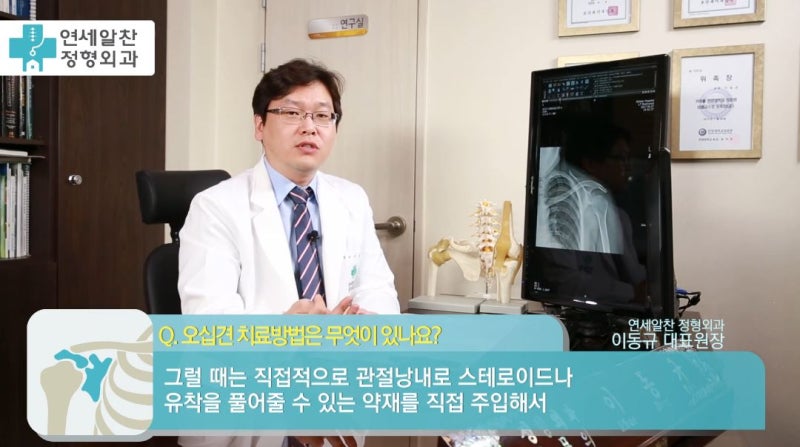
To restore range of motion, self-stretching exercises can be performed, and when scapular problems are severe, a physical therapist can perform manual therapy to restore range of motion. When severe joint adhesion is present, hydrodilatation can expand the narrowed joint capsule and treat the inflammatory response. Exercise afterward becomes much easier for restoring joint range of motion. For primary frozen shoulder, treatment as described above can resolve most cases.
However, secondary frozen shoulder is different. In these cases, if the underlying cause is not addressed, recovery will be difficult and even if improvement occurs, recurrence rates are high. The underlying disease must be treated simultaneously. For ligament damage, ligament-strengthening injections and shockwave therapy can be used. When calcific tendinitis is present, calcification aspiration and shockwave therapy can be performed concurrently for more effective treatment. As such, treatment for frozen shoulder varies depending on the underlying cause. Rather than blindly pursuing various treatments just because frozen shoulder is present, treatment combined with approaches suited to the patient's condition will be most effective. Occasionally, patients see posts online about someone's successful frozen shoulder treatment and come to the hospital requesting the same treatment. The most effective approach for frozen shoulder is accurate diagnosis by a specialist and receiving treatment appropriate for your specific condition.